On this page
How to identify it
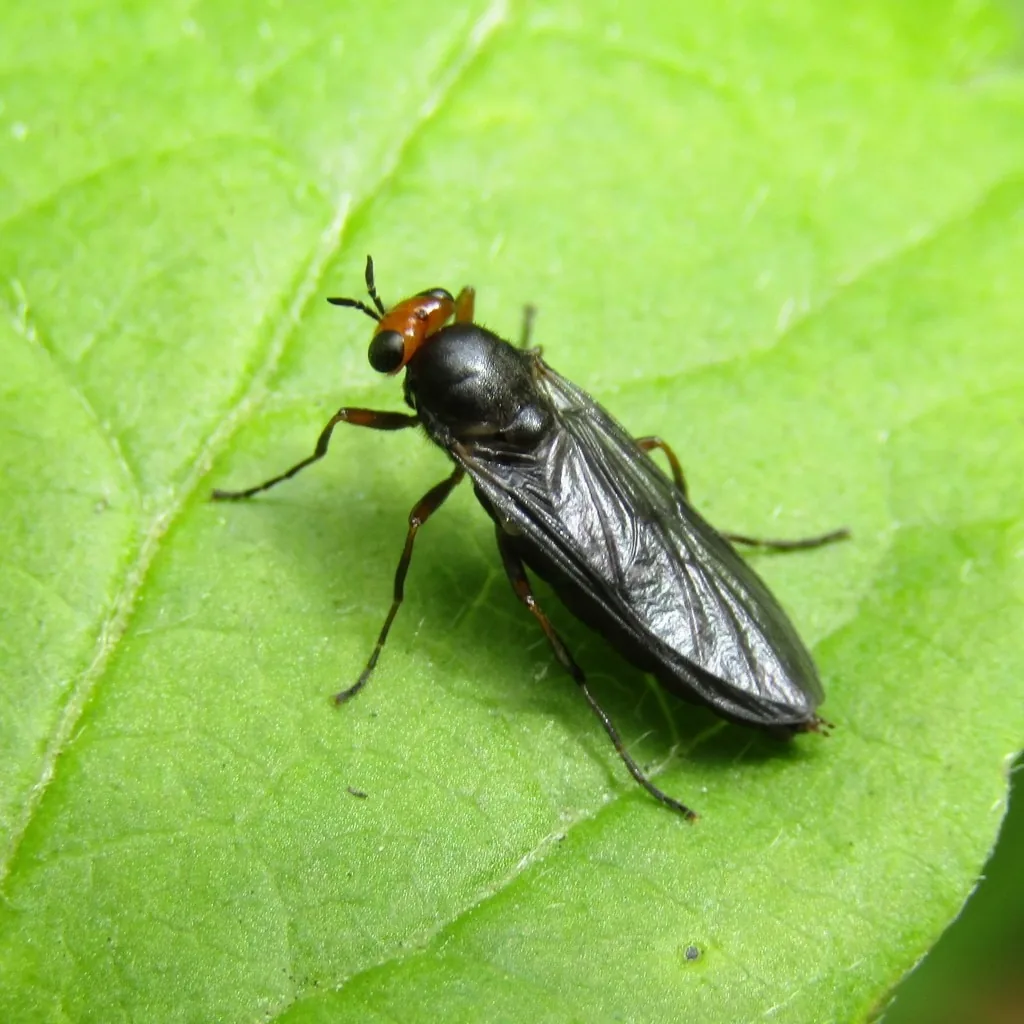
- Adult males are black with yellowish legs and about 1/4 inch (6 millimeters) long. Females are larger, about 0.4 inch (9.5 millimeters), black with reddish legs and a red head.[1]
- Full-grown larvae are legless maggots about 1/2 inch (1.3 centimeters) long with a flattened, distinctly segmented, light tan body with a coarsely granular surface, six long stiff bristles on each segment and a distinct, cone-shaped black head.[1]
Look-alikes
| Look-alike | How to tell them apart |
|---|---|
| March fly larvae | March fly maggots also live in turf but mostly feed on decaying organic matter. Sod fly larvae are told apart by their flattened, distinctly segmented bodies.[1] |
Where it lives
UC IPM says it is found only occasionally in California, and only in the San Francisco Bay Area. GBIF has 451 U.S. records since 1990, and all 448 that name a state are from California. It is native to eastern Australia, where it attacks sugarcane in Queensland, and is an introduced pest of pastures in northern New Zealand.[1][3][2][4]
Biology and life cycle
Adults may fly in May, but their main period of activity is September through November.[1]
Eggs are laid in the soil, and UC IPM says the larvae may take two years to complete development (see where the sources disagree).[1]
All turfgrass species are susceptible. In sugarcane trials the larvae fed on roots, slowing shoot growth and sharply reducing the regrowth (ratoon) shoots after harvest.[1][2]
In Queensland, adults emerge between March and June, usually on still, warm days. Females mate and lay eggs on the day they emerge, tucking them close to the soil surface under small clods or in cracks, and the eggs take 6-13 days to hatch.[5]
In the Queensland study, pupation happened inside the last larval skin and lasted three weeks.[5]
Damage and signs
Health risk
UC IPM, the Queensland sugarcane studies and the New Zealand pasture review describe it only as a pest of turf, sugarcane and pasture and don't mention any risk to people or pets.[1][2][5][4]
Control
Prevention
Keep turf well maintained, adequately watered and vigorously growing; such a lawn can normally withstand a moderate sod fly infestation.[1]
Biological control
Predators matter. In New Zealand pastures, rove beetles and click beetle larvae are important predators of the larvae, and in Queensland surface-active predators, mostly ground beetles and rove beetles, killed 13-97% of soldier fly pupae. Researchers think soldier fly outbreaks followed heavy use of DDT and other organochlorine insecticides, which killed the predators while the fly, being fairly tolerant of insecticides, survived.[4]
Pesticides
UC IPM says there are no registered chemical controls and no known biological or cultural controls for it in turf; research from New Zealand and Queensland describes predators that keep it in check in pasture and cane (see where the sources disagree).[1][4]
Where the sources disagree
Larval development: UC IPM says larvae may take two years to complete development; the Queensland study found that one-third of larvae matured to adults at the end of one year and only a few of the rest survived to emerge after two.[1][5]
Natural control: UC IPM says there are no known biological controls; the New Zealand review says rove beetles, ground beetles and click beetle larvae suppress soldier fly, reports 13-97% predation of pupae by surface-active predators in Queensland, and suggests that in newly infested pasture the best strategy may be to accept temporary losses until predators build up.[1][4]
Common questions
- What are the flat, bristly maggots in my Bay Area lawn?
- They could be Australian sod fly larvae: legless, flattened, light tan maggots about 1/2 inch long with stiff bristles on each segment and a black, cone-shaped head. They feed on grass roots.[1]
- How do I control Australian sod fly?
- UC IPM says there are no registered chemical controls and no known biological or cultural controls in turf. The best defense is healthy, well-watered turf, which can normally withstand a moderate infestation.[1]
- Why did spraying once make this pest worse?
- In New Zealand the outbreaks of 1950 to the early 1970's coincided with widespread DDT use against grass grub. The fly tolerated the insecticide but its beetle predators did not, and once DDT use ended, numbers generally fell well below damaging levels.[4]
Sources
- University of California Statewide IPM Program, “Australian Sod Fly (Pest Management Guidelines: Turfgrass).” ipm.ucanr.edu/agriculture/turfgrass/australian-sod-fly (accessed 2026-11-13)
- Journal of Economic Entomology (via NCBI PubMed), “Effect of feeding by larvae of Inopus rubriceps on development and growth of sugarcane (P. R. Samson; Journal of Economic Entomology 94(5), 2001; abstract).” pubmed.ncbi.nlm.nih.gov/11681671/ (accessed 2026-11-13)
- Global Biodiversity Information Facility (GBIF), “Inopus rubriceps: U.S. occurrence records since 1990 by state (GBIF occurrence search).” api.gbif.org/v1/occurrence/search?taxonKey=1578356&country=US&hasGeospatialIssue=false&occurrenceStatus=PRESENT&year=1990%2C2026&facet=stateProvince&facetLimit=400&limit=0 (accessed 2026-11-13)
- New Zealand Journal of Ecology, New Zealand Ecological Society, “Recent advances in pasture pest management in the northern North Island (East, Prestidge and Robertson).” newzealandecology.org/nzje/1668/pdf (accessed 2026-11-13)
- Bulletin of Entomological Research, Cambridge University Press (abstract), “Studies on the life-cycles of two species of soldier flies (Diptera, Stratiomyidae) which affect sugar-cane in Queensland (Hitchcock 1976).” www.cambridge.org/core/journals/bulletin-of-entomological-research/article/studies-on-the-lifecycles-of-two-species-of-soldier-flies-diptera-stratiomyidae-which-affect-sugarcane-in-queensland/26DCA5339C2F5A525E64908473358E82 (accessed 2026-11-13)
- Global Biodiversity Information Facility (GBIF), “Inopus rubriceps (Macquart, 1847) (GBIF Backbone Taxonomy).” api.gbif.org/v1/species/1578356 (accessed 2026-11-13)
- iNaturalist, “Inopus rubriceps taxon page (order and family).” www.inaturalist.org/taxa/357883 (accessed 2026-11-09)