On this page
How to identify it
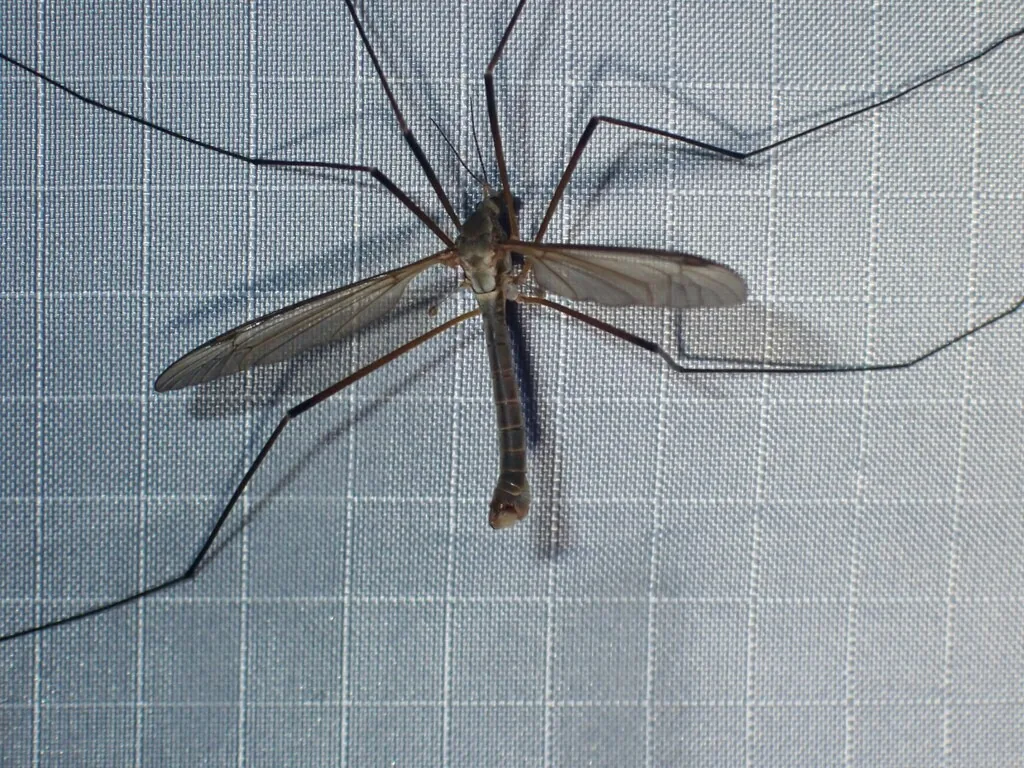
- European crane fly adults are tan to brownish gray with a long, thin abdomen and very long legs. Oregon State and Washington State give a body about 1 inch long; the Pacific Northwest handbook gives 14 to 19 mm for males and 19 to 25 mm for females; Cornell's fact sheet gives a much larger 2.5 to 3 inches.[1][6][5][2]
- They have one pair of working wings plus a pair of tiny knobbed balancing organs called halteres, a feature of true flies. The wings are often held out at about a 45-degree angle.[1][4]
- The wings are unpatterned except for a narrow smoky band along the leading edge. In T. oleracea the wings are about as long as the abdomen or longer; in T. paludosa they are shorter.[2]
- Larvae, called leatherjackets, are gray to gray-brown, legless and worm-like with tough, leathery skin, reaching 1 to 1.5 inches. Oregon State describes no well-defined head; Missouri's general description of crane fly larvae mentions a definite head.[1][6][5][4]
Look-alikes
| Look-alike | How to tell them apart |
|---|---|
| Mosquitoes | Crane flies are much larger, have a snout-like mouth rather than a piercing tube, lack scales on the wing veins and have a V-shaped groove on the thorax. Despite nicknames like mosquito hawk, adults don't eat mosquitoes.[4][1] |
| Native crane flies | New York alone has over 250 native crane fly species, and Missouri counts more than 500 in North America. Many have spotted wings, but some clear-winged natives also live in lawns, so a specialist may be needed. Native crane flies don't gather in large numbers on turf the way the European species do.[2][4][7] |
| Cutworm damage | Leatherjacket surface feeding on turf can look like black cutworm damage, so dig and look for the gray, legless larvae.[2] |
Where it lives
The two lawn-damaging species, Tipula paludosa and T. oleracea, are invasive from Europe and now widespread across much of North America, especially in rainy regions such as the Pacific Northwest.[1][2]
Biology and life cycle
Tipula paludosa has one generation a year; the marsh crane fly, T. oleracea, has two, so its adults also appear in spring (late April to early May in New York).[1][2][7][5]
Adults don't feed, only drink water, and usually mate and lay eggs within a day of emerging. The Pacific Northwest handbook gives an adult life of 2 to 14 days; Oregon State's summary says about a month. The handbook gives emergence from July to mid-October; Washington State says late August through September.[5][1][6]
Females lay up to about 300 eggs at or near the soil surface, choosing moist, low-lying spots. Eggs hatch in about 11 to 15 days, and eggs and young larvae die quickly in dry soil, so they survive best in rainy fall weather.[2][5][1]
Larvae feed in the top inch or so of soil through fall, winter and spring, mostly at night and on overcast days. T. paludosa spends the winter as a third-stage larva.[2][5][6][1]
In New York, where both species were first found in turf in 2004, surveys through 2006 found T. oleracea in 12 counties and T. paludosa in four.[8][2]
Damage and signs
- Leatherjackets eat roots, crowns and grass blades. Oregon State says thinning starts in February, with wet, low areas stripped bare by April and May; the Pacific Northwest handbook puts the worst damage in April and May, and Cornell in early to mid May in New York.[1][5][2]
- Birds such as starlings, plus skunks and raccoons, dig and peck for the larvae, tearing up infested turf further. Heavy bird activity on a lawn is often the first clue.[1][5][2]
- Damage is worst where drainage is poor and thatch has built up. Grass usually recovers once larvae stop feeding, but weeds may move into the weakened patches.[2][6]
Health risk
Adult crane flies don't bite and live only briefly, so they pose no threat to people; Missouri calls them completely harmless. Their importance is as lawn and pasture pests in the larval stage.[1][2][4]
Control
Prevention
Keep turf healthy with regular mowing, appropriate fertilizing and summer irrigation, which helps lawns resist and recover. Washington State says well-established, properly watered and fertilized lawns rarely need treatment even above threshold.[1][6][7]
Improve drainage, and cut back irrigation around early September (about Labor Day in Oregon's Willamette Valley), when females seek wet soil for eggs; drier soil kills eggs and young larvae.[1][5][2][7]
Ignore the adults; they are short-lived, so management should target the larvae.[2][1]
Traps and physical control
Scout from November into midwinter or again in early spring: cut a 1-foot-square piece of sod about 1 inch deep where grass is thinning, flip it and count larvae. For a 6-by-6-inch sample, multiply the count by 4; for a 4-inch cup cutter core, by 11.5. Sample several spots, because numbers vary a lot over short distances.[1][7][5]
Biological control
Starlings, robins and predatory insects often eat enough larvae to keep numbers below damaging levels by spring; beneficial nematodes are listed as a biological option.[6][5]
Pesticides
Thresholds differ: Oregon State and the Pacific Northwest handbook use about 25 larvae per square foot in well-kept turf, Washington State 25 to 30, and the Northeastern IPM Center says healthy turf may tolerate 40 while as few as 15 can damage stressed turf.[1][5][6][7]
Timing advice differs by region. Oregon State advises winter applications, saying spring treatments come too late; Washington State monitors in February and March and treats then, or in mid-November to December after a bad year, but not both; Cornell says preventive treatments work best in September and October, with curative treatment in May.[1][6][2]
Oregon State lists chlorantraniliprole, imidacloprid, bifenthrin and esfenvalerate; some products need a license, and the Pacific Northwest handbook marks bifenthrin restricted use. Many pyrethroids are toxic to bees, so mow or remove weed flowers before applying and never apply bee-toxic products to blooming weeds.[1][5][6]
Common questions
- Do crane flies eat mosquitoes?
- No. Despite nicknames like mosquito hawk and skeeter eater, adults don't eat mosquitoes; they only drink water. Missouri notes that the larvae of some crane fly species eat other insects, including mosquito larvae.[1][4]
- Do crane flies bite?
- No. They have no piercing mouthparts, and many adults don't feed at all during their short lives.[4][1][2]
- Why is my lawn dying in early spring?
- In wet regions, leatherjackets feeding through winter can thin turf beginning in February. Dig a sod sample to check for gray, legless larvae.[1][5]
- Why are there so many crane flies on my house?
- Adults emerge from lawns and pastures in late August and September and may gather on the sides of houses in large numbers. They live only days and need no treatment.[6][5]
Sources
- Oregon State University Extension Service, “Managing Crane Fly in Lawns, EM 9296 (September 2020).” extension.oregonstate.edu/sites/default/files/documents/em9296.pdf (accessed 2026-11-11)
- Cornell University, College of Agriculture and Life Sciences, Integrated Pest Management, “European Crane Flies (Tipula paludosa and Tipula oleracea), Ornamental IPM Fact Sheet (updated May 2026).” cals.cornell.edu/integrated-pest-management/outreach-education/fact-sheets/european-crane-flies-tipula-paludosa-and-tipula-oleracea-ornamental-ipm-fact-sheet (accessed 2026-11-11)
- iNaturalist, “Tipula paludosa taxon page (order and family).” www.inaturalist.org/taxa/61917 (accessed 2026-11-11)
- Missouri Department of Conservation, “Large Crane Flies (Field Guide).” mdc.mo.gov/discover-nature/field-guide/large-crane-flies (accessed 2026-11-11)
- Pacific Northwest Pest Management Handbooks (Oregon State, Washington State and University of Idaho Extension), “Turfgrass-Crane fly (European crane fly), Pacific Northwest Insect Management Handbook.” pnwhandbooks.org/insect/hort/turfgrass/turfgrass-crane-fly (accessed 2026-11-11)
- Washington State University Extension, “Lawn and Turf: European Crane Fly (Hortsense).” hortsense.cahnrs.wsu.edu/fact-sheet/european-crane-fly/ (accessed 2026-11-11)
- Northeastern IPM Center and New York State IPM Program, Cornell University, “European Crane Fly, School IPM Best Practices (reviewed February 2020).” www.northeastipm.org/schools/pests/european-crane-fly/ (accessed 2026-11-11)
- Journal of Economic Entomology (PubMed 19449646), “Peck DC, Olmstead D. Invasive Tipula in turfgrass of the northeast United States: geographic distribution and local incidence three years after detection. J Econ Entomol 2009;102(2):652-8.” pubmed.ncbi.nlm.nih.gov/19449646/ (accessed 2026-11-11)