On this page
How to identify it
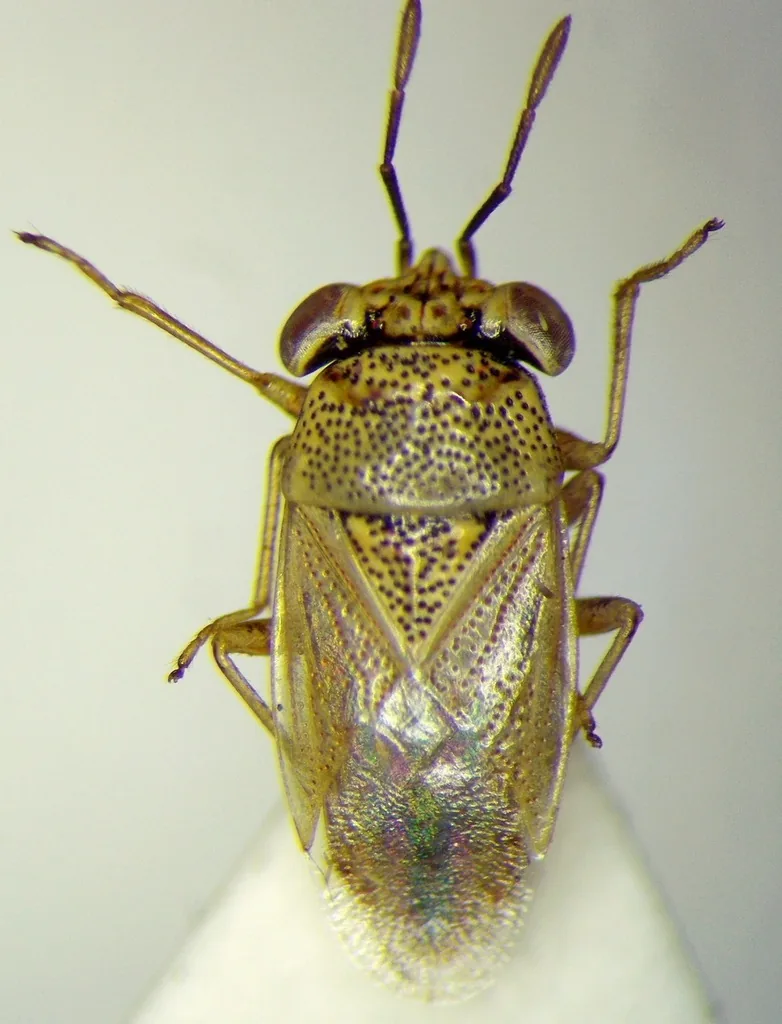
- Adults are oval, about 1/8 to 1/4 inch (3 to 6 mm) long, and black, brownish, gray or yellowish, sometimes with red-brown spots.[1][4][5]
- The head is wide with large, bulging eyes set far apart, their most distinctive feature.[1][3][4]
- They are small and fast and often scurry off before you notice them. NC State notes four-segmented antennae, against five in stink bugs, and no cuneus plates on the front wings like plant bugs have.[4][3]
- Eggs are laid singly on leaves, stems or the soil surface; they're pale, under 1 mm long, and show red eyespots shortly before hatching.[1][4][5]
Look-alikes
| Look-alike | How to tell them apart |
|---|---|
| Chinch bugs | Chinch bugs and false chinch bugs have smaller eyes, narrower bodies and a pointed, somewhat triangular head.[1] |
| Plant bugs (Lygus) | Plant bugs have smaller eyes, longer antennae and a narrower head, plus a distinct triangle where the wings attach.[1] |
Where it lives
Utah State counts about 25 species in the U.S. and Canada. NC State calls Geocoris native throughout eastern North America and common in crops, landscapes and turf, and UC IPM and Washington State list several western species.[4][3][1][5]
Biology and life cycle
Adults overwinter in sheltered, weedy spots and perennial plantings, then lay eggs on plants or soil litter in spring; Washington State says one Pacific Northwest species overwinters as eggs instead.[4][5]
Eggs hatch in about 10 days, depending on temperature, and nymphs pass through five stages over three to four weeks. Both nymphs and adults hunt.[4][1]
Utah State says a female lays an average of about 150 eggs, and there are several generations a year; Washington State gives two a year for Geocoris pallens and three for G. bullatus.[4][1][5]
They also feed on pollen, seeds and plant juices, so diverse flowering plantings and cover crops that offer food and shelter can boost their numbers.[1][4]
Damage and signs
Health risk
Bigeyed bugs prey on small insects and mites; NC State says they are not known for biting people, and UC IPM notes no health concern.[3][1]
Control
Prevention
Check before treating a lawn for chinch bugs. Bigeyed bugs are common in turf, where they eat chinch bugs, and are easily confused with them.[3][1]
Look for them in plant debris and at the base of plant stems.[4]
Biological control
Conserve them by cutting back on broad-spectrum insecticides, choosing selective products, and planting flowering species. Sources disagree on buying them: NC State says they are sold commercially, while Utah State says they can't be bought from suppliers.[1][4][3]
Common questions
- Are these chinch bugs or bigeyed bugs?
- Look at the eyes. Bigeyed bugs have a wide head with large, bulging eyes; chinch bugs have small eyes and a narrower, pointed head.[1]
- How much do they eat?
- A lot. Utah State says they kill prey at once, suck it dry and eat many prey to finish developing, and their presence alone can make prey stop feeding or drop off the plant.[4]
Sources
- University of California Statewide IPM Program, “Bigeyed Bugs (Natural Enemies Gallery).” ipm.ucanr.edu/natural-enemies/bigeyed-bugs/ (accessed 2026-11-12)
- iNaturalist, “Geocoris punctipes taxon page (order and family).” www.inaturalist.org/taxa/261555 (accessed 2026-11-12)
- NC State University Department of Entomology and Plant Pathology, “Big-eyed Bug (Biological Control Information Center).” entomology.ces.ncsu.edu/biological-control-information-center/beneficial-predators/big-eyed-bug/ (accessed 2026-11-12)
- Utah State University Extension and Utah Plant Pest Diagnostic Laboratory, “Big-eyed Bugs (fact sheet).” extension.usu.edu/planthealth/uppdl/files/factsheet/big-eyed-bugs.pdf (accessed 2026-11-12)
- Washington State University Extension, “Big-Eyed Bug, PLS-82.” wpcdn.web.wsu.edu/wp-puyallup/uploads/sites/408/2015/02/PLS-82-Big-Eyed-Bug.pdf (accessed 2026-11-12)