On this page
How to identify it
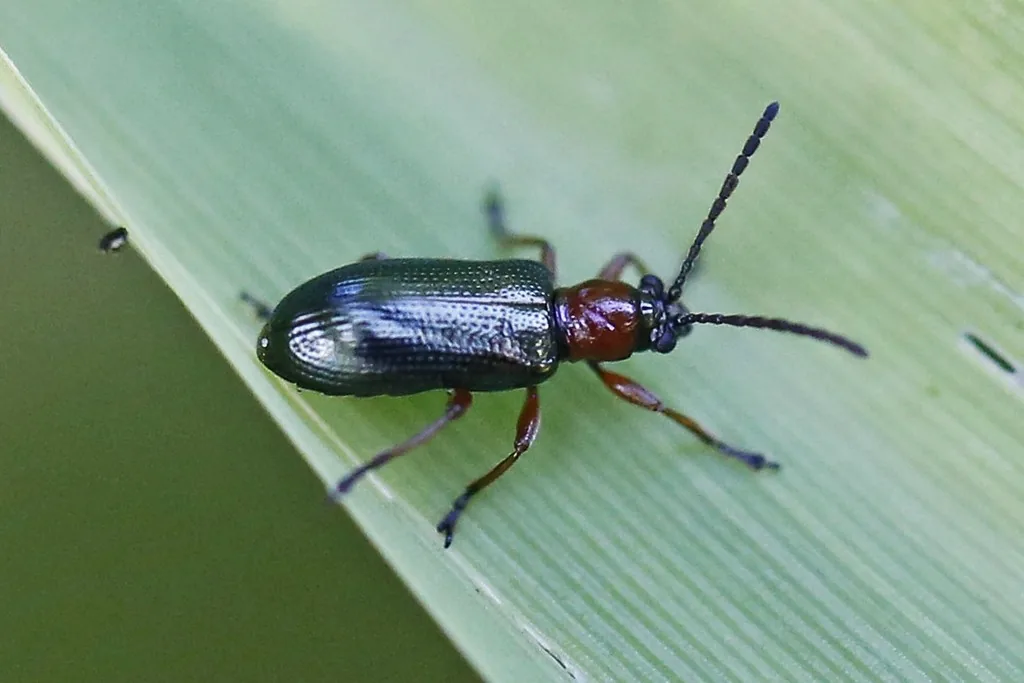
- Adults are about 3/16 to 1/4 inch long, with long, beaded antennae, metallic wing covers and an orange to red thorax; see where the sources disagree on wing-cover and leg color.[1][4][2][5]
- The larvae are yellowish under a shiny coat of mucus and their own feces, which makes them look like tiny slugs on the leaf.[1][2][4]
- The eggs are yellow to orange, about 1/16 inch long, and laid singly or in pairs along the midrib on the upper side of the leaf; they darken before hatching.[1][4]
Look-alikes
| Look-alike | How to tell them apart |
|---|---|
| Collops beetles | These beneficial predators are similar in size and color but have shorter wing covers that leave the red tip of the abdomen exposed, and their legs are not red.[2] |
Where it lives
It was first found in the United States in a Michigan grain field in 1962. Utah State says at least 30 states had confirmed it, and CFIA's 2013 document says 36; it reached Utah by 1984, Oregon in 1999 and Siskiyou and Modoc counties in California in 2013. Montana State says it is well established in Montana, North Dakota and nearby parts of the Canadian prairie provinces, and CFIA says it has been established in Canada for more than 35 years.[5][3][6][2]
Biology and life cycle
Adults spend the winter in sheltered spots (see where the sources disagree), then move into grain fields from about mid-March into April and feed for two to three weeks before laying eggs.[1][4][2]
They prefer young plants, so spring-planted oats and late-planted wheat take most of the eggs.[4]
Larvae feed for about 10 days to three weeks, then drop and burrow an inch or two into the soil to pupate; new adults appear about two weeks later.[4][2][1]
The new adults feed briefly in grain and corn fields, rest for most of the summer, and fly back to wooded shelter in the fall. There is one generation a year.[1][5]
Damage and signs
- Older larvae do most of the damage, scraping the green tissue from the upper leaf surface in long, narrow strips between the veins without chewing through the leaf.[1][2]
- Heavy infestations give fields a white, frosted look and can reduce yield and grain quality; Penn State says adult feeding has not been shown to matter economically, and Delaware says the greatest damage can occur between flowering and the soft dough stage.[1][2][4]
- Regulation differs by agency. CFIA says the U.S. Department of Agriculture deregulated the beetle within the United States in the 1970s, and that CFIA stopped enforcing its import, export and domestic movement requirements for it on October 1, 2008. California's agriculture department gives it a B pest rating, notes that it is a regulated quarantine pest in New Zealand, Japan and possibly other countries, and says it is commonly intercepted at California's border stations.[3][6]
Health risk
It feeds on grasses and small grains. Penn State, Montana State, Utah State and Delaware describe crop damage only and don't mention any risk to people or pets, and California's pest rating says it is not injurious or poisonous to agriculturally important animals.[1][2][5][4][6]
Control
Prevention
Damage is worst in thin or poorly established stands, so good crop management controls it in many fields; in Delaware, planting wheat right after the Hessian fly-free date has also helped.[1][4]
Biological control
Introduced parasitic wasps, especially Tetrastichus julis, kill many larvae where they are established; California's agriculture department says that in most of the United States these biological control agents manage the beetle so well that chemical treatment is seldom required. Montana State says plowing and disking harm the parasitoid pupae and that pesticide applications can depress parasitoid activity.[2][1][5][6]
Pesticides
Scout each field early in spring for eggs and young larvae, since populations are spotty, and target the larvae: Penn State says spraying adults hasn't proved effective. See where the sources disagree on thresholds.[1][4][2]
Where the sources disagree
Color: Penn State and Delaware describe a metallic blue-black head and wing covers, Utah State metallic blue, and Montana State metallic dark green; Delaware and Montana State say the legs are red, while Utah State says yellow.[1][4][5][2]
Winter shelter: Penn State says leaf litter in woodlots, hedgerows and similar areas; Montana State says crop stubble and other protected areas in or around fields; California's rating says debris and leaf litter.[1][2][6]
Thresholds: Penn State, one or more larvae per stem, especially before the flag leaf emerges; Montana State, three eggs and/or larvae per plant or stem before boot and one or more larvae per flag leaf after; Delaware, 25 eggs and/or larvae per 100 tillers once more than half the sample is larvae.[1][2][4]
How much yield it costs: Utah State says yields can drop 30 to 50 percent if left untreated; CFIA says damage ranges from 25 to 50 percent without controls but that parasitoids, cold winters and drought usually keep populations below economic thresholds, and that in eastern Canada it has never significantly affected cereal yields or quality.[5][3]
Quarantines: CFIA deregulated it in Canada in 2008, noting that California still regulated it at the state level; California's rating says beetles moved in trade nearly always fail to establish populations, showing that quarantines do not play much of a role in limiting its spread.[3][6]
Common questions
- Why do cereal leaf beetle larvae look slimy?
- They coat themselves in mucus and their own fecal pellets, which protects them from predators and from drying out.[1][2]
- Should I spray when I see the adult beetles?
- No. Penn State says adult feeding isn't economically significant and targeting adults hasn't worked; the larvae are the stage to scout for and manage.[1]
Sources
- Penn State Extension, “Cereal Leaf Beetle (updated May 12, 2026).” extension.psu.edu/cereal-leaf-beetle (accessed 2026-11-13)
- Montana State University Extension, “Pest Fact Sheets: Cereal Leaf Beetle (MontGuide MT201604AG).” extension-store.montana.edu/montguides/pest-fact-sheets-cereal-leaf-beetle (accessed 2026-11-13)
- Canadian Food Inspection Agency, “RMD-07-02: Cereal Leaf Beetle (Oulema melanopus), risk management decision document (1st revision June 27, 2013).” inspection.canada.ca/en/plant-health/invasive-species/directives/pest-risk-management/rmd-07-02 (accessed 2026-11-13)
- University of Delaware Cooperative Extension, “Cereal Leaf Beetle Control in Small Grains (J. Whalen, reviewed by D. Owens, April 2025).” www.udel.edu/content/dam/udelImages/canr/pdfs/extension/factsheets/Cereal-Leaf-Beetle-Control-in-Small-Grains.pdf (accessed 2026-11-13)
- Utah State University Extension and Utah Plant Pest Diagnostic Laboratory, “Cereal leaf beetle, ENT-84-07PR (August 2007).” extension.usu.edu/planthealth/uppdl/files/factsheet/cereal-leaf-beetles07.pdf (accessed 2026-11-13)
- California Department of Food and Agriculture, Plant Health and Pest Prevention Services, “Oulema melanopus (Linnaeus): Cereal Leaf Beetle (Pest Rating Proposals and Final Ratings; pest rating B).” blogs.cdfa.ca.gov/Section3162/?p=232 (accessed 2026-11-13)
- Global Biodiversity Information Facility (GBIF), “Oulema melanopus (Linnaeus, 1761) (GBIF Backbone Taxonomy).” api.gbif.org/v1/species/1048319 (accessed 2026-11-13)
- iNaturalist, “Oulema melanopus taxon page (order and family).” www.inaturalist.org/taxa/1370475 (accessed 2026-10-06)