On this page
How to identify it
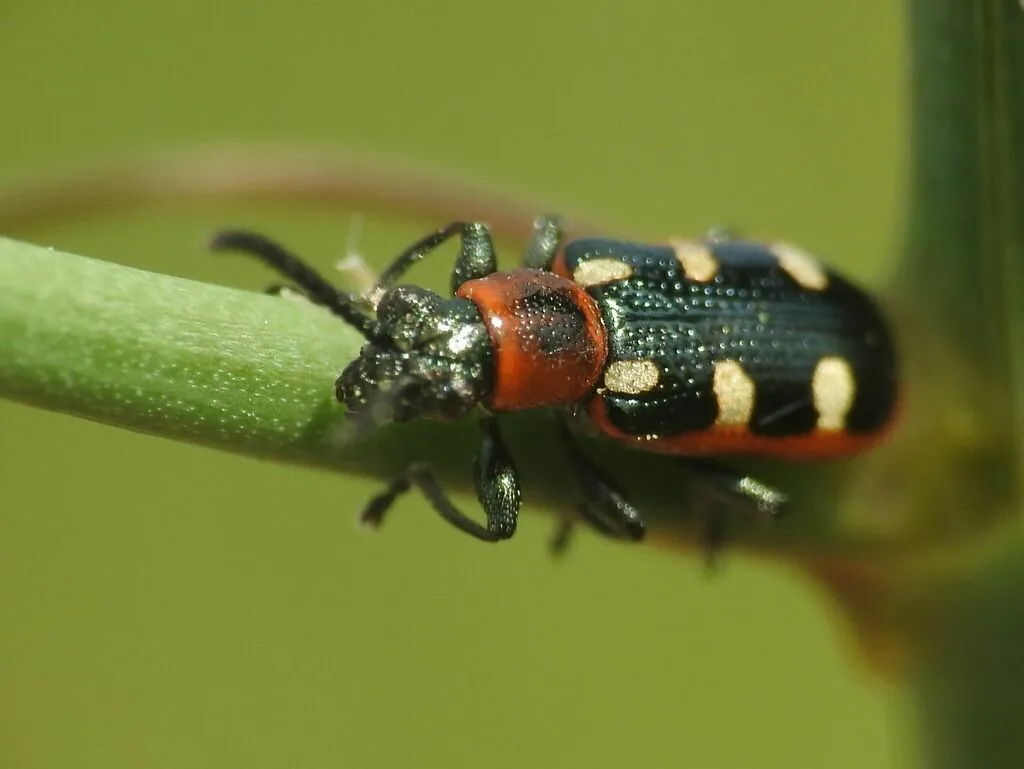
- The common asparagus beetle is about 1/4 inch (6.3 mm) long, with an elongated, metallic blue-black body, red margins and six cream-colored markings on the wing covers.[3][1][2]
- The spotted asparagus beetle is about the same size, roughly 1/4 inch, but reddish orange with 12 black spots.[1][2]
- Larvae are soft, wrinkled and slug-like with black heads and legs. Common asparagus beetle larvae are olive-green to gray and reach about 1/3 inch (8.4 mm); spotted asparagus beetle larvae are orange (Minnesota) or cream colored (Illinois).[3][1][2]
- Common asparagus beetle eggs are dark brown ovals laid on end in rows on spears, ferns or flower buds, so they stick up from the spear tips; Kansas State says each female lays up to 30. Spotted asparagus beetles lay greenish eggs on the ferns.[1][3]
Look-alikes
| Look-alike | How to tell them apart |
|---|---|
| Lady beetles | Lady beetles have rounder, dome-shaped bodies, short antennae and heads partly or completely hidden from above; asparagus beetles are oval with moderate-length antennae.[1] |
Where it lives
Kansas State calls the common asparagus beetle a major pest of garden asparagus throughout the United States, and Minnesota and Illinois Extension both report the common and the spotted asparagus beetle in home gardens.[3][1][2]
Biology and life cycle
Adults overwinter in sheltered places such as hollow stems of old asparagus plants, leaf litter, plant debris or loose bark, and appear just as spears come up in spring.[1][3][2]
Eggs hatch within about a week; larvae feed for about two weeks, drop to the soil to pupate, and new adults emerge one to two weeks later.[1][3]
Kansas State reports two generations a year in Kansas and up to three in other parts of the United States, each taking about eight weeks; common asparagus beetles keep feeding on the ferns for the rest of the season.[3][1]
The spotted asparagus beetle shows up later, around mid-May in Minnesota, is gone by late July, and its larvae feed inside the berries.[1]
Beetles are most active on warm, sunny afternoons.[1]
Damage and signs
- Adult feeding scars and notches spears, which turn brown and bend over into a hook.[1][2]
- Larvae and adults stripping the ferns weaken the plant, reduce food stored for next year's crop and leave it more open to Fusarium disease.[1]
- Eggs on the spears, and the black fluid larvae leave on plants, don't harm the plant but make harvested asparagus unappealing and less marketable.[1][3][2]
- Spotted asparagus beetle larvae eat only the berries and don't affect plant health.[1]
Health risk
Asparagus beetles are plant feeders. Kansas State notes damaged asparagus is still edible; the harm is scarred, unappealing spears and weakened plants.[3][1]
Control
Prevention
Harvest spears promptly and regularly so beetles have fewer places to lay eggs.[1]
Planting all-male asparagus varieties eliminates the spotted asparagus beetle as a pest, because its larvae live and feed inside the berries.[2]
Sanitation
Remove and dispose of ferns in fall once they are fully brown, or as early as possible in spring if snow came first, and clear plant debris to take away overwintering sites.[1][3]
Traps and physical control
Handpick adults and larvae into soapy water and rub off the dark eggs; keep checking on warm afternoons, when beetles are most active.[1][3]
Biological control
A tiny metallic green wasp, Tetrastichus asparagi, lays its eggs inside asparagus beetle eggs and can kill up to 70 percent of them; lady beetles and other predators eat eggs and larvae.[1][2]
Pesticides
Consider an insecticide only at thresholds. Minnesota uses 10 percent of plants with adults, 50 to 75 percent with larvae, or 20 percent of spears with eggs; Illinois uses the same adult and larva figures but 2 percent of spears with eggs. Products must be labeled for asparagus or vegetables; observe the days to harvest.[1][2]
Minnesota lists pyrethrins, neem, spinosad, malathion, carbaryl and pyrethroids such as permethrin, lambda-cyhalothrin and cyfluthrin; Kansas State adds insecticidal soap and horticultural oil and names carbaryl as Sevin. Most are toxic to bees, so avoid spraying while plants are flowering.[1][3]
Common questions
- Why are my asparagus spears bent into hooks?
- Asparagus beetle adults feeding on spears cause them to turn brown and bend into a hook.[1]
- What are the tiny black specks standing up on my asparagus tips?
- Those are likely common asparagus beetle eggs: dark brown ovals laid on end in rows. Rub them off or harvest the spears promptly.[1][3]
- Should I cut down asparagus ferns in fall?
- Yes. Asparagus beetles overwinter in the patch, so remove the ferns once they are completely brown.[1]
Sources
- University of Minnesota Extension, “Asparagus Beetles.” extension.umn.edu/garden-and-home/yard-and-garden/yard-and-garden-insects/asparagus-beetles (accessed 2026-11-12)
- University of Illinois Extension, “Asparagus Beetle.” extension.illinois.edu/insects/asparagus-beetle (accessed 2026-11-12)
- Kansas State University Research and Extension, “Common Asparagus Beetle (MF3231).” bookstore.ksre.ksu.edu/pubs/common-asparagus-beetle_MF3231.pdf (accessed 2026-11-12)
- iNaturalist, “Crioceris asparagi taxon page (order and family).” www.inaturalist.org/taxa/127309 (accessed 2026-11-12)