On this page
How to identify it
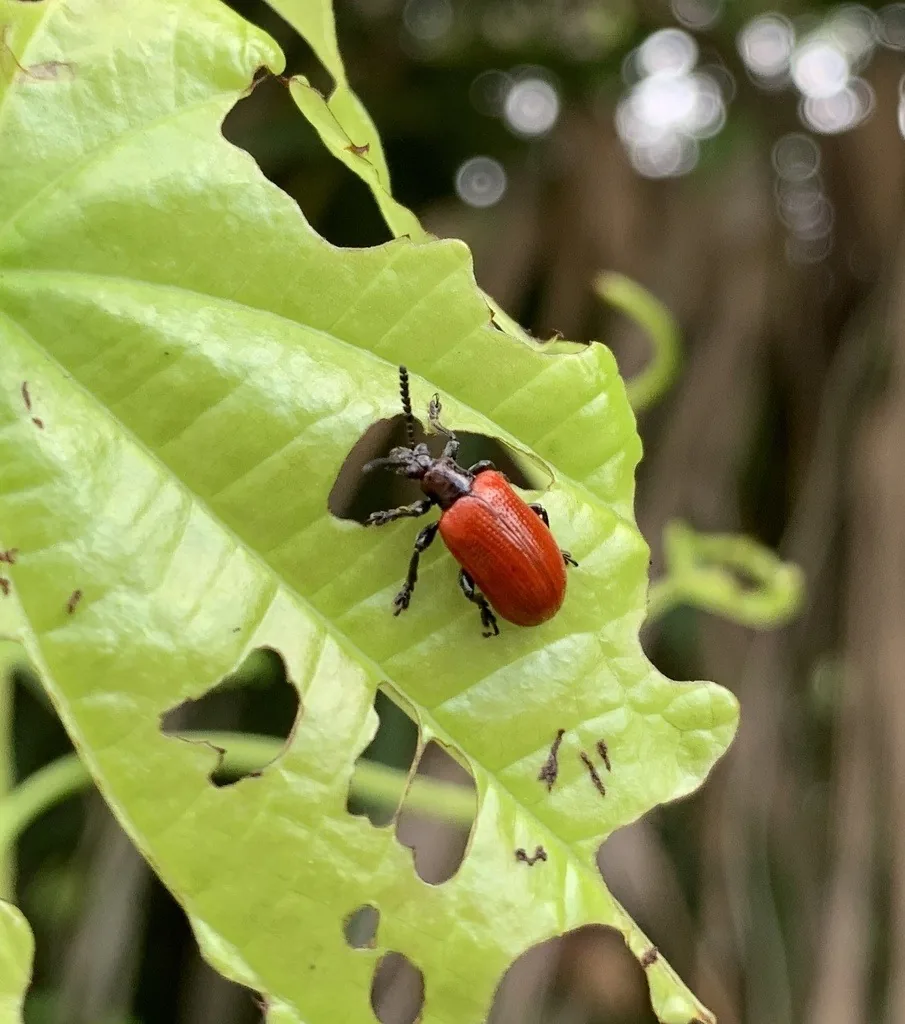
- UF/IFAS gives adults as about 9 mm long and 4 mm wide; USDA-APHIS says Lilioceris beetles are typically 1 cm long and 0.5 cm wide. The wing covers range from tan or brown to orange or bright red, and the head, thorax, abdomen and legs are shiny, patent-leather black.[3][1]
- The body is elongate, with a rectangular abdomen, a narrow thorax about half as wide and a narrow head with bulging eyes. USDA-APHIS and UF/IFAS both liken the shape to a square violin with a short neck.[1][3]
- Larvae are soft-bodied and somewhat slug-like. Young larvae are yellowish to reddish and older ones grayish to reddish, with a black head, legs and plate just behind the head. They are often coated in a sticky secretion with their own droppings stuck to it, a shield on their backs.[1][2][3]
- Eggs are pale white, oblong and about 1 mm long, turning yellowish as they develop, with dark reddish eye spots midway. They are laid in loose clusters on the undersides of young, expanding leaves; adults bite the leaf veins and the egg-laying deforms the leaf, so it curls at the edges into a cup around the eggs.[3][1][2]
Look-alikes
| Look-alike | How to tell them apart |
|---|---|
| Air potato bulbil beetle (Lilioceris egena) | A second air potato beetle in the same genus, approved by USDA-APHIS for release in Florida in 2021. It is colored the same way but slightly larger, about 10 mm long and 5 mm wide, and UF/IFAS says the two are virtually impossible to tell apart in the field. Its adults bore into and feed mainly on the bulbils, females lay eggs on and inside fallen bulbils, and its larvae feed inside them rather than on the leaves.[4][5] |
| Lily leaf beetle (Lilioceris lilii) | The only other Lilioceris in the United States, an invasive pest of lilies. Its bright red thorax separates it from the two air potato beetles, whose thorax is black.[4] |
Where it lives
It is native to subtropical and tropical Asia, with records from China, India, Laos and Nepal and finds in northern Thailand. It was first released in Florida in 2012, and from 2014 to 2021 Florida's state rearing program released beetles at nearly 7,000 sites in Florida, Georgia, Mississippi, Alabama, Louisiana and Texas.[1][3][2]
Biology and life cycle
Both adults and larvae feed on air potato leaves and can also feed on the aerial bulbils. The larvae feed in groups, often on the growing tips, and skeletonize the leaves as they move across the undersides; they prefer young, tender leaves but also eat older ones.[1][3]
Development is fast. Eggs hatch in about four days, and the four larval stages take about eight days in all, about two days each. Grown larvae drop to the soil and pupate in groups, inside a white, foam-like cocoon about 7 mm long that they secrete from the mouth and that hardens around them.[1][2][3]
USDA-APHIS gives about 16 days for the pupal stage; UF/IFAS says adults emerge 12 to 16 days after pupation, start mating after about 10 days and begin laying eggs five days after that. Adults live five months or longer, and a female lays more than 1,200 eggs on average.[1][3][2]
Air potato loses its leaves in the cool, dry season, so the adults go several months without food, presumably resting under leaf litter and other debris. Overwintered adults come out in spring, and the females begin laying eggs.[1][3]
Adults find the vine by smell. In laboratory tests they moved toward air potato leaves only when moving air carried the leaves' odor to them, and wandered at random when there was no airflow or no leaves.[6]
Releases in the southern half of Florida have established poorly, with lower reproduction and less damage to the vines than beetles released farther north, according to unpublished data cited by the state rearing team.[2]
Damage and signs
- It damages only its target. Larvae and adults eat air potato leaves and bulbils, and even a little feeding on a bulbil's shoot area greatly reduces its ability to sprout. Damage to the growing tips keeps vines from lengthening and may limit their climbing; at the first release sites heavy damage was visible within three months, and in Florida its release and establishment have greatly reduced vine growth, bulbil production and spread.[1][3][5]
- In host-range testing it survived only on air potato, and in choice tests adults fed only on air potato. UF/IFAS says testing at the USDA-ARS laboratory in Fort Lauderdale showed it will not complete development on any other plant found in Florida, and in its native range it is known to feed only on air potato.[1][3]
- Even where the leaf beetle has reduced air potato, the vine keeps producing bulbils, especially in South Florida, and it spreads only by bulbils. That is why a bulbil-feeding beetle, Lilioceris egena, was added.[4]
Health risk
It is a plant-feeding beetle that specializes on air potato, and none of these sources describes any risk to people.[1][2]
Control
Prevention
Leave it alone: it is a biological control agent at work on an invasive vine. Florida's program mass-reared and distributed hundreds of thousands of these beetles, and the state now considers it established in Florida, so laboratory rearing and releases are no longer necessary.[2][5]
The second air potato beetle: Lilioceris egena
Native to Southeast Asia, with records from China, India, Laos, Nepal, Vietnam and Singapore.[4]
Females lay eggs on the surface of and inside fallen bulbils, singly or in clusters of 2 to 15. A female averages 8 eggs a day and more than 900 in her life, and eggs take about 5.5 days to develop.[4]
Newly hatched larvae cannot enter a bulbil on their own and use tunnels dug by feeding adults. The larval stage lasts about 16 days, and several larvae in one bulbil can leave its interior liquefied and unable to sprout.[4][5]
The pupal stage lasts about 12 days, and egg to adult takes about 35 days. Adults typically live 120 days, some up to 200 days.[4]
In host-range tests on 82 plant species from 46 families, females laid eggs only on air potato, and larvae forced onto other plants mostly died.[4]
Cold reduces egg-laying: in FDACS laboratory tests, beetles held at 16°C laid significantly fewer eggs than those at 24°C.[4]
Where the sources disagree
Adult size: UF/IFAS gives about 9 mm by 4 mm for L. cheni; USDA-APHIS says Lilioceris beetles are typically 1 cm by 0.5 cm.[3][1]
Pupal stage: USDA-APHIS gives about 16 days, the Florida rearing team about 14 days, and UF/IFAS 12 to 16 days.[1][2][3]
Common questions
- Should I kill the red beetles on my air potato vine?
- No. The air potato leaf beetle was introduced on purpose to control air potato, an invasive vine, and testing showed it cannot complete development on any other plant found in Florida.[1][5][3]
- Will it eat my other plants?
- It is not expected to. In host-range tests it survived only on air potato and would not complete development on any other Florida plant, and in Asia it is known to feed only on air potato. Because it is host-specific, USDA-APHIS expects it to stay within the range of that vine.[1][3]
- How do the beetles find air potato?
- By scent. In laboratory tests, adults moved toward air potato leaves when moving air carried the leaves' odor to them.[6]
- Is there more than one air potato beetle?
- Yes. A second species, Lilioceris egena, was approved for release in Florida in 2021. It looks almost the same but feeds mainly inside the bulbils, while L. cheni mainly eats the leaves.[4]
Sources
- USDA Animal and Plant Health Inspection Service (APHIS), “Field Release of Lilioceris cheni Gressitt & Kimoto (Coleoptera: Chrysomelidae) for Biological Control of Air Potato, Dioscorea bulbifera: Environmental Assessment (February 2011).” www.aphis.usda.gov/sites/default/files/Lilioceris-airpotato.pdf (accessed 2026-11-14)
- Insects (MDPI), full text in PubMed Central (PMC8781818), “Kraus, Murray, Kelm, Poffenberger, Rohrig and Fairbanks. Advancements in Mass Rearing the Air Potato Beetle Lilioceris cheni. Insects 13: 65 (2022), doi:10.3390/insects13010065.” pmc.ncbi.nlm.nih.gov/articles/PMC8781818/ (accessed 2026-11-14)
- University of Florida/IFAS Extension (Featured Creatures), “Air Potato Leaf Beetle (Suggested Common Name), Lilioceris cheni Gressitt and Kimoto, EENY-547/IN972 (T. D. Center and W. A. Overholt).” ask.ifas.ufl.edu/publication/IN972 (accessed 2026-11-14)
- University of Florida/IFAS Extension (Featured Creatures), “Lilioceris egena (Weise), Biological Control Agent of Air Potato Vine, EENY-804/IN1406 (F. A. Dray Jr., O. Menocal, R. Murray, E. Rohrig and C. Minteer).” ask.ifas.ufl.edu/publication/IN1406 (accessed 2026-11-14)
- Florida Department of Agriculture and Consumer Services, Division of Plant Industry, “Air Potato Vine Biological Control.” www.fdacs.gov/Agriculture-Industry/Pests-and-Diseases/Plant-Pests-and-Diseases/Biological-Control/Air-Potato-Vine-Biological-Control (accessed 2026-11-14)
- Journal of Chemical Ecology (Springer), indexed in PubMed (PMID 37278905), “Griesheimer, Gaffke, Minteer, Mass, Hight and Martini. Attraction of the Air Potato Leaf Beetle, Lilioceris cheni, to Leaf Volatiles of the Air Potato, Dioscorea bulbifera. Journal of Chemical Ecology 49: 498-506 (2023), doi:10.1007/s10886-023-01436-z (abstract).” doi.org/10.1007/s10886-023-01436-z (accessed 2026-11-14)
- iNaturalist, “Lilioceris cheni taxon page (order and family).” www.inaturalist.org/taxa/464044 (accessed 2026-11-14)