On this page
How to identify it
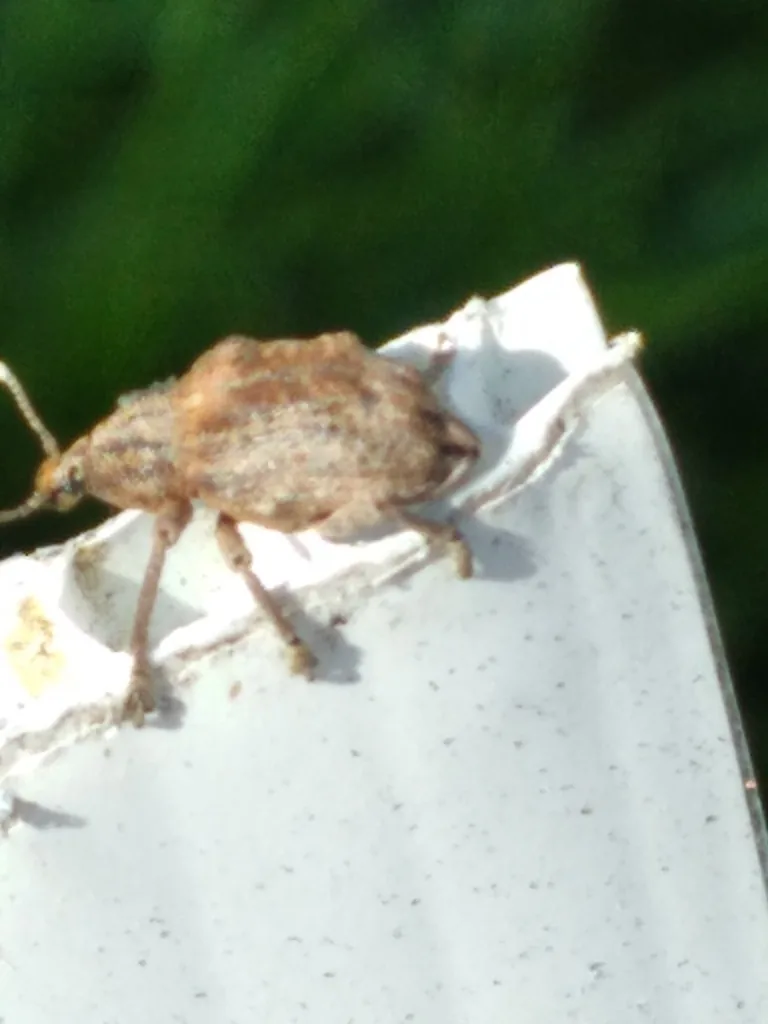
- Adults are up to 9 mm long, reddish-brown when new and turning darker gray. UF/IFAS describes them as small and gray, 6 to 9 mm (about 1/4 to 1/3 inch) long, with males usually smaller than females, and IBiocontrol adds a stout snout and knobby protuberances on the wing covers. They sit on the leaves and stems of saplings and on the new growth of older trees.[1][3][4]
- Early larvae are yellow; mature larvae are up to 14 mm long, grayish and slug-like, coated in an oily secretion that darkens, and they trail fecal coils. UF/IFAS says newly hatched larvae are under 1 mm, the secretion is translucent yellow or orange and turns black once droppings are worked into it, and it protects the larvae from fire ants and possibly other predators. Mature larvae stop feeding and turn yellow before they pupate.[1][3]
- Larvae feeding on the young flush leave window scars; adults feeding on older leaves leave narrow, superficial scars. Eggs are about 1 mm long, yellow with a dark coating. UF/IFAS says the eggs look like gel capsules and the female almost always covers them in a secretion that hardens into a brown to black casing. Adults chew holes or gouges into buds, leaves and stems and occasionally nearly cut off young shoot tips, while the larvae's paper-thin feeding trails are a clear sign the weevil is present.[1][3]
Look-alikes
| Look-alike | How to tell them apart |
|---|---|
| Melaleuca psyllid (Boreioglycaspis melaleucae) | A sap-feeding agent released in 2002. Adults are up to 3 mm long, its colonies produce waxy filaments, and it can have up to 13 generations a year. USDA-ARS surveys found it on 78 percent of the melaleuca infestation and the beetle on 71 percent, the two at equal densities with no sign of competition.[1][2] |
Where it lives
Native to Australia; released in Florida in 1997 and established throughout the state, densest in the south. USDA-ARS surveys found it on 71 percent of the melaleuca infestation, with stands lacking it or the psyllid mainly at the northern extremes of the tree's range, and found it more often where sandy soils dominate than on organic soils. UF/IFAS says it was released only after Australian field studies and laboratory tests showed it would reproduce only on melaleuca, and that establishment has been confirmed in most central and South Florida counties where the tree grows.[1][2][3]
Biology and life cycle
It breeds continuously, with 2 to 3 generations a year, and adults live over a year. A female lays 500 to 1,000 eggs on young leaves, buds and twigs.[1]
Larvae feed on the flush of new growth through four instars, then pupate in the soil.[1]
The tree's chemistry decides which trees the larvae eat. Melaleuca comes in two terpene types, one rich in E-nerolidol and one rich in viridiflorol; viridiflorol is a strong feeding deterrent for the weevil and slows larval development, so the larvae avoid those trees, while the psyllid prefers to lay its eggs on them. Each chemotype is held in check by a different insect.[5]
UF/IFAS says females start laying eggs at about six weeks old, lay up to nine a day and can live up to 10 months. Eggs hatch in about seven days, and larvae finish feeding in about seven weeks, then crawl or drop to the ground and build a pupal capsule of soil about 10 mm across. The pupal stage lasts two to six weeks, usually four, and in the laboratory egg to adult takes about 12 weeks.[3]
In South Florida, UF/IFAS says larvae are common on melaleuca from October to May, in step with the flushes of new leaves, while adults are present only in summer unless the trees are mowed or damaged. Anything that pushes out new leaves, such as regrowth from cut stumps, damaged branches or root suckers, can carry larvae at a site all year.[3]
UF/IFAS says pupation success may be higher in sandy soils, and that sites with infrequent flooding, moderate melaleuca densities and dry winters favor establishment; the weevil probably fails at permanently flooded sites because submerged pupae cannot survive long without oxygen.[3]
Damage and signs
- Defoliation and tip dieback stimulate new growth that drains the tree's nutrients, and reduce its reproductive output.[1]
- With the psyllid, the gall midge Lophodiplosis trifida and a Puccinia rust, the beetle has reduced the height, branching and biomass of coppice regrowth and increased seedling mortality, and repeated attack lets other plants colonize melaleuca sites. USDA-ARS surveys found greater damage on sandy soils.[1][2]
- UF/IFAS says large larvae can strip most of the leaves from several shoots of a plant, and USDA-ARS experiments at several South Florida sites showed flowering cut by up to 90 percent, which may help reduce seed production and slow the tree's spread.[3]
Health risk
It is a leaf-feeding weevil. The USFS field guide and the USDA-ARS survey don't mention any risk to people or pets.[1][2]
Control
Prevention
The field guide says it does best with dry winters and abundant young foliage and rarely persists where melaleuca stands in permanent water; the gall midge does best at humid or flooded sites.[1]
Biological control
The beetle is the biological control. A USDA-ARS program redistributed 3.3 million agents to 407 locations in 15 Florida counties, and surveys of 162 stands found the beetle and psyllid at equal densities with no sign of competition. UF/IFAS says the weevil spread slowly on its own, so the TAME Melaleuca Project redistributed it across all 22 infested counties of central and South Florida, using a standard method for collecting and moving adults developed in St. Lucie County. The project is now complete and often cited as a biological control success story.[2][3]
Where the sources disagree
Name: the field guide and the peer-reviewed studies spell it Oxyops vitiosa; the GBIF Backbone accepts Oxyops vitiosus Pascoe, 1870.[1][2][6]
Adult color: UF/IFAS describes the adults as gray, while the Forest Service field guide and IBiocontrol say they are reddish-brown when new and turn darker gray with age.[3][1][4]
Lifespan: UF/IFAS says females can live up to 10 months; the Forest Service field guide calls adults long-lived, over one year.[3][1]
Common questions
- What are the gray slug-like things covered in slime on my melaleuca?
- Probably melaleuca snout beetle larvae: grayish and slug-like, up to 14 mm long, coated in an oily secretion that darkens, trailing fecal coils. UF/IFAS says the coating protects them from fire ants and that the larvae leave paper-thin feeding trails in the leaves.[1][3]
- Will the beetle kill the trees?
- The field guide describes defoliation, tip dieback and reduced reproduction, and with the other agents, less regrowth and more seedling deaths, with repeated attack letting other plants move in. It does not say the beetle kills mature trees.[1]
- Does it attack other trees?
- UF/IFAS says laboratory testing before its 1997 release showed it would reproduce only on melaleuca, and IBiocontrol lists melaleuca as its only host in North America. Within melaleuca, a study found that trees rich in viridiflorol deter the weevil.[3][4][5]
- When are the larvae and adults out?
- In South Florida, UF/IFAS says larvae are common from October to May with the flushes of new leaves, and adults show up only in summer unless the trees are mowed or damaged. Regrowth from cut stumps, damaged branches or root suckers can support larvae all year.[3]
Sources
- USDA Forest Service, Forest Health Technology Enterprise Team, “Field Guide for the Biological Control of Weeds in Eastern North America (FHTET-2016-04), by Winston, Randall, Blossey, Tipping, Lake and Hough-Goldstein (2017).” www.fs.usda.gov/foresthealth/technology/pdfs/FHTET-2016-04_Biocontrol_Field_Guide.pdf (accessed 2026-11-14). Read from the Forest Service PDF; agent entries for each weed.
- Environmental Entomology (Entomological Society of America), “Balentine, Pratt, Dray, Rayamajhi and Center (USDA-ARS Invasive Plant Research Laboratory). Geographic distribution and regional impacts of Oxyops vitiosa (Coleoptera: Curculionidae) and Boreioglycaspis melaleucae (Hemiptera: Psyllidae), biological control agents of the invasive tree Melaleuca quinquenervia. Environmental Entomology 38: 1145-1154 (2009), doi:10.1603/022.038.0422.” doi.org/10.1603/022.038.0422 (accessed 2026-11-14)
- University of Florida IFAS Extension (EDIS), “Melaleuca Snout Beetle, Melaleuca Weevil (unofficial common names), Oxyops vitiosa (Pascoe), EENY211/IN368 (J. Cuda, S. Wineriter, G. Buckingham, T. Center and K. T. Gioeli; Featured Creatures).” ask.ifas.ufl.edu/publication/IN368 (accessed 2026-11-14)
- IBiocontrol / North American Invasive Species Management Association, “Melaleuca leaf weevil, Oxyops vitiosa (agent profile summarizing Smith and Rayamajhi 2022, Melaleuca Biocontrol Agents: History and Ecology in North America, NAISMA-BCW-2022-26).” ibiocontrol.org/bio/oxyops-vitiosa/ (accessed 2026-11-14)
- Phytochemistry (Elsevier), “Padovan, Keszei, Kollner, Degenhardt and Foley (Australian National University). The molecular basis of host plant selection in Melaleuca quinquenervia by a successful biological control agent. Phytochemistry 71: 1237-1244 (2010), doi:10.1016/j.phytochem.2010.05.013.” doi.org/10.1016/j.phytochem.2010.05.013 (accessed 2026-11-14)
- Global Biodiversity Information Facility (GBIF), “Oxyops vitiosus Pascoe, 1870 (GBIF Backbone Taxonomy).” api.gbif.org/v1/species/5018370 (accessed 2026-11-14). ACCEPTED; order Coleoptera, family Curculionidae; read 2026-11-14.