On this page
How to identify it
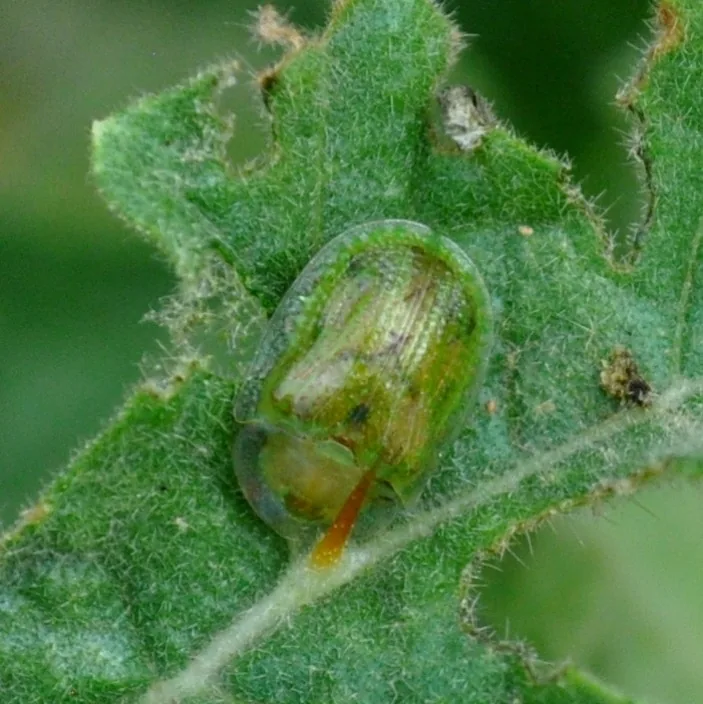
- Adults are up to 6 mm long and 5 mm wide with a hard covering; females are slightly larger. Reproductive adults are green and diapausing adults light brown. UF/IFAS gives adults as about 6 mm (1/4 inch) long and 4 to 5 mm wide, deep green when reproductive and pale brown in winter diapause. Under the tip of the abdomen males show two orange testes through the skin and females white oviducts.[1][2]
- Larvae are pale green, up to 6 mm, with spines along the margins that carry their molted skins and frass as camouflage; they feed on the undersides of young leaves. UF/IFAS describes the pupae as 5 to 6 mm long, pale green, spiny, flattened and immobile on the undersides of the leaves.[1][2]
- Eggs are oval, up to 1.8 mm, encased in two translucent papery membranes and laid singly. Adults and larvae both leave a shot-hole feeding pattern. UF/IFAS describes the eggs as 1 to 1.8 mm long and brown inside a papery envelope, and calls the leaf damage a distinctive 'shotgun' hole pattern, visible from April to November.[1][2]
Where it lives
Native to South America. Beetles from Argentina and Paraguay were released in Alabama, Florida, Georgia and Texas from 2003. It is widespread and abundant in south and central Florida but limited or absent in northern Florida; it overwintered at first in Alabama, Georgia and Texas, but permanent establishment there has not been confirmed. UF/IFAS gives its native range as southern Brazil, northern Argentina and Paraguay. In Florida it is present through much of the state, but its damage to tropical soda apple is most evident south of 29° N latitude, about the latitude of Wildwood. More than 250,000 beetles were reared and released across Florida from 2003 to 2011.[1][2]
Biology and life cycle
Adults emerge in early spring. A female lays up to 300 eggs singly; larvae feed through five instars and pupate attached to leaf undersides. The cycle takes about a month, with 7 to 8 generations a year in Florida, and the last generation diapauses in leaf litter.[1]
Its numbers are greater in open habitats, but its damage and survival are higher in shade, and cold hinders it. A University of Florida study found that leaves grown in shade were less tough, held more water and nitrogen and had less dense, smaller glandular hairs, and beetles reared on them survived better as immatures, ate more, grew larger and laid more eggs. In the field, more eggs survived to adult in shaded habitats, and predators were more abundant in the open pasture, where their numbers tracked the beetle's.[1][3]
UF/IFAS says larvae hatch in 5 to 6 days and feed aggressively; after five instars and 16 to 18 days they pupate on the undersides of the leaves for 6 to 7 days. Egg to adult takes 29 to 31 days at 25°C (77°F).[2]
In Florida, UF/IFAS says it feeds and reproduces from March or April until October or November. From December to early March adults are in reproductive diapause, hidden in leaf litter beneath the plants, which lets them survive cold and food scarcity but makes them hard to find.[2]
UF/IFAS lists its natural enemies in Florida: predatory bugs such as Geocoris punctipes, Perillus bioculatus and Stiretrus anchorago, the fire ant Solenopsis invicta and the spider Peucetia viridans; parasitoids reared from the pupae; and diseases including a Nosema species. No egg or larval parasitoids have been found, and populations still build quickly in summer in central and south Florida.[2]
Damage and signs
- Feeding reduces photosynthesis and aids attack by secondary diseases, reducing the plant's growth, reproduction and competitive ability. In Florida, feeding defoliates plants and inhibits fruit production. UF/IFAS adds that the feeding wounds may let plant diseases in, and that by weakening the weed the beetle indirectly helps pasture grasses and native plants recover.[1][2]
- At high densities it has been credited with up to a 90 percent decline in plant density within three years, and the weed is now limited at many sites; beetle abundance is variable. UF/IFAS says studies in central Florida pastures showed it can drastically reduce tropical soda apple density in less than a year after release, though it may take longer at some sites; it will not eliminate the weed but brings it down to a more tolerable level.[1][2]
Health risk
It is a leaf-feeding beetle. The USFS field guide and CSIRO don't mention any risk to people or pets.[1][4]
Control
Prevention
Results are weaker in the north: cold limits its northern distribution, and permanent establishment in Alabama, Georgia and Texas has not been confirmed. UF/IFAS says the beetle may need to be supplemented with herbicides and mowing, especially in winter when it is inactive and in north Florida, where its impact is low.[1][2]
Biological control
The beetle is the biological control. CSIRO, which is testing it for Australia, says it has been used successfully in Florida, where it proved host specific and effective. UF/IFAS says field release was approved in 2003 because in testing the beetle fed and survived only on tropical soda apple.[4][2]
Where the plants must be killed, the field guide describes a bioherbicide, a strain of tobacco mild green mosaic virus sold as SolviNix, registered in 2014 for pastures and wooded areas; infected plants die within about six weeks. EPA's product database lists SolviNix LC (81179-3) as an active registration.[1][5]
Where the sources disagree
Host range: CSIRO says the beetle proved host specific in Florida, yet its own quarantine tests saw some feeding, limited egg laying and incomplete development on a few native Australian Solanum species.[4]
Origin: UF/IFAS's Featured Creatures profile says the beetle was discovered in Paraguay and gives a native range of southern Brazil, northern Argentina and Paraguay; the Forest Service field guide says released beetles came from Argentina and Paraguay; UF/IFAS's list of Florida's established weed biocontrol agents gives Argentina alone.[2][1][6]
Egg size: UF/IFAS gives 1 to 1.8 mm and describes the eggs as brown in a papery envelope; IBiocontrol and the Forest Service field guide give up to 1.8 mm, encased in two translucent papery membranes.[2][7][1]
Common questions
- What is the green beetle with holes all over my tropical soda apple?
- Probably the tropical soda apple leaf beetle: a green tortoise beetle up to 6 mm long whose adults and larvae leave a shot-hole pattern in the leaves.[1]
- Why hasn't it spread north?
- Cold. The field guide says it is limited or absent in northern Florida, and permanent establishment in Alabama, Georgia and Texas has not been confirmed. UF/IFAS says its damage is most evident south of about 29° N, near Wildwood, and that it was also released in Texas, Alabama and Georgia without confirmed establishment.[1][2]
- Will it eat my tomatoes or eggplant?
- None of the sources read for this page reports it on tomato or eggplant. UF/IFAS says it fed and survived only on tropical soda apple in testing and that tropical soda apple is its only host in Florida. In CSIRO's quarantine tests in Australia on 20 species in the nightshade family, there was some feeding, limited egg laying and incomplete development on a few native Australian Solanum species.[2][4]
Sources
- USDA Forest Service, Forest Health Technology Enterprise Team, “Field Guide for the Biological Control of Weeds in Eastern North America (FHTET-2016-04), by Winston, Randall, Blossey, Tipping, Lake and Hough-Goldstein (2017).” www.fs.usda.gov/foresthealth/technology/pdfs/FHTET-2016-04_Biocontrol_Field_Guide.pdf (accessed 2026-11-14). Read from the Forest Service PDF; agent entries for each weed.
- University of Florida IFAS Extension (EDIS), “Tropical Soda Apple Leaf Beetle, Gratiana boliviana Spaeth, EENY-543/IN974 (W. Overholt, R. Diaz, K. Hibbard and J. Medal; Featured Creatures).” ask.ifas.ufl.edu/publication/IN974 (accessed 2026-11-14)
- Environmental Entomology (via NCBI PubMed), “Differential performance of tropical soda apple and its biological control agent Gratiana boliviana (Coleoptera: Chrysomelidae) in open and shaded habitats (R. Diaz, C. Aguirre, G. S. Wheeler, S. L. Lapointe, E. Rosskopf and W. A. Overholt; University of Florida, USDA-ARS; Environmental Entomology 40: 1437-1447, 2011; doi:10.1603/EN11203; abstract).” pubmed.ncbi.nlm.nih.gov/22217759/ (accessed 2026-11-14)
- CSIRO (Commonwealth Scientific and Industrial Research Organisation, Australia), “Our research: Tropical soda apple biological control.” research.csiro.au/tsa/our-research/ (accessed 2026-11-14). Only CSIRO's own statements and quarantine results are cited.
- U.S. EPA Pesticide Product Label System, “Pesticide Product Label System: product-name search 'SolviNix'.” ordspub.epa.gov/ords/pesticides/cswu/ProductSearch/partialprodsearch/v2/riname/SolviNix (accessed 2026-11-14). 1 row, Active: 81179-3 SOLVINIX LC (status date December 11, 2014); saved 2026-11-14.
- University of Florida IFAS Extension (EDIS), “Florida's Established Arthropod Weed Biological Control Agents and Their Targets, ENY-853/IN779 (J. Cuda and J. H. Frank).” ask.ifas.ufl.edu/publication/IN779 (accessed 2026-11-14)
- IBiocontrol / North American Invasive Species Management Association, “Tortoise beetle, Gratiana boliviana (agent profile summarizing Diaz and Charudattan 2022, Tropical Soda Apple Biocontrol Agents: History and Ecology in North America, NAISMA-BCW-2022-24).” ibiocontrol.org/bio/gratiana-boliviana/ (accessed 2026-11-14)
- Global Biodiversity Information Facility (GBIF), “Gratiana boliviana (GBIF Backbone Taxonomy).” api.gbif.org/v1/species/6274447 (accessed 2026-11-14). ACCEPTED; order Coleoptera, family Chrysomelidae; read 2026-11-14.