On this page
How to identify it
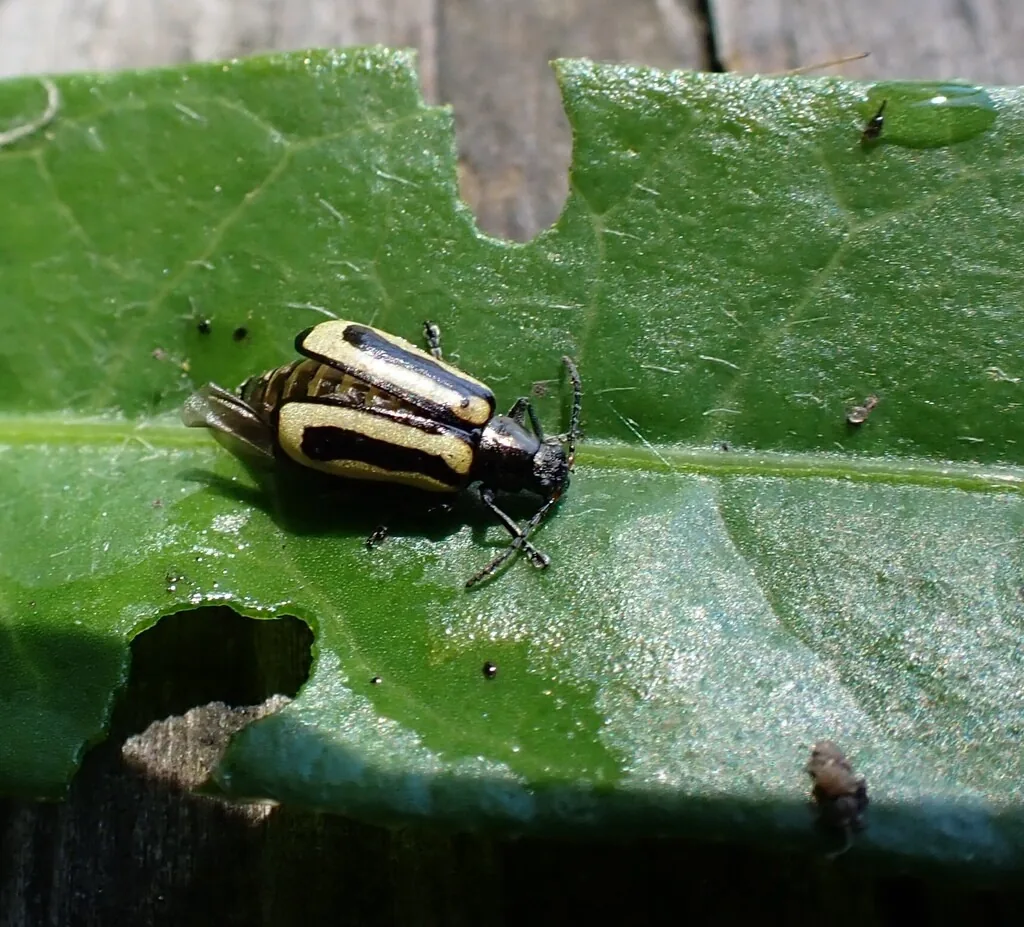
- Adults are 4 to 6 mm long and black with four lengthwise stripes, two on each wing cover. Enlarged hind thighs let them jump long distances, and females are slightly larger than males.[1]
- Larvae are yellow at first and turn black as they age, reaching up to 6 mm. Their feeding often leaves transparent 'windows' in the leaves.[1]
- Eggs are pale yellow and cylindrical, laid in two rows of 12 to 54 on the undersides of alligatorweed leaves. Pupae, inside the stems, are cream-colored at first and darken with age.[1]
- Adults emerge in early spring and feed on alligatorweed leaves and stems; the field guide says establishment can be checked by looking for adults or larvae on the foliage.[1]
Look-alikes
| Look-alike | How to tell them apart |
|---|---|
| Alligatorweed stem borer (Arcola malloi) | A moth also released against alligatorweed. Its larvae are white to yellow at first and look brown at maturity because of tan, wavy lengthwise stripes, reaching up to 14 mm; they bore into stem tips and mine downward. Attacked stems wilt, yellow and die, and whole mats often turn yellow and sink.[1] |
| Alligatorweed thrips (Amynothrips andersoni) | Another established agent. Adults are 2 mm long and black; nymphs go from pale yellow to orange-red. It sucks out cell contents, deforming leaves and tips and stunting plants rather than chewing them, and it is the most cold tolerant of the established alligatorweed agents.[1] |
Where it lives
Native to South America. Beetles from Uruguay and Argentina were released from 1964 in Alabama, Arkansas, Florida, Georgia, Louisiana, Mississippi, North Carolina, South Carolina, Tennessee and Texas. It overwinters only in warmer places and extends into colder areas in summer and autumn. USGS says it survives winter only where the mean January temperature is 11°C or warmer, which includes Florida and coastal areas of the Southeast, and a habitat model predicts 15.9 percent of alligatorweed's U.S. range is highly or moderately suitable for it.[1][2][3]
Biology and life cycle
Adults emerge in early spring and begin mating and laying eggs; a female lays an average of 1,100 eggs in her life, in two-row clusters on leaf undersides.[1]
Larvae feed on leaf tissue through three instars, then chew into the stems and pupate inside them. There are 4 to 6 generations a year, and last-generation adults overwinter among alligatorweed roots and stems along the water's edge.[1]
Populations fall in summer because high temperatures reduce egg laying, and hot, dry summers reduce beetle numbers at some sites.[1]
It attacks only the aquatic form of alligatorweed, though minor feeding has been seen on plants that have only recently become terrestrial after a drawdown. It is not effective against the terrestrial form.[1]
Damage and signs
- Larval and adult feeding on leaves and stems is often severe, eventually sinking the floating mat and clearing waterways. A 2025 study says alligatorweed is controlled across much of its introduced range, with insufficient control at temperate latitudes.[1][3]
- The field guide says it is highly successful in northern Florida and warmer coastal areas where it can overwinter, but populations elsewhere are variable.[1]
Health risk
It is a plant-feeding leaf beetle. The USFS field guide and USGS don't mention any risk to people or pets.[1][2]
Control
Prevention
The field guide says cold hinders overwintering at inland sites and the beetle is ineffective on the terrestrial form. USGS says the U.S. Army Corps of Engineers Jacksonville District, on request, coordinates yearly shipments of beetles collected in Florida's St. Johns River to areas where they do not overwinter.[1][2]
Biological control
The beetle is the control, not the pest. It has demonstrated effective control of alligatorweed but is not commercially available; depending on location and conditions, populations may already be present in the wild. Texas A&M AgriLife advises that even where the beetle is present, biological control usually works best combined with other methods in an integrated program.[4]
Where the sources disagree
Establishment: the field guide says all releases, including those in North Carolina, Arkansas and Tennessee, are believed to have established; USGS says the beetle survives winter only where the mean January temperature is 11°C or warmer, and a habitat model rates only 15.9 percent of the weed's U.S. range as suitable.[1][2][3]
Stem borer: the field guide calls the stem borer (Arcola malloi, synonym Vogtia malloi) a useful adjunct to the flea beetle but possibly not as good a competitor; USGS says the stem borer has done more damage in the interior of alligatorweed's range than the flea beetle has in southern and coastal areas.[1][2]
Common questions
- What is eating holes in the alligatorweed in my pond?
- If the leaves show see-through windows and you find small black, striped beetles that jump, the alligatorweed flea beetle is a likely cause: its larvae leave transparent feeding windows, and adults feed on leaves and stems.[1]
- Can I buy alligatorweed flea beetles?
- Texas A&M says they are not commercially available, though populations may be found in the wild. USGS says the Corps of Engineers Jacksonville District, on request, ships beetles from Florida to areas where they do not overwinter.[4][2]
- Why doesn't the beetle control alligatorweed farther north?
- USGS says it survives winter only where the mean January temperature is 11°C or warmer, and a habitat model predicts only 15.9 percent of alligatorweed's U.S. range is highly or moderately suitable for it. The same study finds the alligatorweed thrips more cold tolerant, with a broader range.[2][3]
Sources
- USDA Forest Service, Forest Health Technology Enterprise Team, “Field Guide for the Biological Control of Weeds in Eastern North America (FHTET-2016-04), by Winston, Randall, Blossey, Tipping, Lake and Hough-Goldstein (2017).” www.fs.usda.gov/foresthealth/technology/pdfs/FHTET-2016-04_Biocontrol_Field_Guide.pdf (accessed 2026-11-14). Read from the Forest Service PDF; agent entries for each weed.
- U.S. Geological Survey, “Alternanthera philoxeroides (alligatorweed) species profile, Nonindigenous Aquatic Species database.” nas.er.usgs.gov/queries/FactSheet.aspx?speciesID=227 (accessed 2026-11-14)
- Environmental Entomology (Entomological Society of America), full text in PubMed Central (PMC12716278), “Knight, Bingham, Harlow, Huang, Bohaty and Harms. A proposed method for estimating habitat suitability of weed biological control agents with experimentally derived thermal injury and weather data. Environmental Entomology 54: 1179-1186 (2025), doi:10.1093/ee/nvaf099.” doi.org/10.1093/ee/nvaf099 (accessed 2026-11-14)
- Texas A&M AgriLife Extension, “How to Control Alligator Weed (AquaPlant: Management of Pond Plants and Algae).” aquaplant.tamu.edu/management-options/alligator-weed/ (accessed 2026-11-14)
- Global Biodiversity Information Facility (GBIF), “Agasicles hygrophila (GBIF Backbone Taxonomy).” api.gbif.org/v1/species/1047377 (accessed 2026-11-14). ACCEPTED; order Coleoptera, family Chrysomelidae; read 2026-11-14.