On this page
How to identify it
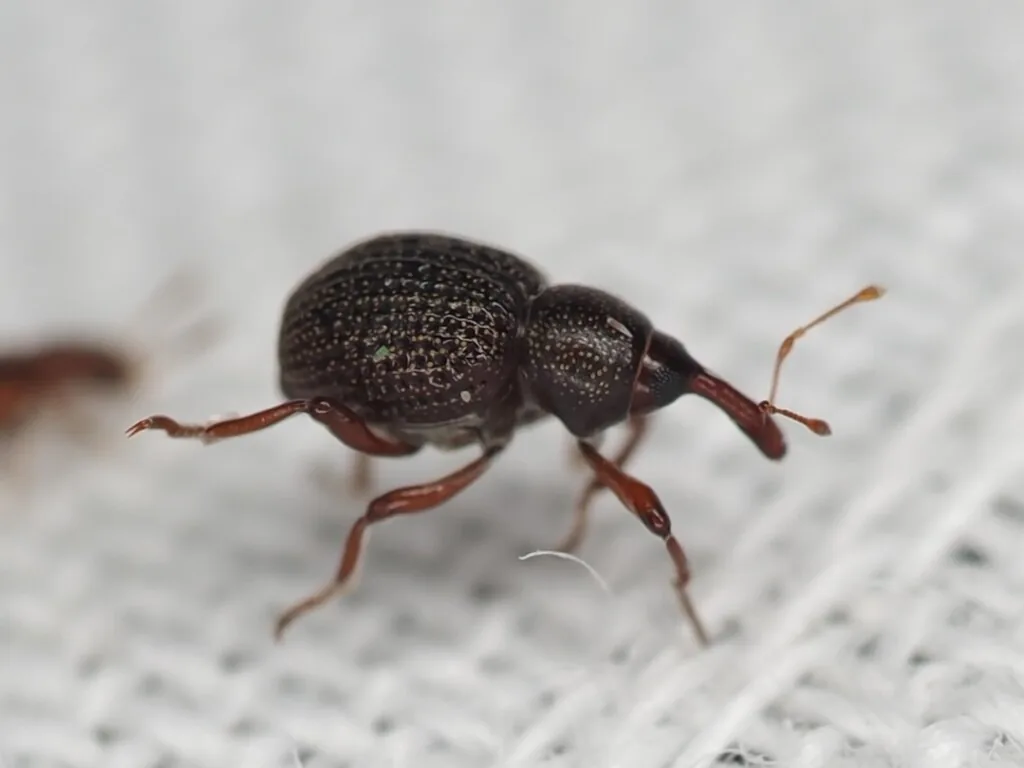
- Adults are up to 2.5 mm long with a long snout; females are slightly larger. New adults are brown and turn shiny black within a few days. The Florida ecotype is significantly smaller than the Brazilian. UF/IFAS says adults stay brown for the first five days after emerging and carry their antennae and chewing mouthparts at the tip of the snout. IBiocontrol adds ridges and pits along the body bearing tiny golden scales; adults sit at the base of the buds or among the submerged filaments.[1][3][4]
- Larvae are white and C-shaped with a brown head, up to 4 mm long. Eggs are white, elliptical and about 0.5 mm long. UF/IFAS says the larvae grow from 1 mm in the first instar to 2.6 mm in the fifth and are milky white with a hardened, dark brown head capsule, and the milky white eggs measure 0.5 by 0.2 mm, laid singly on the leaves or rhizomes. Pupae, 2 by 2.6 mm, sit underwater inside the rhizomes in a cocoon made of the plant's roots.[1][3]
- Adults feeding on buds, leaves and filaments leave a 'shot-hole' pattern. IBiocontrol says attacked fronds go from a healthy green to yellow to brown before they disintegrate and sink.[1][4]
Look-alikes
| Look-alike | How to tell them apart |
|---|---|
| Water hyacinth weevils (Neochetina) | Larger weevils of water hyacinth, not salvinia; their adults leave 2 to 3 mm scars on hyacinth leaves and their larvae mine the leaf stalks.[1] |
Where it lives
Native to South America; two ecotypes are in the United States. The Florida ecotype probably arrived by accident before 1960, spread on its own to giant salvinia in Florida, and was redistributed to giant salvinia in Louisiana and Texas in 1999 and to common salvinia in Louisiana from 2002. The Brazilian ecotype was released on giant salvinia in Louisiana and Texas, by way of Australia, from 2001. It does best between 55 and 91°F (13 to 33°C). Texas A&M says it may be effective for giant salvinia management. UF/IFAS says it is native to southern Brazil and now occurs in at least 17 other countries, including Australia, Papua New Guinea, Sri Lanka and South Africa. It puts the Florida introduction in the 1960s or earlier and says the weevil is now in more than 77 percent of Florida's waterbodies; the Texas and Louisiana project with Brazilian weevils began in 1999.[1][5][3]
Biology and life cycle
A female lays up to 300 eggs singly in cavities in the rhizomes, leaves and filaments. Larvae feed on buds and leaves, then inside the rhizomes, through three instars, and pupate underwater in cocoons on filaments or leaf bases.[1]
Adults feed on buds, leaves and filaments, breathe from a film of trapped air, and live 20 to 38 weeks. How it overwinters is unknown, and the number of North American generations is unknown but believed to be one. UF/IFAS calls that air film a plastron, a bubble the weevil attaches to the underside of its body.[1][3]
Winter is the limiting factor. In Texas A&M laboratory trials, adult mortality after two, four and six cycles of repeated cold exposure was 22, 70 and 82 percent, and the survivors fed less; the results were matched against caged weevils through four winters on two northeast Texas lakes to help predict when spring releases will be needed.[2]
Louisiana State University researchers have worked out how to grade female weevils by the state of their ovaries, which shows whether a field population or a rearing colony is reproducing.[6]
UF/IFAS says egg to adult takes about 45 days, varying with temperature and food quality: eggs hatch after about 10 days, larvae feed for about 23 days and the pupal stage lasts 10 to 15 days. Females start laying about five days after emerging, cutting small crevices into new growth, and can lay one egg every two to five days for at least 60 days.[3]
Newly hatched larvae feed on the roots in their first to fourth days and move to new leaf buds within five to nine days, then tunnel into the rhizomes, which they must do to complete development. Adults eat roots, buds and the young leaves around the buds, and UF/IFAS says nitrogen-rich plants speed larval development and raise egg production.[3]
Damage and signs
- Larval mining cuts off the flow of nutrients, and plants turn brown, disintegrate and sink; adult feeding also helps suppress growth.[1]
- The Brazilian ecotype successfully suppresses most giant salvinia infestations along the Gulf Coast. The Florida ecotype failed on giant salvinia in Louisiana but is abundant on common salvinia there and on both species in Florida, with boom-and-bust cycles.[1]
- Fire ants may hold it below the level needed for control at some Louisiana sites, and inland in Louisiana and Texas colder temperatures slow its growth and hinder overwintering.[1]
- UF/IFAS says larval feeding does the most harm because it destroys the vascular tissue and cuts off nutrient flow, so the plant decays, loses buoyancy and sinks. In Texas and Louisiana the weevil has shown it can reduce giant salvinia surface cover by more than 99 percent; released in Lake Moondarra, Australia, in 1980, it eliminated an infestation within 15 months, and introductions in at least 17 other countries achieved similar control within 36 months.[3]
- UF/IFAS credits the weevil with controlling common salvinia (Salvinia minima) in Florida, where that fern is no longer considered a problem.[3]
Health risk
It is a plant-feeding weevil. The USFS field guide and Texas A&M don't mention any risk to people or pets.[1][5]
Control
Prevention
Texas A&M says salvinia weevils feed on salvinia and may be effective for its management. UF/IFAS says feeding by its larvae and adults kills the host plants and restores recreational, agricultural and ecosystem functions in the water.[5][3]
Biological control
Inland, cold reduces control: the field guide says colder temperatures hinder overwintering, and laboratory trials found repeated cold exposure killed most adults. For redistribution, the field guide describes extracting adults with a Berlese funnel or by submerging plants and collecting the adults. IBiocontrol says that under ideal conditions its damage alone is enough to manage salvinia, but at many other sites it has to be combined with other management.[1][2][4]
Where the sources disagree
Family: the field guide places Cyrtobagous in Erirhinidae; the GBIF Backbone places it in Brachyceridae.[1][7]
Adult size: UF/IFAS gives 2 to 3.5 mm, the Forest Service field guide up to 2.5 mm and IBiocontrol up to 2 mm.[3][1][4]
Larval stages: UF/IFAS describes five instars; the Forest Service field guide and IBiocontrol give three.[3][1][4]
Arrival in Florida: the Forest Service field guide says the Florida ecotype was likely introduced before 1960; UF/IFAS says probably in the 1960s or earlier.[1][3]
Generations: the Forest Service field guide says the number in North America is unknown but believed to be one, IBiocontrol says likely one at cold sites and three at warm sites such as southern Louisiana and Texas, and UF/IFAS calls it multivoltine, with multiple generations a year.[1][4][3]
Common questions
- My giant salvinia is turning brown. Is that the weevil?
- Look for the weevil's signs: larval mining turns plants brown before they disintegrate and sink, and adults leave a shot-hole pattern on buds and leaves. IBiocontrol says the adults sit at the base of the buds or among the submerged filaments.[1][4]
- Why did the weevils disappear over winter?
- Repeated freezes kill overwintering adults: in laboratory trials mortality reached 70 percent after four cold cycles and 82 percent after six. The field guide says colder temperatures hinder overwintering inland in Louisiana and Texas.[2][1]
- Will it attack other pond plants?
- UF/IFAS says field studies in Brazil found it feeds only on Salvinia, and in the United States it feeds only on giant and common salvinia, the only two Salvinia species in North America.[3]
Sources
- USDA Forest Service, Forest Health Technology Enterprise Team, “Field Guide for the Biological Control of Weeds in Eastern North America (FHTET-2016-04), by Winston, Randall, Blossey, Tipping, Lake and Hough-Goldstein (2017).” www.fs.usda.gov/foresthealth/technology/pdfs/FHTET-2016-04_Biocontrol_Field_Guide.pdf (accessed 2026-11-14). Read from the Forest Service PDF; agent entries for each weed.
- Environmental Entomology (Entomological Society of America), “Obeysekara, Knutson, Mukherjee and Heinz (Texas A&M University). Repeated cold exposure effects on mortality and feeding activity of the salvinia weevil, Cyrtobagous salviniae (Coleoptera: Curculionidae). Environmental Entomology 44: 1590-1598 (2015), doi:10.1093/ee/nvv123.” doi.org/10.1093/ee/nvv123 (accessed 2026-11-14)
- University of Florida IFAS Extension (EDIS), “Salvinia Weevil, Cyrtobagous salviniae (Calder & Sands), EENY-729/IN1245 (P. Prade, E. Kariuki and A. G. Dale; Featured Creatures).” ask.ifas.ufl.edu/publication/IN1245 (accessed 2026-11-14)
- IBiocontrol / North American Invasive Species Management Association, “Salvinia weevil, Cyrtobagous salviniae (agent profile summarizing Pham, Diaz and Nachtrieb 2022, Salvinia Biocontrol Agents: History and Ecology in North America, NAISMA-BCW-2022-20).” ibiocontrol.org/bio/cyrtobagous-salviniae/ (accessed 2026-11-14)
- Texas A&M AgriLife Extension, “How to Control Giant Salvinia (AquaPlant: Management of Pond Plants and Algae).” aquaplant.tamu.edu/management-options/giant-salvinia/ (accessed 2026-11-14)
- International Journal of Insect Science (SAGE), full text in PubMed Central (PMC5772501), “Eisenberg, Johnson (Louisiana State University) and Grodowitz. The reproductive morphology and physiological age grading of the female salvinia weevil, Cyrtobagous salviniae Calder and Sands. International Journal of Insect Science 10 (2018), doi:10.1177/1179543317751909.” doi.org/10.1177/1179543317751909 (accessed 2026-11-14)
- Global Biodiversity Information Facility (GBIF), “Cyrtobagous salviniae (GBIF Backbone Taxonomy).” api.gbif.org/v1/species/10757415 (accessed 2026-11-14). ACCEPTED; order Coleoptera, family Brachyceridae; read 2026-11-14.