On this page
How to identify it
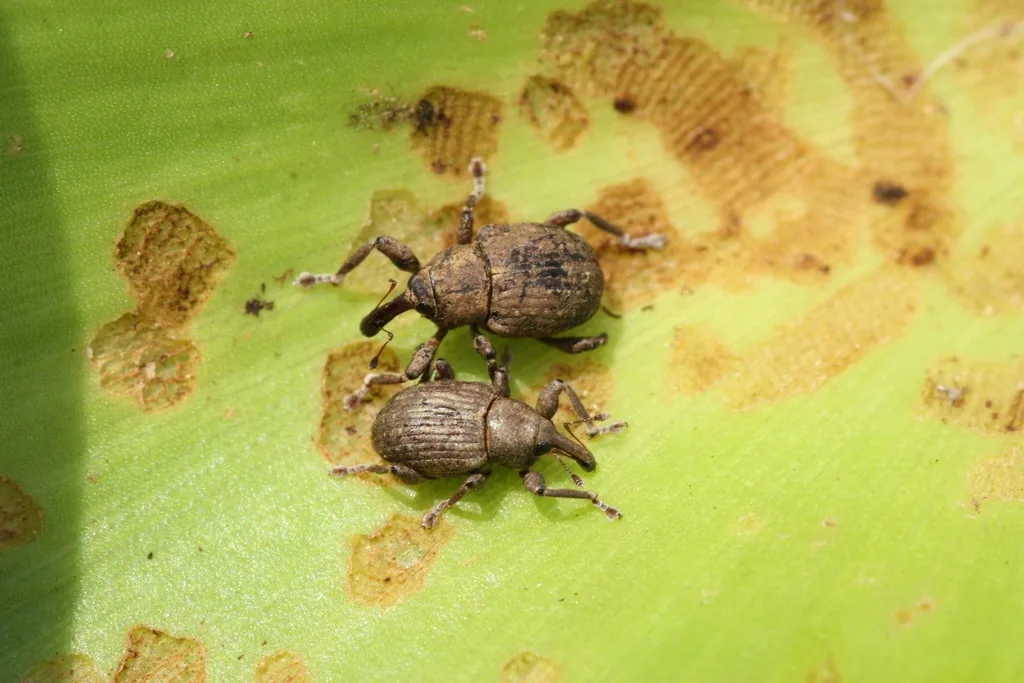
- Adults of both species are somewhat rounded weevils with long snouts. N. bruchi is tan or brown, often with a lighter v-shaped band on the lower wing covers; N. eichhorniae is darker, mottled gray and brown. Each has two dark markings on the wing covers, shorter and midway down in N. bruchi, longer and closer to the head in N. eichhorniae.[1]
- Larvae are C-shaped, white with yellow-orange heads, up to 9 mm long, inside the petioles. Pupae are white, in cocoons on the roots below water. Eggs are white and oval.[1]
- Adult feeding scars 2 to 3 mm across on the leaves and petioles are the usual field sign.[1]
Look-alikes
| Look-alike | How to tell them apart |
|---|---|
| Water hyacinth moth (Niphograpta albiguttalis) | Another released agent whose larvae tunnel in the plant, but it is a moth: later-instar larvae are cream with scattered dark brown spots and a dark orange head, up to 2 cm long, and their tunneling makes leaves curl and brown. It was released in Florida, Louisiana and Texas from 1977 and has rarely been seen recently.[1] |
| Salvinia weevil (Cyrtobagous salviniae) | A smaller weevil, up to 2.5 mm and shiny black when mature, that lives on salvinia rather than water hyacinth.[1] |
Where it lives
Native to South America. N. eichhorniae from Argentina was released in Florida in 1972, in Texas and Louisiana from 1974 and in California in 2002; N. bruchi was released in Florida, Louisiana and Texas from 1974 and in California in 1982 and 2002. Both are well established in Florida, Louisiana and Texas and thrive wherever water hyacinth persists year-round. Texas A&M says the weevils are commonly used to manage water hyacinth biologically.[1][2]
Biology and life cycle
Both species breed continuously. In warm areas where the plant does not freeze, all stages overwinter; adults live over a year and are found year-round.[1]
Adults feed on leaves and petioles, leaving scars 2 to 3 mm across. A female lays 300 to 400 eggs embedded in leaf and petiole tissue, N. bruchi several at a site and N. eichhorniae singly.[1]
Larvae mine the petioles toward the root crown through three instars, N. bruchi larvae developing faster, and pupate in cocoons on the roots below water.[1]
Because water hyacinth is their main food, the weevils depend on the plant: in a 54-site Florida survey, sites kept nearly clear by repeated herbicide treatment held far fewer weevils simply because there were few plants, while at untreated sites the dense weevil populations had stressed the plants so much that fewer females were reproductive.[2][3]
Damage and signs
- Scarring and petiole mining stunt the plants and reduce flowering and vegetative spread; the petioles become thin and brittle, and the plants waterlog and sink.[1]
- In the Gulf Coast states the two species' damage is hard to tell apart and they likely complement each other; N. bruchi is usually outnumbered by N. eichhorniae. Chemical control is needed significantly less there, though water hyacinth is still a problem in some areas.[1]
- The Florida survey found that herbicide maintenance control actually improved the nutritional quality of surviving plants and so stimulated weevil reproduction, but also guaranteed regrowth; the USDA-ARS authors recommended integrating the two, using herbicides to hold water hyacinth below management thresholds in ways that conserve the weevil populations.[3]
- Spillover feeding on pickerelweed (Pontederia cordata) and Canna was insignificant and temporary, and the field guide reports no recent nontarget attack.[1]
Health risk
They are plant-feeding weevils. The USFS field guide and Texas A&M don't mention any risk to people or pets.[1][2]
Control
Prevention
Texas A&M says that because water hyacinth is the weevils' main food, they are commonly used to manage it biologically.[2]
Biological control
Where water hyacinth is also sprayed, the USDA-ARS advice is to integrate the two: keep infestations below management thresholds with herbicide while leaving enough plants to carry the weevil population, rather than clearing every mat.[3]
Where the sources disagree
Family: the field guide places Neochetina in Erirhinidae; the GBIF Backbone places it in Brachyceridae.[1][4]
Herbicides: the field guide credits the weevils with significantly reducing chemical control in the Gulf Coast states; a Florida survey found far fewer weevils at sites kept nearly clear by repeated herbicide treatment.[1][3]
Common questions
- What are the small scars all over the water hyacinth leaves?
- Probably adult feeding scars of the waterhyacinth weevils, 2 to 3 mm across, on the leaves and petioles.[1]
- Which weevil do I have?
- N. eichhorniae is darker, mottled gray and brown, with longer dark marks closer to the head; N. bruchi is tan or brown, often with a lighter v-shaped band, and shorter marks midway down the wing covers.[1]
- Will spraying the hyacinth wipe out the weevils?
- Spraying removes their only food, so weevil numbers fall with the plants. The USDA-ARS recommendation is to use herbicides to keep the weed below thresholds while conserving enough plants for the weevils, as the survey's authors concluded the two should be integrated.[3]
Sources
- USDA Forest Service, Forest Health Technology Enterprise Team, “Field Guide for the Biological Control of Weeds in Eastern North America (FHTET-2016-04), by Winston, Randall, Blossey, Tipping, Lake and Hough-Goldstein (2017).” www.fs.usda.gov/foresthealth/technology/pdfs/FHTET-2016-04_Biocontrol_Field_Guide.pdf (accessed 2026-11-14). Read from the Forest Service PDF; agent entries for each weed.
- Texas A&M AgriLife Extension, “How to Control Water Hyacinth (AquaPlant: Management of Pond Plants and Algae).” aquaplant.tamu.edu/management-options/water-hyacinth/ (accessed 2026-11-14)
- Environmental Management (Springer), “Center, Dray, Jubinsky and Grodowitz (USDA-ARS Aquatic Plant Control Research, Fort Lauderdale). Biological control of water hyacinth under conditions of maintenance management: can herbicides and insects be integrated? Environmental Management 23: 241-256 (1999), doi:10.1007/s002679900183.” doi.org/10.1007/s002679900183 (accessed 2026-11-14)
- Global Biodiversity Information Facility (GBIF), “Neochetina eichhorniae (GBIF Backbone Taxonomy).” api.gbif.org/v1/species/4290716 (accessed 2026-11-14). ACCEPTED; order Coleoptera, family Brachyceridae; read 2026-11-14.
- Global Biodiversity Information Facility (GBIF), “Neochetina bruchi (GBIF Backbone Taxonomy).” api.gbif.org/v1/species/1247433 (accessed 2026-11-14). ACCEPTED; order Coleoptera, family Brachyceridae; read 2026-11-14.