On this page
How to identify it
- Sizes differ by source and species: Minnesota says most are 1/16 to 1/8 inch, with the spinach flea beetle reaching 1/4 inch; UC IPM says all are under 1/10 inch; UW-Madison gives 1/16 to 1/4 inch.[2][1][5]
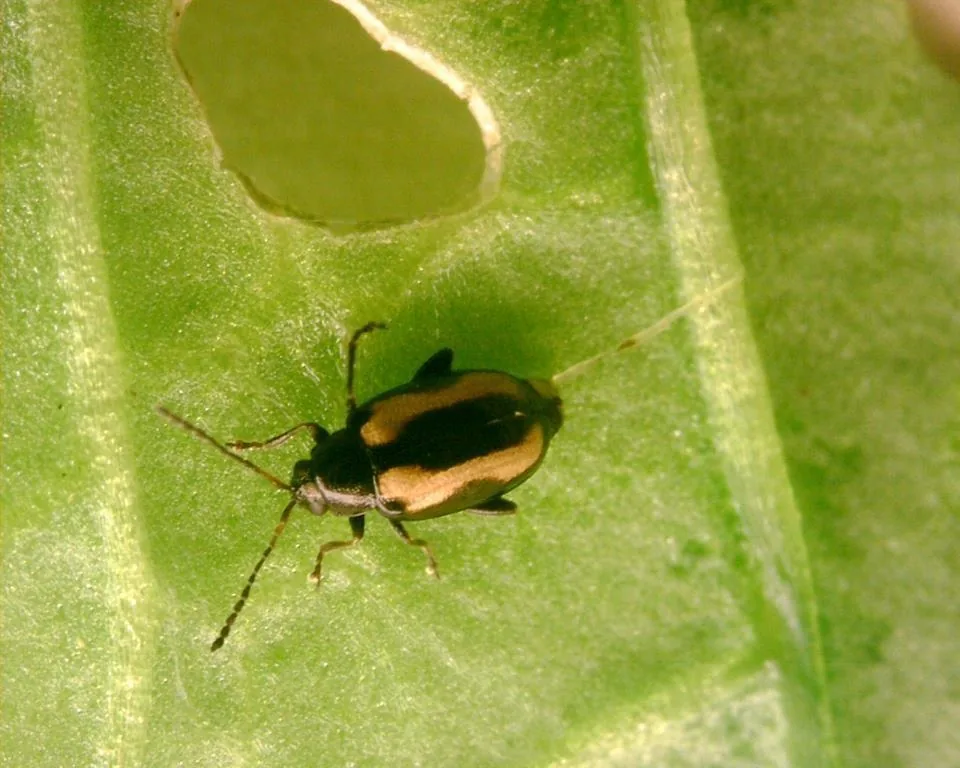
- They are black, bronze, bluish, brown or metallic gray, and some have pale spots or stripes.[2][5]
- The hind legs are enlarged for jumping.[1][2]
- Feeding leaves small rounded holes, usually under 1/8 inch, and shallow pits, a pattern Minnesota calls unique to flea beetles. UW-Madison notes some plant diseases can make similar shot holes, so look for the beetles too.[2][5]
- The striped flea beetle shown here has two yellow stripes on its back; it and the all-black crucifer flea beetle feed only on cabbage-family crops.[6][2]
- Larvae are small (1/16 to 3/16 inch), pale, worm-like grubs with dark heads; most live in the soil.[5][1]
Look-alikes
| Look-alike | How to tell them apart |
|---|---|
| Cucumber beetles | Much larger, about 1/4 inch, and yellowish with black spots or stripes, while most flea beetles are 1/8 inch or smaller.[3][2] |
Where it lives
Flea beetles are widespread; different species dominate in different regions, such as the crucifer and striped flea beetles in Minnesota and the tobacco and western potato flea beetles in the western United States.[2][1]
Biology and life cycle
Adults spend winter in leaf litter, soil, plant debris, hedgerows, windbreaks or woods and become active in early spring; UW-Madison puts that at about 50°F.[2][1][5]
Females lay eggs in soil, roots, small holes or leaves. UW-Madison says eggs are usually laid at the base of host plants in May and hatch in 7 to 14 days.[2][1][5]
Larvae feed mostly on roots, then pupate in the soil; UW-Madison gives 11 to 13 days as pupae.[2][1][5]
Generation counts differ: one or two a year in Minnesota's and UC IPM's accounts, one to three depending on species in UW-Madison's. UMass describes brassica flea beetles in Massachusetts producing new adults in mid-June and again in late July.[2][1][5][6]
Most species stick to a few related plants, which their common names often reflect (crucifer, eggplant, potato flea beetle). The pale-striped flea beetle is an exception, eating squash, beans, corn, sunflowers, lettuce, potatoes and many weeds.[2][5]
Adults are most active on calm, warm, sunny days.[5]
Damage and signs
- Adults do most of the harm by feeding on leaves and stems, and heavy feeding can wilt, stunt or kill seedlings.[2][5][6]
- Plants started from seed tolerate feeding less well than transplants, and damage is not usually serious past the seedling stage. Leafy crops such as kale and spinach can be unmarketable when damage is heavy.[2][1][5]
- Glossy-leaved brassicas such as bok choy, napa cabbage and mustard are highly attractive, while waxy cabbage, broccoli and kale draw less feeding, mostly at the leaf edges.[6]
- Larvae seldom cause much damage, except potato flea beetle larvae, which make narrow tunnels in tubers that let fungi in. In the Pacific Northwest, the tuber flea beetle is the only one of the three local potato species that seriously injures tubers.[1][2][7]
- Many flea beetle species can also spread plant diseases.[5]
Health risk
Flea beetles are plant feeders; the harm they do is chewed seedling leaves and, for some species, tunnels in potato tubers.[2][1]
Control
Prevention
Watch seedlings from the day they emerge. Yellow sticky traps (UC IPM also uses white) show when beetles arrive, and UW-Madison says trap counts track the feeding nearby.[2][1][5]
Plant after the adults emerge, or later in the normal window, so seedlings grow quickly in warm weather, and plant spring brassicas as far as you can from last fall's.[2][5][6]
Plant a highly favored trap crop such as radish 7 to 14 days before the main crop; beetles gather there and can be treated on the trap crop alone.[2][6]
Keep them out
Cover seedlings with floating row covers set up just before the crop emerges or right after transplanting, with the edges held down with soil or bags. UC IPM suggests keeping them on until about the sixth leaf; remove covers before crops that need bees start to flower.[1][2][5][6]
Sanitation
Control weeds, including cabbage-family weeds, and clear away crop debris in fall so fewer beetles find winter shelter. UMass suggests tilling crops in right after harvest to kill larvae on the roots.[2][1][5][6]
Biological control
A native parasitic wasp, Microctonus vittatae, kills adult flea beetles but is uncommon and not sold. UW-Madison reports some success with beneficial nematodes.[2][5]
Pesticides
Thresholds differ: Minnesota suggests treating seedlings with more than five beetles per plant, UMass about one beetle per plant or 10 percent leaf damage on young brassicas. UC IPM says insecticides shouldn't normally be needed and don't work well once numbers are high, and Minnesota says treatment is generally unnecessary by summer, when plants reach the 4- or 5-leaf stage.[2][6][1]
Garden products labeled for flea beetles include pyrethrins, spinosad, carbaryl, malathion and permethrin; UW-Madison adds insecticidal soap and neem oil, which work only on contact. Check that your vegetable is on the label and observe the harvest interval.[2][5]
Common questions
- What is making tiny holes all over my seedlings?
- Many small, round holes and pits in young leaves, under 1/8 inch, are the classic sign of flea beetles. Look for tiny beetles that jump when you touch the plant.[2][1][5]
- Do I need to spray flea beetles all summer?
- Generally not. Flea beetles are most damaging in spring, and by summer plants are strong enough to outgrow the feeding.[2]
- What is tunneling into my potatoes?
- Potato and tuber flea beetle larvae feed in tubers, leaving narrow tunnels or shallow, wavy furrows under the skin that let fungi in. The Pacific Northwest handbook notes that tuber flea beetle damage looks almost identical to symphylan damage.[1][7]
Sources
- University of California Statewide IPM Program, “Flea Beetles (Pest Notes, Home and Landscape).” ipm.ucanr.edu/home-and-landscape/flea-beetles/ (accessed 2026-11-11)
- University of Minnesota Extension, “Flea beetles (reviewed 2022).” extension.umn.edu/yard-and-garden-insects/flea-beetles (accessed 2026-11-11)
- University of California Statewide IPM Program, “Cucumber Beetles (Pest Notes, Home and Landscape).” ipm.ucanr.edu/home-and-landscape/cucumber-beetles/ (accessed 2026-11-11)
- iNaturalist, “Phyllotreta striolata taxon page (order and family).” www.inaturalist.org/taxa/228009 (accessed 2026-11-11)
- University of Wisconsin-Madison Extension, “Flea Beetles.” hort.extension.wisc.edu/articles/flea-beetles/ (accessed 2026-11-11)
- University of Massachusetts Amherst Extension, “Brassica Flea Beetles (Vegetable Program fact sheet, updated May 26, 2022).” www.umass.edu/agriculture-food-environment/vegetable/fact-sheets/brassica-flea-beetles (accessed 2026-11-11)
- Pacific Northwest Pest Management Handbooks (Oregon State, Washington State and University of Idaho Extension), “Potato, Irish: Flea beetle, Pacific Northwest Insect Management Handbook.” pnwhandbooks.org/insect/vegetable/irish-potato/potato-irish-flea-beetle (accessed 2026-11-11)