On this page
How to identify it
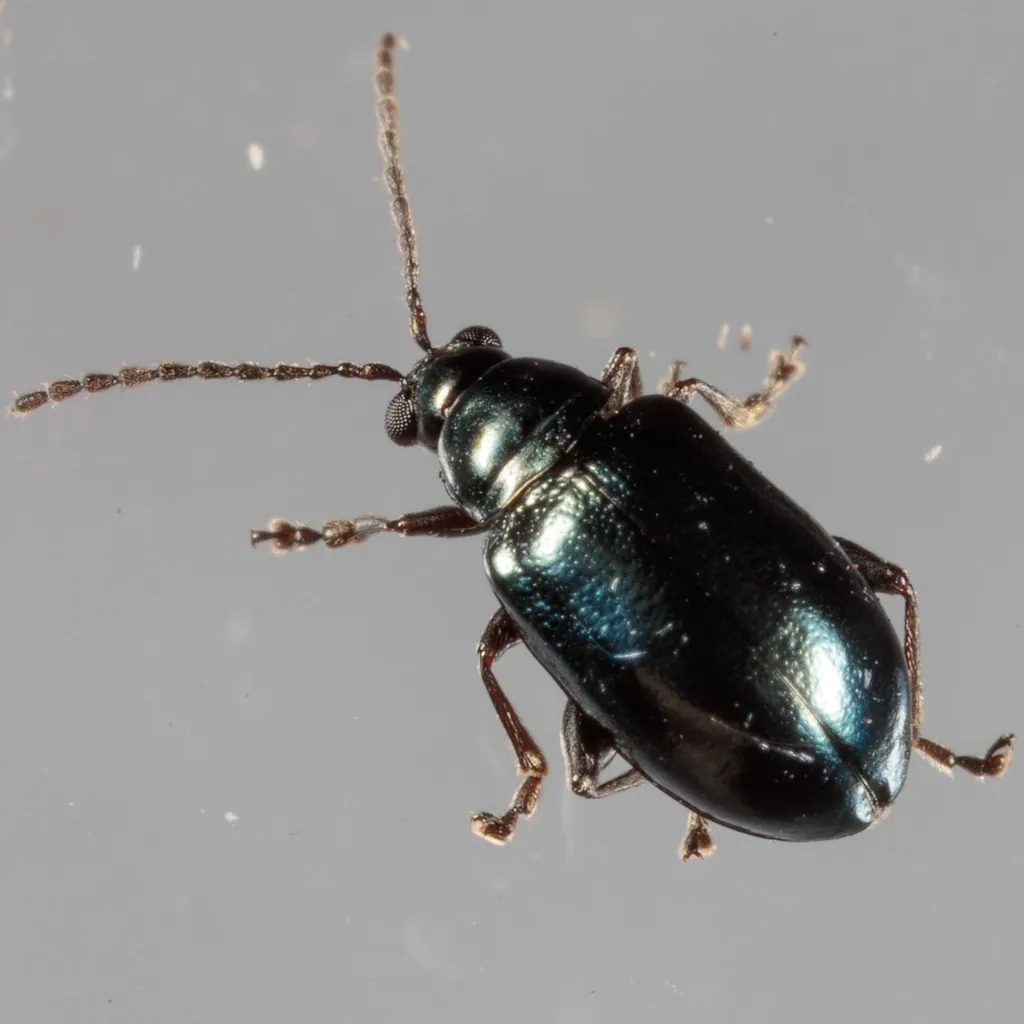
- Adults are small, dark, metallic blue-green beetles that jump like fleas when disturbed. NC State notes it also goes by water primrose, evening primrose and primrose willow flea beetle.[1]
- Damage on crape myrtle is irregular, roundish holes chewed in the leaves; the grubs are never found feeding on crape myrtle.[1]
- Grubs are small, yellowish-green and spotted, and feed on leaves rather than roots. The small, yellowish, oblong eggs are laid in loose groups on the leaf surface.[1]
Where it lives
Adults are important pests of crape myrtles grown in container nurseries in the southern United States. GBIF has only about 150 U.S. records since 1990, too few to map the range; the ones with a state come from Oklahoma and Texas.[3][1][4]
Biology and life cycle
Its normal hosts are Ludwigia (water primrose, rattlebox or water purslane). It also feeds on evening primroses (Oenothera) and gaura, and has been reported from purple loosestrife.[1][3]
Sources group the hosts differently: NC State describes them as the primrose family, while a 2007 study places them in the evening primrose (Onagraceae) and loosestrife (Lythraceae) families; crape myrtle belongs to the loosestrife family.[1][3]
Development speeds up with heat: from egg hatch to adult took 13.3 days at 30°C (86°F) on an evening primrose (Oenothera speciosa) but 64 days at 15°C (59°F) on one gaura cultivar, and eggs hatched in 4.5 to 15.8 days. It developed best on Oenothera.[3]
NC State links heavy infestations on crape myrtle to nearby stands of water primrose, and a 2007 study reports that the problem in container nurseries grew substantially over the preceding decade.[1][3]
Damage and signs
Health risk
It feeds on plants, and no cited source describes any risk to people or pets.[1]
Control
Prevention
Choose resistant crape myrtles. Lagerstroemia indica cultivars were the most damaged in field and lab tests, while all L. fauriei cultivars and most L. indica x fauriei hybrids resisted feeding; NC State also notes the beetle's preference for L. indica.[2][1]
Watch weedy or planted evening primroses in late winter and early spring: beetles or feeding damage there signal a new generation within about 300 to 400 degree-days above roughly 10°C (50°F).[3]
Pesticides
Most insecticides labeled for residential landscapes give adequate control on crape myrtle. Because water primrose grows in or near water, don't use pyrethroids near standing water; they are toxic to fish and other aquatic animals.[1][3]
Where the sources disagree
Host plant family: NC State places its hosts in the primrose family (Primulaceae), while Pettis and Braman place them in the evening primrose (Onagraceae) and loosestrife (Lythraceae) families.[1][3]
Resistant crape myrtles: NC State describes a preference for L. indica over L. fauriei cultivars, while Cabrera et al. found most, but not all, L. indica x fauriei hybrids resistant; the hybrid 'Biloxi' was among the susceptible plants.[1][2]
Control: NC State says most insecticides labeled for residential landscapes should give more than adequate control, while Pettis and Braman say the beetles are easily controlled but the hard part is timing sprays to prevent heavy defoliation.[1][3]
Common questions
- What are the shiny blue-green bugs chewing my crape myrtle leaves?
- Probably crapemyrtle flea beetles, small metallic beetles that jump like fleas; they usually come from water primrose or evening primroses nearby.[1][3]
- Do the larvae damage crape myrtles too?
- No. NC State notes the grubs are never found feeding on crape myrtle; only the adults move onto it.[1]
- Are some crape myrtles resistant?
- Yes. In tests, L. fauriei cultivars and most L. indica x fauriei hybrids resisted feeding, while L. indica cultivars were the most damaged.[2]
Sources
- NC State Extension, “Crapemyrtle Flea Beetle.” content.ces.ncsu.edu/crapemyrtle-flea-beetle (accessed 2026-11-13)
- HortScience (American Society for Horticultural Science), “Cabrera RI, Reinert JA, McKenney CB, et al. (2008), Differential resistance among crape myrtle (Lagerstroemia) species, hybrids, and cultivars to foliar feeding by adult flea beetles (Altica litigata), HortScience 43(2):403-407.” doi.org/10.21273/HORTSCI.43.2.403 (accessed 2026-11-13). Cited from the abstract (Crossref).
- Journal of Entomological Science (Georgia Entomological Society), “Pettis GV, Braman SK (2007), Effect of temperature and host plant on survival and development of Altica litigata Fall, Journal of Entomological Science 42(1):66-73.” doi.org/10.18474/0749-8004-42.1.66 (accessed 2026-11-13). Cited from the abstract (OpenAlex).
- Global Biodiversity Information Facility (GBIF), “Altica litigata (crapemyrtle flea beetle): occurrence records in the U.S., 1990-2026 (GBIF occurrence search).” api.gbif.org/v1/occurrence/search?taxonKey=1047710&country=US&hasGeospatialIssue=false&occurrenceStatus=PRESENT&year=1990%2C2026&facet=stateProvince&facetLimit=400&limit=0 (accessed 2026-11-13). Exact count at access: 147 U.S. records since 1990 (Oklahoma 35; Texas 18; the rest have no state).
- Global Biodiversity Information Facility (GBIF), “Altica litigata Fall, 1910 (GBIF Backbone Taxonomy).” api.gbif.org/v1/species/1047710 (accessed 2026-11-13)