On this page
How to identify it
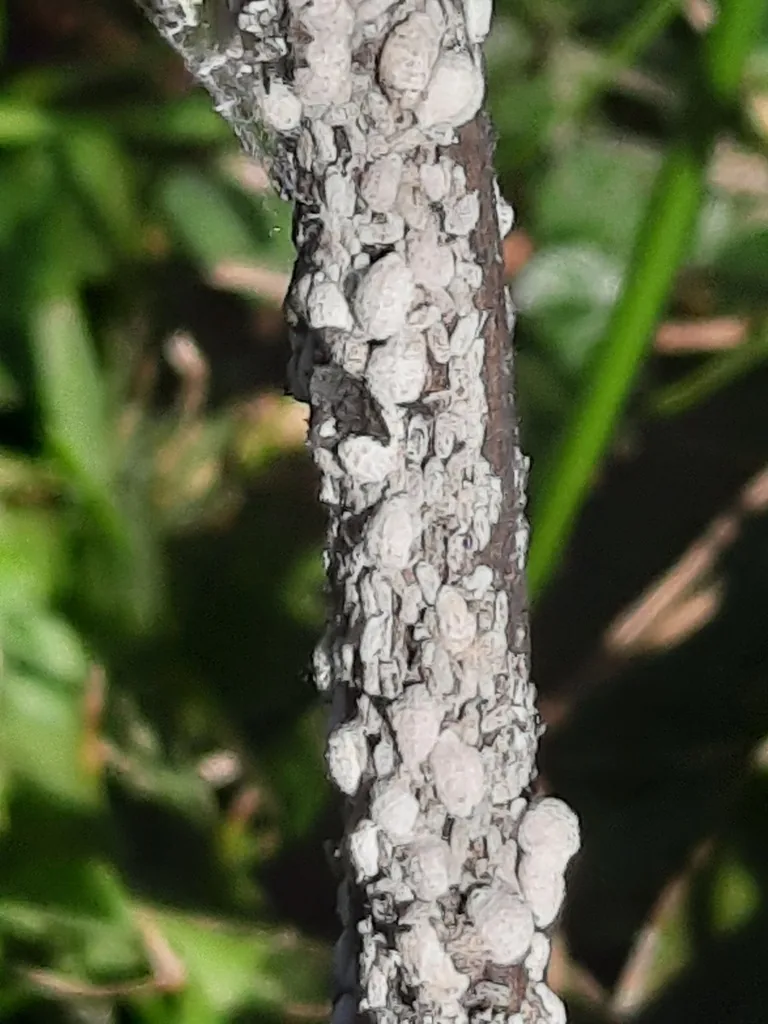
- The female hides under a white egg sac of felted or matted threads, about 1/8 inch long and 1/16 inch thick, mostly in twig crotches and on twigs.[2][4]
- Pull back the white cover and you may see pink to reddish purple eggs; the female beneath is dark red.[2][4]
- Newly hatched crawlers are tiny and pink to purple, and settle on the bark, especially near twig crotches.[2][4][1]
- Infested trees are usually marked by sticky honeydew and black sooty mold on the bark and on plants and surfaces below.[3][4][1]
Look-alikes
| Look-alike | How to tell them apart |
|---|---|
| Other scale insects | It belongs to the family Eriococcidae, and its females hide under white, felted sacs on bark and twigs.[1][2] |
| Azalea bark scale | A close relative in the same group that lives on azaleas.[1] |
| Crapemyrtle aphid | Before the bark scale arrived, the crapemyrtle aphid and the Japanese beetle were the main insect pests of crape myrtle. If sooty mold shows up, check the bark and twig crotches for the scale's white felted sacs.[1][2] |
Where it lives
It was first reported in 2004 at a nursery in Richardson, Texas. By August 2016 it had been reported in Alabama, Arkansas, Georgia, Louisiana, Mississippi, New Mexico, North Carolina, Oklahoma, Tennessee, Texas, Virginia and Washington, and it has since been studied in Delaware. GBIF's roughly 320 U.S. records since 1990 come mostly from Texas, Virginia, North Carolina and Maryland. A cold-tolerance study predicts its spread north will be limited around 43 degrees north latitude.[1][4][5][6]
Biology and life cycle
Each female lays 100 to 300 eggs under her felt cover and then dies. Crawlers move onto the bark, push their long, thread-like mouthparts into it and begin feeding and making honeydew.[4][2]
Males develop inside small white sacs and emerge as tiny pink, winged, gnat-like insects with no mouthparts that live only to mate.[4][1]
Two to four generations a year are thought to occur in the U.S., as in Asia. Timing varies by place: NC State describes eggs in late April hatching in early May, with a second hatch in September, while in Delaware crawlers appeared from late May through early June and again in early August.[1][2][4]
In the U.S. it overwinters as nymphs feeding through the bark.[2][1]
Crape myrtle is the main U.S. host, and NC State says American beautyberry has also been reported. Delaware's host list adds Kalm's St. John's wort, apple, fig, persimmon and pomegranate.[2][4]
Damage and signs
Health risk
It feeds on woody plants, and no cited source describes any risk to people or pets.[2][3]
Control
Prevention
The best control is not bringing it home: work with your nursery or landscaper to make sure any crape myrtles you buy are free of the scale.[3]
Traps and physical control
Brushing infested trunks with a mild dishwashing-soap solution, or washing scales and sooty mold off with high-pressure water, reduces numbers.[1]
Biological control
In Louisiana and Texas, lady beetles prey on the scale, including the twice-stabbed lady beetles Chilocorus cacti and C. stigma; C. cacti eats its eggs and crawlers. Mississippi State notes the scale has few natural enemies here, which helps it build huge populations.[1][3]
Pesticides
Soil-applied systemic insecticides such as imidacloprid, dinotefuran or thiamethoxam are the most effective treatments. Mississippi State says late March through May is the best time, Delaware advises mid-April, and NC State says very early spring for imidacloprid.[3][4][2][1]
Sprays work only on exposed crawlers, not on eggs or females under their sacs. Spray in late spring and late summer when crawlers are out. NC State lists imidacloprid, pyrethroids or summer oil for this, and oil also helps weather away sooty mold; Delaware adds insect growth regulators.[2][4]
No treatment gives complete control, so plan to treat again the next year. Scale numbers have rebounded after systemic treatments at recommended rates, and a 2016 review warns that insecticides such as imidacloprid and cypermethrin can harm pollinators and natural enemies, including the lady beetles that eat the scale.[3][1]
Where the sources disagree
Hatch timing: NC State says eggs laid in late April hatch in early May, with a second hatch in September. Delaware saw crawlers from late May through early June and again in early August, and says the first generation hatches from late May to early July.[2][4]
Generations: a 2016 review says two to four a year, depending on location, while Delaware says it is still studying how many generations occur in the Mid-Atlantic.[1][4]
Systemic timing: Mississippi State says late March through May, Delaware generally mid-April, and NC State very early spring for soil-applied imidacloprid.[3][4][2]
Hosts: NC State lists crape myrtle and American beautyberry in the U.S., and the 2016 review says it had been reported feeding only on those two here, while Delaware's host list adds Kalm's St. John's wort, apple, fig, persimmon and pomegranate.[2][1][4]
Natural enemies: Mississippi State says the scale has few natural enemies here, while the 2016 review reports lady beetles feeding on it in Louisiana and Texas.[3][1]
Scientific name: NC State, Delaware and the 2016 review use Acanthococcus lagerstroemiae, while the GBIF Backbone Taxonomy accepts Eriococcus lagerstroemiae and lists Acanthococcus lagerstroemiae as a synonym.[2][4][1][7][8]
Common questions
- Why is the bark on my crape myrtle turning black?
- Black bark is often sooty mold growing on honeydew from crapemyrtle bark scale; look for white, felted specks on the trunk, twigs and crotches.[3][2][4]
- Will crapemyrtle bark scale kill my tree?
- Usually not. The main harm is unsightly sooty mold and fewer, smaller flowers, though heavy infestations can cause poor growth and branch dieback.[3][4][1]
Sources
- Insects, via PubMed, “Crapemyrtle bark scale: a new threat for crapemyrtles, a popular landscape plant in the U.S. (Wang et al. 2016; full text via PMC).” pubmed.ncbi.nlm.nih.gov/27999262/ (accessed 2026-11-13)
- NC State Extension, “Crapemyrtle Bark Scale (PDIC Factsheet).” content.ces.ncsu.edu/crapemyrtle-bark-scale (accessed 2026-11-13)
- Mississippi State University Extension Service, “Crape Myrtle Bark Scale (Bug's Eye View, Vol. 5, No. 6).” extension.msstate.edu/newsletters/bugs-eye-view/2019/crape-myrtle-bark-scale-vol-5-no-6 (accessed 2026-11-13)
- University of Delaware Cooperative Extension, “Crape Myrtle Bark Scale Insect (March 2025).” www.udel.edu/academics/colleges/canr/cooperative-extension/fact-sheets/crape-myrtle-bark-scale/ (accessed 2026-11-13)
- Global Biodiversity Information Facility (GBIF), “Eriococcus lagerstroemiae (GBIF's accepted name for Acanthococcus lagerstroemiae): U.S. occurrence records since 1990 by state (GBIF occurrence search).” api.gbif.org/v1/occurrence/search?taxonKey=2081737&country=US&hasGeospatialIssue=false&occurrenceStatus=PRESENT&year=1990%2C2026&facet=stateProvince&facetLimit=400&limit=0 (accessed 2026-11-13). Exact count at access: 321 U.S. records since 1990 (Texas 114; Virginia 45; North Carolina 38; Maryland 17; Alabama 16; Georgia 15; Mississippi 13).
- Environmental Entomology, via PubMed, “Thermal tolerance and prediction of northern distribution of the crapemyrtle bark scale (Wang, Chen and Diaz 2019).” pubmed.ncbi.nlm.nih.gov/30859190/ (accessed 2026-11-13)
- Global Biodiversity Information Facility (GBIF), “Eriococcus lagerstroemiae Kuwana, 1907 (GBIF Backbone Taxonomy).” api.gbif.org/v1/species/2081737 (accessed 2026-11-13)
- Global Biodiversity Information Facility (GBIF), “Acanthococcus lagerstroemiae Borchsenius, 1960, synonym (GBIF Backbone Taxonomy).” api.gbif.org/v1/species/2081740 (accessed 2026-11-13)