On this page
How to identify it
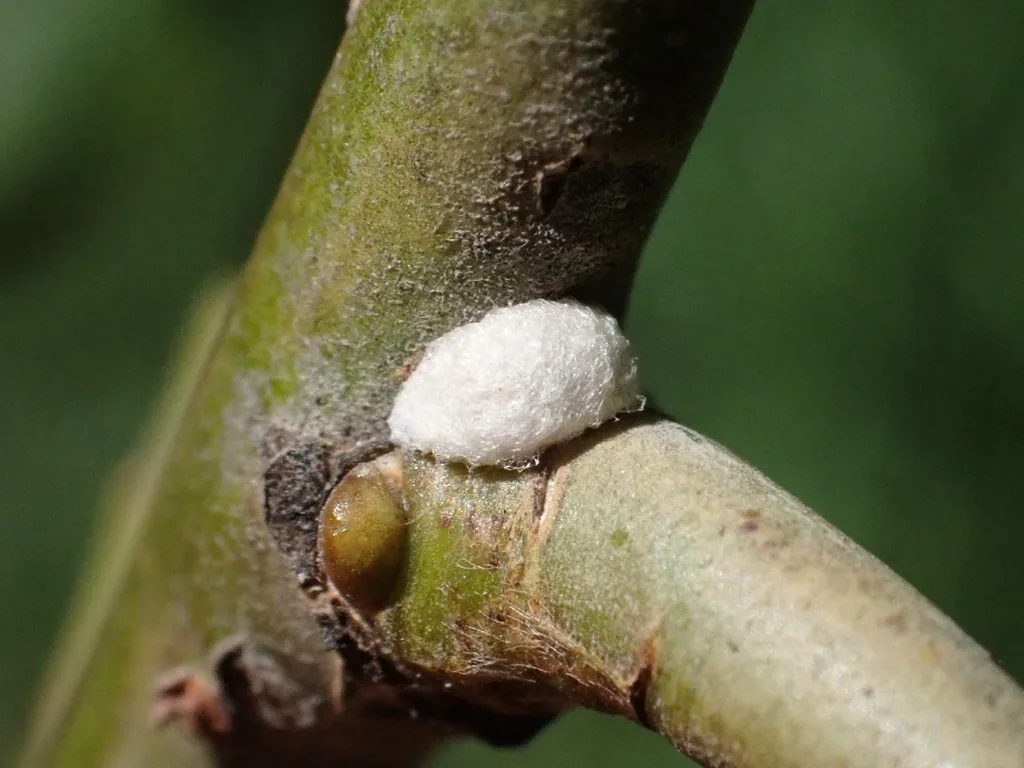
- Mature females look like white cottony or felt-like sacs on twigs and stems, especially in branch forks. PNW says about 0.13 inch long; UMass and Georgia say the female is about 3 mm, and UMass says males are half that size.[1][2][3]
- Under the white covering the insects are red to purple: PNW says eggs, crawlers and adults are red, while UMass and Georgia describe the female as dark or purple-red and Georgia calls the eggs purple and the crawlers red.[1][2][3]
- It is often mistaken for a mealybug; UMass says it looks like one without the waxy strands.[1][2][3]
Look-alikes
Where it lives
The PNW Insect Management Handbook covers it in Pacific Northwest landscapes, UMass in Massachusetts and Connecticut, and University of Georgia Extension calls it a serious threat to azaleas, rhododendrons and Pieris in Georgia.[1][2][3]
Biology and life cycle
Sources differ on how it overwinters: PNW says as adults that lay eggs in spring, while UMass and Georgia say as immature scales, which Georgia says shelter in bark cracks. Red crawlers, the only mobile stage, move over the plant and settle in crevices and branch forks, then form their waxy covering.[1][2][3]
Sources differ on generations and timing: PNW says usually one, possibly two a year; UMass says one in Connecticut with crawlers around late June to mid-July and up to two farther south; Georgia says two in Georgia, with eggs hatching by mid-May and females of the second generation maturing by September.[1][2][3]
Hosts include azalea, rhododendron, andromeda (Pieris), hawthorn, poplar and willow, plus blueberry; Georgia also lists huckleberry.[1][2][3]
Damage and signs
- Feeding causes yellow, dropping leaves and dying branches, and the honeydew grows black sooty mold on bark and leaves. UMass says most infestations are minor; Georgia says it rarely kills a plant unless the infestation is severe and uncontrolled. PNW and Georgia say it favors sickly, stressed plants.[2][3][1]
Health risk
It feeds on plants, and no cited source describes any risk to people or pets.[1][2][3]
Control
Prevention
Inspect twigs in the dormant season, use sticky tape and a 10x lens to spot red crawlers, avoid excess nitrogen, and keep plants well watered and fed so they tolerate attack.[1][3]
Traps and physical control
Scrape scales off with a fingernail or brush, prune out infested branches (Georgia suggests in winter), and wrap double-sided sticky tape near adults to catch crawlers.[1][2][3]
Biological control
Several kinds of beetles and parasitic wasps attack it; UMass names the chalcid Coccophagus immaculatus. Avoid broad-spectrum insecticides that kill them, and check under the covering for live scales before treating.[1][2][3]
Pesticides
Georgia says horticultural or summer oil sprayed after bloom in late spring helps, with thorough coverage and a second spray in the same season if needed; old sacs stay on the bark, so crush them to check: live scales are juicy, dead ones aren't. PNW says crawlers are the stage most susceptible to sprays, and UMass says light infestations may not need chemicals. Follow the label.[3][1][2]
More from UMass Extension
UMass Extension describes the azalea bark scale as looking like a mealybug without waxy strands: adult females are dark purple, about 3 mm long, under a white waxy coat, and males are half that size. Besides azalea and rhododendron it lists Japanese andromeda, hawthorn, poplar and willow as hosts. One generation a year has been seen in Connecticut and up to two farther south; crawlers hatch around late June to mid-July and settle in branch crotches and bark crevices. Most infestations are minor: prune out infested twigs in light cases and spare the chalcid wasp that parasitizes it.[2]
Common questions
- What are the white cottony things in my azalea's branch forks?
- Likely azalea bark scales; the red insects live under the white sacs.[1]
- When are azalea bark scales easiest to control?
- As crawlers, the stage most susceptible to sprays; monitor with sticky tape and a hand lens.[1]
- Is it Acanthococcus azaleae or Eriococcus azaleae?
- Both names are in use. UMass uses Acanthococcus azaleae, while Georgia uses Eriococcus, and GBIF's backbone taxonomy treats Eriococcus azaleae Comstock, 1881 as the accepted name with Acanthococcus azaleae as a synonym.[2][3][4][5]
Sources
- Pacific Northwest Pest Management Handbooks (OSU, WSU, University of Idaho), “Azalea (Rhododendron): Azalea bark scale (Insect Management Handbook).” pnwhandbooks.org/insect/hort/landscape/hosts-pests-landscape-plants/azalea-rhododendron-azalea-bark-scale (accessed 2026-11-13)
- UMass Extension, “Acanthococcus (formerly Eriococcus) azaleae (Azalea Bark Scale).” www.umass.edu/agriculture-food-environment/landscape/publications-resources/insect-mite-guide/acanthococcus-formerly-eriococcus-azaleae (accessed 2026-11-13)
- University of Georgia Cooperative Extension, “Azalea Bark Scale (Circular 1260, full review July 15, 2026).” fieldreport.caes.uga.edu/publications/C1260/azalea-bark-scale (accessed 2026-11-13)
- Global Biodiversity Information Facility (GBIF), “Eriococcus azaleae Comstock, 1881 (GBIF Backbone Taxonomy).” api.gbif.org/v1/species/2082173 (accessed 2026-11-13)
- Global Biodiversity Information Facility (GBIF), “Acanthococcus azaleae Borchsenius, 1949 (GBIF Backbone Taxonomy).” api.gbif.org/v1/species/2082176 (accessed 2026-11-13)