On this page
How to identify it
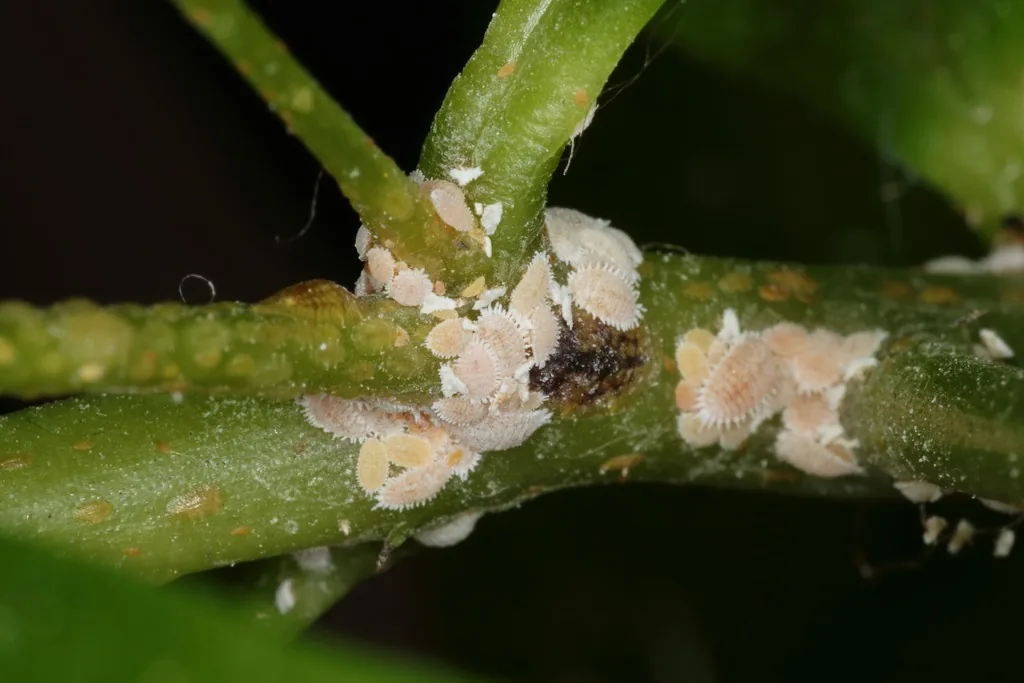
- Adult females are wingless, soft and oval, with segmented bodies covered in white wax; older ones have wax filaments around the edges.[1][2][3]
- The citrus mealybug has short, even wax filaments and may show a faint dark stripe down the back; the longtailed mealybug has two tail filaments as long as or longer than its body. UF/IFAS says adult citrus mealybug females are about 3 mm (0.12 inch) long, white to light brown with brown legs and antennae, with a faint gray stripe down the back and a slightly longer pair of wax filaments at the rear.[1][4][5][6]
- Females lay eggs in white, cottony egg sacs, so infested plants can look like they have bits of cotton stuck to them. UF/IFAS describes citrus mealybug eggs as glossy, light yellow ovals about 0.3 mm long.[1][4][2][6]
- Colonies tuck into protected spots: leaf joints, branch crotches, plant crowns, stems near the soil, growing tips and between touching fruits.[1][2][3]
- Unlike scale insects, most mealybugs keep their legs all their lives and can crawl, though slowly.[2][1][3]
- Adult males are rarely seen; they are tiny two-winged insects with long white tail threads. UF/IFAS says citrus mealybug males carry two long white wax threads, live only one to two days after emerging and cannot feed; only males spin a cottony cocoon and pupate.[1][4][6]
Look-alikes
| Look-alike | How to tell them apart |
|---|---|
| Cottony cushion scale and soft scales | These also make wax and honeydew; check the insect under the wax to confirm a segmented, legged mealybug.[1] |
| Whiteflies | Whitefly nymphs are flat, legless-looking and fixed in place, while mealybug nymphs and adults keep their legs and can crawl.[1][7] |
Where it lives
Mealybugs favor warm weather and thrive where winters are mild and on indoor plants. The citrus mealybug is the most common mealybug on houseplants and indoor ornamentals; outdoors it does not survive North Carolina winters. More than 170 mealybug species occur in California alone. UF/IFAS says the citrus mealybug is native to Asia and occurs through the Americas, Europe and Oceania, with U.S. records from Alabama, Arizona, Arkansas, California, Florida, Hawaii, Kansas, Louisiana, Maryland, Massachusetts, Missouri, New Mexico, Ohio, South Carolina, Tennessee, Texas and Virginia. Called the greenhouse mealybug in Europe, it has been a hard-to-control pest there since 1813 and in the United States since 1879.[1][2][4][6]
Biology and life cycle
Most females lay 100 to 200 or more eggs in cottony egg sacs; citrus mealybug females lay up to 600.[1][4][2]
The longtailed mealybug lays no egg sacs; its eggs hatch almost at once, so the female appears to give birth to live young.[1][5][2]
Newly hatched crawlers are yellow to pink, wax-free and mobile; they soon settle to feed and start producing wax.[1][2]
Females can't fly, so they spread on new plants, pots and tools, crawl between plants whose leaves touch, or are carried by ants, birds or people; tiny nymphs can also be blown by wind. UF/IFAS adds birds' feet, machinery and work crews, and says ants drawn to the honeydew often carry them from tree to tree.[1][4][2][6]
Mealybugs have two to six generations a year, and indoors or in warm climates all stages may be present year-round. NC State says a new citrus mealybug generation takes six to ten weeks.[1][4]
A few species feed on roots. The ground mealybug is the most common one in pots, especially on African violets, and causes yellowing, wilting and stunting.[2][1]
UF/IFAS says a citrus mealybug female lays 300 to 600 eggs in groups of five to 20, an average of 29 a day, and they hatch in six to 10 days or several weeks depending on season. The yellow, red-eyed nymphs take six to 10 weeks to mature; females go through four stages, males three plus a prepupal stage, and adult females live up to 29 days depending on the host plant.[6]
In Florida citrus, UF/IFAS says citrus mealybugs are most common in spring and early summer and peak in June or July, then drop off quickly with the rainy season; in greenhouses they breed year-round.[6]
Damage and signs
- Feeding weakens plants; heavy infestations slow growth and cause leaves to yellow, wilt and drop, and plants can die.[1][2][3]
- Sticky honeydew falls on leaves and fruit below and grows black sooty mold.[1][4][2]
- Some plants react strongly to citrus mealybug saliva, which can cause stunting, wilting, malformation or dieback.[4][2]
- Common houseplant targets include cactus, coleus, dracaena, ferns, ficus, hoya, jade, orchids, palms, philodendron, schefflera, poinsettia, croton and rosemary.[1][2][4]
- On citrus, UF/IFAS says feeding at the fruit button causes fruit drop, oranges develop hard lumps and discolor, and sooty mold on the fruit makes it unmarketable without heavy scrubbing; mealybugs left on harvested fruit keep breeding in storage.[6]
- UF/IFAS says the citrus mealybug has been collected from at least 27 plant families, with grapefruit its favorite citrus; other hosts include amaryllis, begonia, bougainvillea, cactus, canna, croton, cyclamen, dahlia, gardenia, impatiens, daffodil, coleus, tulip, roses, avocado, banana, mango, guava, pineapple and strawberries.[6]
Health risk
Mealybugs feed only on plants; the harm is weakened plants, sticky honeydew, sooty mold and ruined appearance.[1][4]
Control
Prevention
Inspect new plants closely before bringing them home or planting them, and keep new houseplants apart for a week or so if you can. Return or discard any that carry mealybugs.[1][2]
Go easy on nitrogen fertilizer, which spurs the tender, lush growth where mealybugs prefer to feed and lay eggs.[1][2]
UF/IFAS says to avoid growing heavily infested ornamental hosts near citrus and to watch and treat those plants so mealybugs don't spread; cleaning equipment and keeping trees from touching also limit spread.[6]
Traps and physical control
Handpick or prune out small infestations, and check pots and stakes for egg sacs. Dispose of cuttings right away, since mealybugs survive on detached plant parts while they stay moist, and discard badly infested houseplants rather than treating them over and over.[1][2]
On houseplants, dab mealybugs with a cotton swab dipped in rubbing alcohol; UC IPM says use 70% or weaker. Test a small area first, since leaf burn can take a day or two to show, and repeat as new mealybugs appear.[1][4][2][3]
On sturdy plants, a forceful spray of water, warm water for houseplants, dislodges many mealybugs; repeat every few days.[1][2]
Biological control
Outdoors, parasitic wasps, lady beetles such as the mealybug destroyer, lacewings and spiders usually keep mealybugs in check; keep ants away and avoid broad-spectrum sprays. UF/IFAS names the wasps Leptomastidea abnormis, Leptomastix dactylopii and Anagyrus pseudococci, which attack second and third stage nymphs, and the mealybug destroyer Cryptolaemus montrouzieri; summer rains also wash many mealybugs off plants.[1][2][6]
Pesticides
Insecticidal soap, horticultural oil or neem oil sprayed directly on young mealybugs can reduce numbers; egg sacs shield eggs, so plan on two or three weekly treatments.[1][4][2][3]
UC IPM says systemic products with dinotefuran or imidacloprid are less reliable on mealybugs than on other sap feeders and should be avoided on flowering plants to protect pollinators.[1]
UF/IFAS says sprays are often inefficient because mealybugs hide in crevices; on citrus the best timing is before the spring flush, or right after most eggs hatch, before the crawlers can hide.[6]
Where sources disagree
Size: Wisconsin says adult females are about 1/16 inch long; Clemson says 1/8 to 1/4 inch; NC State says longtailed mealybug females are up to 1/8 inch, about 1/4 inch counting the tails; UF/IFAS gives citrus mealybug females as 3 mm (0.12 inch) and males as 4.5 mm (0.18 inch).[2][3][5][6]
Egg laying: NC State says a citrus mealybug female lays 300 to 600 eggs and Wisconsin up to 600; UC IPM says most mealybugs lay over 10 to 20 days, while Wisconsin says 5 to 10 days, after which the female dies.[4][2][1]
Systemic houseplant products: UC IPM calls imidacloprid less reliable on mealybugs than on other sap feeders; Clemson says imidacloprid granules on the soil will control them.[1][3]
Common questions
- What is the white cottony stuff on my houseplant?
- Often mealybugs or their egg sacs. Look in leaf joints, growing tips and along stems for small, oval, wax-covered insects and sticky honeydew.[1][2][4]
- Does rubbing alcohol kill mealybugs?
- Yes, on small houseplant infestations. Dab them with isopropyl alcohol on a cotton swab, UC IPM says 70% or weaker, after testing the plant for leaf burn.[1][4][2]
- Why don't sprays work well on mealybugs?
- Their waxy coating repels most contact insecticides, and they cluster in hidden crevices that sprays can't reach.[1][2][3]
- Can mealybugs live in the soil?
- Yes. Ground mealybugs feed on roots; look for small white cottony masses around the pot's drainage holes or check the root ball. Infested plants are usually best discarded.[2][1]
- Do ants have anything to do with mealybugs?
- Yes. UF/IFAS says ants drawn to the honeydew often carry mealybugs from plant to plant, and in California, keeping Argentine ants off citrus trees with sticky bands or ant baits was recommended because the ants interfere with the mealybugs' natural enemies.[6]
Sources
- University of California Statewide IPM Program, “Mealybugs (Pest Notes, Home and Landscape).” ipm.ucanr.edu/home-and-landscape/mealybugs/ (accessed 2026-11-11)
- University of Wisconsin-Madison Extension (Wisconsin Horticulture), “Mealybugs.” hort.extension.wisc.edu/articles/mealybugs-2/ (accessed 2026-11-11)
- Clemson Cooperative Extension, “Common Houseplant Insects & Related Pests (HGIC).” hgic.clemson.edu/factsheet/common-houseplant-insects-related-pests/ (accessed 2026-11-11)
- NC State Extension, “Citrus Mealybug (PDIC Factsheet, reviewed August 10, 2023).” content.ces.ncsu.edu/citrus-mealybug (accessed 2026-11-11)
- NC State Extension, “Longtailed Mealybug.” content.ces.ncsu.edu/longtailed-mealybug-2 (accessed 2026-11-11)
- University of Florida IFAS Extension (EDIS), “Citrus Mealybug, Planococcus citri (Risso), EENY-537/IN947 (H. Gill, G. Goyal and J. Gillett-Kaufman; Featured Creatures).” ask.ifas.ufl.edu/publication/IN947 (accessed 2026-11-14)
- University of California Statewide IPM Program, “Whiteflies (Pest Notes, Home and Landscape).” ipm.ucanr.edu/home-and-landscape/whiteflies/ (accessed 2026-11-11)
- iNaturalist, “Planococcus citri taxon page (order and family).” www.inaturalist.org/taxa/330251 (accessed 2026-11-11)