On this page
How to identify it
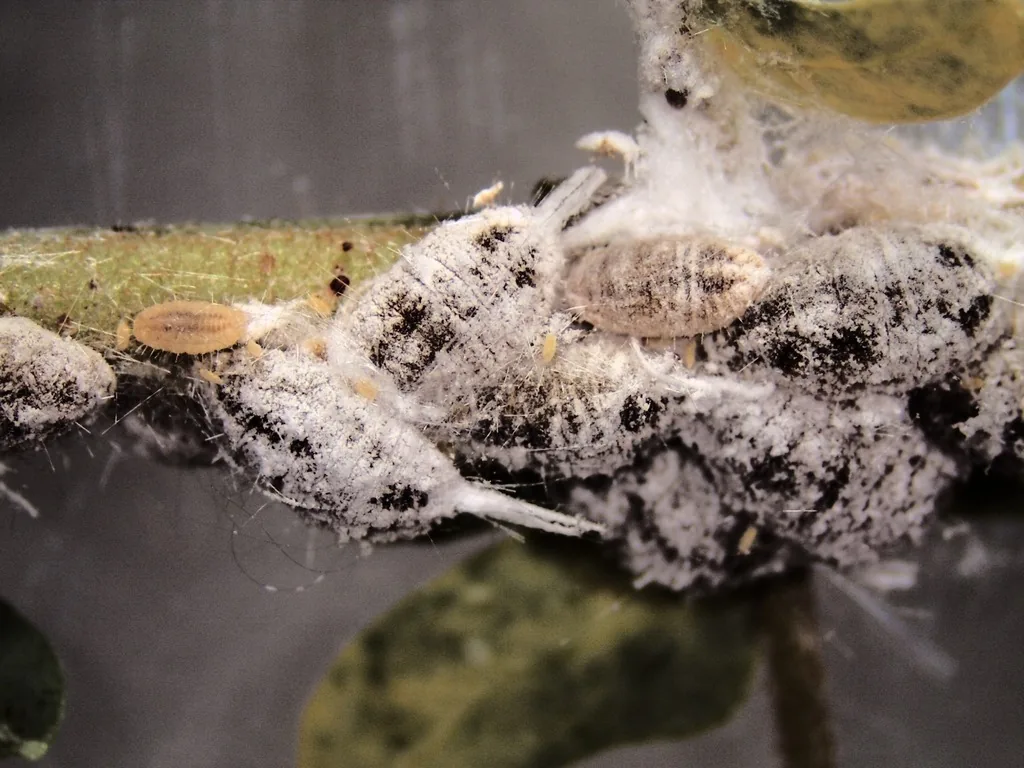
- Adult females are covered with fluffy white wax except for two dark (sometimes purplish) stripes down the back. NC State gives a length of up to 3/16 inch; California's pest rating gives up to 4.5 mm.[1][2][4]
- Slender, clear to glossy white, hair-like wax threads stick out through the fluff, and there are two noticeable white tail filaments.[1][4]
- Males have two wings, long antennae and a pair of long white filaments at the rear. They have no mouthparts and live only three or four days.[1]
Look-alikes
| Look-alike | How to tell them apart |
|---|---|
| Mealybugs | University of Guam Extension says the combination of back stripes and two long wax tails sets it apart from other mealybugs.[4] |
| Other Ferrisia mealybugs | It closely resembles other members of its genus, Ferrisia, and naming the species takes slide-mounted adult females under a microscope. After a 2012 revision of the genus, every California specimen once filed as striped mealybug turned out to be a different Ferrisia species.[2] |
Where it lives
Its native range is not known; it was first described from Jamaica. It is now recorded from Africa, Mexico, Brazil, the Caribbean, much of Asia, Australia and Hawaii, occurs through most of the Pacific region, and a 2026 study counts it as established in over 122 countries. In the U.S., NC State finds it in North Carolina landscapes, while California's pest rating says it is not known to be present there and has been intercepted on fruit from Florida and Hawaii.[2][4][3][1]
Biology and life cycle
NC State says each female lays 64 to 737 eggs over 20 to 29 days on a pad of fluffy filaments beneath her, and the eggs hatch 30 minutes to 4 hours later. In a Brazilian lab study, females produced 277 to 440 young depending on temperature.[1][5]
Female nymphs molt three times and male nymphs four times. University of Guam Extension puts the whole life cycle at about 40 days; in the Brazilian study nymphs developed in 19.1 to 20.5 days at 28°C.[1][4][5]
Only mated females produced young in the Brazilian study, and California's rating notes it is not reported to reproduce without mating.[5][2]
They don't walk far, so large clusters build up around shoot tips and leaves. Young crawlers can be carried by wind, and infested plants and fruit move them longer distances.[4][1][2]
They go down to the soil and roots: NC State says females crawl into the soil beneath the plant in cold weather, and Guam Extension says they move onto roots in dry weather.[1][4]
Ants often tend them and keep parasites and lady beetles away from the colony.[4]
Damage and signs
- NC State lists hosts in over 203 plant genera in 77 families; a 2026 study gives more than 234 genera in 83 families. In North Carolina it is seen mostly on landscape azaleas and yaupon holly. Other hosts include citrus, coffee, gardenia, cotton, hibiscus, pomegranate, cacti, sweet potato, cassava, cacao and guava, and it is common on tomato and eggplant, especially water-stressed plants.[1][3][2][4]
- Heavy infestations cause yellowing, wilting, dieback and early leaf drop, and the honeydew they excrete grows sooty mold that can cut photosynthesis. On eggplant they get under the calyx and scar the fruit.[1][2][4]
Health risk
It feeds only on plants; none of these sources describe any risk to people or pets.[1][2]
Control
Prevention
Keep plants healthy and avoid water stress, and don't keep vegetable plants in the ground long past their peak.[4]
Biological control
Parasitic wasps, lady beetles and other predators attack striped mealybugs, and on tree crops parasites usually bring an infestation under control eventually. At times, though, the mealybugs are overlooked by natural enemies and still harm their host plants.[1][4]
Pesticides
Most insecticides labeled for home landscapes work on striped mealybugs, but two or three applications may be needed because they retreat into the soil in winter. For vegetable crops, ask your county extension office before spraying.[1][4]
Common questions
- What are the white bugs with two stripes on my azalea?
- If they are covered in white wax with two dark stripes down the back, glassy threads and two white tails, they are most likely striped mealybugs, which NC State sees mostly on azaleas and yaupon holly.[1][4]
- Is the striped mealybug in California?
- Not as far as CDFA knows. Specimens once identified as striped mealybug in California were found to be other Ferrisia species, and in 2020 the state proposed rating it an A pest.[2]
Sources
- NC State Extension, “Striped Mealybug (PDIC Factsheet).” content.ces.ncsu.edu/striped-mealybug (accessed 2026-11-11)
- California Department of Food and Agriculture, “California Pest Rating Proposal: Ferrisia virgata (Cockerell), striped mealybug (2020).” blogs.cdfa.ca.gov/Section3162/wp-content/uploads/2020/07/Ferrisia-virgata-1.pdf (accessed 2026-11-11)
- Neotropical Entomology, via PubMed, “Potential Distribution of Invasive Insect Ferrisia virgata Under Climate Change with Implications for Management (Yang et al. 2026).” pubmed.ncbi.nlm.nih.gov/42530738/ (accessed 2026-11-11)
- University of Guam Cooperative Extension (ADAP), “Striped Mealybug (Ferrisia virgata), Agricultural Pests of the Pacific ADAP 2000-18.” uog.edu/_resources/files/extension/pest-management/2000-18-adap-striped-mealybug.pdf (accessed 2026-11-11)
- Neotropical Entomology, via PubMed, “Performance of the Striped Mealybug Ferrisia virgata under Variable Conditions of Temperature and Mating (Oliveira et al. 2014).” pubmed.ncbi.nlm.nih.gov/27193398/ (accessed 2026-11-11)
- iNaturalist, “Ferrisia virgata taxon page (order and family).” www.inaturalist.org/taxa/330242 (accessed 2026-10-06)