On this page
How to identify it
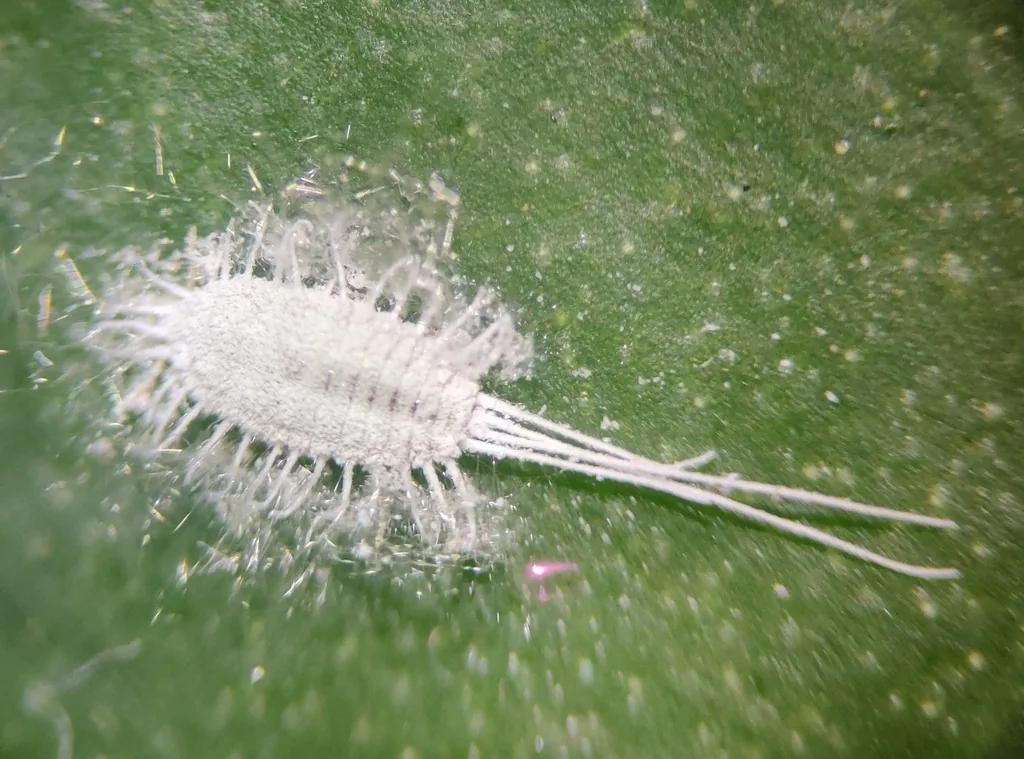
- Adult females are up to 1/8 inch long, yellowish to grayish under white wax, with 17 pairs of wax filaments around the edge; counting the tails, the whole insect may reach about 1/4 inch. The tails can break off. UF/IFAS notes the two long filaments protrude from the last abdominal segment and help distinguish it from other mealybugs feeding on the same plants.[1][4]
- The long rear filaments are the giveaway. UC IPM's mealybug key lists it as the species with two tail filaments longer than the body, and in grapes, where it and the grape and obscure mealybugs are all about 0.2 inch long, it is told apart by its much longer tails.[2][3][1]
- You won't find cottony egg masses. The eggs hatch almost immediately, so females seem to give birth to live young on a shallow pad of white wax. Nymphs look like small females with shorter filaments.[1][5][2]
- Males are rarely seen: the nymphs pupate in a fluffy wax cocoon and the adults are tiny two-winged insects. UF/IFAS says adult males are more slender, darker and winged, and are collected less often than females because they do not feed on the host plant.[1][5][2][4]
- Indoors it often hides in leaf whorls, so check where leaves meet the stem.[5]
Look-alikes
| Look-alike | How to tell them apart |
|---|---|
| Other mealybugs | The citrus mealybug, the commonest species on houseplant foliage, has short filaments of equal length and lays eggs in cottony masses, while the longtailed mealybug has long tails and no egg masses.[5][2] |
| Obscure mealybug | Shares grapevines with the longtailed mealybug but has shorter tail filaments and lays eggs in an egg sac.[3] |
Where it lives
A research team in Spain describes it as a cosmopolitan pest native to Australia that feeds on many crops. In the United States it is best known as a pest of houseplants and greenhouse plants, and in California it also damages vineyards on the Central Coast and occurs in the Coachella Valley. UF/IFAS says it is found on every continent except Antarctica, as a common greenhouse pest around the world and outdoors in warm climates.[6][1][3][2][4]
Biology and life cycle
Females pass through three instars and stay able to crawl all their lives; they are wingless, so infestations usually arrive on infested plants. Male nymphs settle and spin a white wax cocoon. UF/IFAS says males pass through four instars and feed only in the first two; the third, sometimes called the prepupal stage, lacks mouthparts. Female nymphs feed throughout, and their long tails have developed by the third instar.[5][1][2][4]
It needs to mate. Lab work in Chile found that longtailed mealybug females did not reproduce without males, and males court only their own species.[7]
Indoors and in mild climates all stages are present year round. In California vineyards it does not go dormant in winter and has several overlapping generations.[2][3]
Pheromone traps for the males are used to monitor it, though a Spanish population did not respond to the standard lure and turned out to use a different sex pheromone.[6][7]
Damage and signs
- It has been found on at least 26 plant families. Dracaena appears to be the favored host, but most flowering and foliage plants are susceptible, and orchids, ficus, palms and many other houseplants are common mealybug hosts. UF/IFAS lists avocado, citrus, grapes, pear, persimmon and pineapple among its crop hosts, plus tropical and subtropical ornamentals such as cycads and orchids, and says plants kept in homes or greenhouses seem especially at risk because temperature and humidity stay stable there.[1][2][8][4]
- Feeding on sap, it excretes sticky honeydew that grows black sooty mold, and the wax, cocoons and mealybugs disfigure plants. NC State notes that some very sensitive plants may wilt and die under heavy feeding. UF/IFAS adds that sooty mold can reduce the plant's ability to photosynthesize, and that colonies have been seen tended by white-footed ants.[1][2][4]
- In vineyards it contaminates grape clusters and can spread grapevine leafroll viruses. UF/IFAS calls it an efficient vector of grapevine leafroll-associated virus 3, a major cause of grapevine leafroll disease.[3][9][4]
Health risk
It feeds on plants; none of the sources describes any risk to people. UF/IFAS likewise describes only plant damage.[1][2][4]
Control
Prevention
Inspect new plants before bringing them home or into a greenhouse, since mealybugs mostly arrive on plants, pots and tools. Throw out old plants that keep reinfesting new ones.[2][1]
If a houseplant stays badly infested, UC IPM suggests discarding it rather than spraying again and again.[2]
Traps and physical control
For a few mealybugs on a houseplant, dab them with a cotton swab dipped in rubbing alcohol (UC IPM says 70% or less, tested on a leaf first), then wash the plant with mild soapy water. Watch it closely for several weeks.[1][2]
Biological control
A small parasitic wasp, Anagyrus nigricornis, and brown lacewings attack longtailed mealybugs. Outdoors, keep ants away from infested plants, because ants protect mealybugs from their enemies. UF/IFAS notes that generalist predators such as lady beetles and lacewings eat mealybugs but may not give effective control, while two parasitic wasps together keep it below damaging levels on avocado in southern California.[1][2][4]
Pesticides
Aim sprays at young crawlers, which have little wax; insecticidal soap, horticultural oil or neem gives some suppression. Re-treat two or more times at weekly intervals to catch what the first spray missed. UF/IFAS adds that crawlers are also the most mobile stage, that most contact sprays need excellent coverage, and that insect growth regulators can be used but often take longer to kill mealybugs.[2][1][4]
Where sources disagree
Live birth: NC State says the eggs hatch almost as soon as they are laid, so the young only appear to be born alive, and UF/IFAS agrees, saying there is no visible egg stage and that live birth is a mistaken conclusion; UC IPM says the eggs stay inside the female until they hatch and Wisconsin says it produces live young like an aphid.[1][4][2][5]
Mating: UC IPM notes that many mealybug species can reproduce without mating, but a 2023 study found longtailed mealybug females could not.[2][7]
Ease of control: NC State calls it sometimes difficult to control even without a protective egg mass, and UC IPM says home insecticides are not very effective on mealybugs in general because the wax repels them.[1][2]
Common questions
- What are the white fuzzy bugs with tails on my houseplant?
- Probably longtailed mealybugs, named for wax tails as long as their bodies. Look in leaf whorls and where leaves meet the stem.[1][5]
- When are they easiest to kill?
- As young crawlers, before they build up their wax coating; plan to repeat a soap, oil or alcohol treatment weekly for a few weeks.[2][1]
- Why can't I find any eggs?
- This species doesn't leave cottony egg masses. Its eggs hatch almost at once, so new nymphs appear around the female on a thin pad of wax.[1][2]
- Can longtailed mealybugs spread plant viruses?
- Yes, in grapes. UF/IFAS calls it an efficient vector of grapevine leafroll-associated virus 3, a major cause of grapevine leafroll disease, which reduces grape yield and quality.[4]
Sources
- NC State Extension, “Longtailed Mealybug.” content.ces.ncsu.edu/longtailed-mealybug-2 (accessed 2026-11-11)
- University of California Statewide IPM Program, “Pest Notes: Mealybugs.” ipm.ucanr.edu/home-and-landscape/mealybugs/ (accessed 2026-11-11)
- University of California Statewide IPM Program, “Mealybugs (Pseudococcus), Grape Pest Management Guidelines.” ipm.ucanr.edu/agriculture/grape/mealybugs-pseudococcus/ (accessed 2026-11-11)
- University of Florida IFAS Extension (EDIS), “Longtailed Mealybug, Pseudococcus longispinus (Targioni Tozzetti), EENY-666/IN1149 (J. Gillett-Kaufman and M. Byron; Featured Creatures).” ask.ifas.ufl.edu/publication/IN1149 (accessed 2026-11-14)
- University of Wisconsin-Madison Division of Extension, Wisconsin Horticulture, “Mealybugs.” hort.extension.wisc.edu/articles/mealybugs-2/ (accessed 2026-11-11)
- Journal of Agricultural and Food Chemistry, via PubMed, “Vacas, Navarro Fuertes, Garcia-Garcia and others (2024), New monoterpenoid as the sex pheromone of Spanish populations of the longtailed mealybug Pseudococcus longispinus.” pubmed.ncbi.nlm.nih.gov/38769753/ (accessed 2026-11-11)
- Journal of Insect Science, via PubMed, “Ballesteros, Chorbadjian and Zaviezo (2023), Mating behavior of Pseudococcus calceolariae and Pseudococcus longispinus: are asexual reproduction and hybridization possible?.” pubmed.ncbi.nlm.nih.gov/37565770/ (accessed 2026-11-11)
- Bulletin of Entomological Research, via PubMed, “Kot, Kmiec, Gorska-Drabik and others (2015), The effect of mealybug Pseudococcus longispinus infestation of different density on physiological responses of Phalaenopsis.” pubmed.ncbi.nlm.nih.gov/25827410/ (accessed 2026-11-11)
- Phytopathology, via PubMed, “Tsai, Rowhani, Golino, Daane and Almeida (2010), Mealybug transmission of Grapevine leafroll viruses: an analysis of virus-vector specificity.” pubmed.ncbi.nlm.nih.gov/20626287/ (accessed 2026-11-11)
- iNaturalist, “Pseudococcus longispinus taxon page (order and family).” www.inaturalist.org/taxa/84805 (accessed 2026-10-06)