On this page
How to identify it
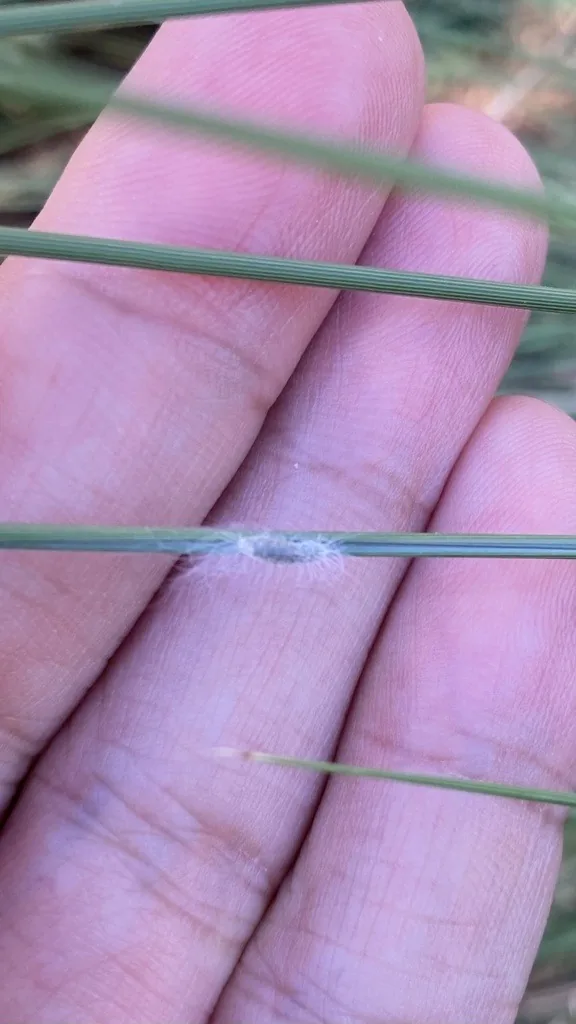
- Adult females are about 1/8 inch long, with a slender, grayish, elongate-oval body under short, dense white wax.[1][2][3]
- Nymphs and adults also carry many long, thin white wax filaments, some up to twice the body length, which give them a hairy look like a loose cotton swab.[1][2][3]
- Eggs are laid in elongated, white, felt-like egg sacs (ovisacs) along the leaves.[1][2][3]
Where it lives
Native to Florida. It was first reported outside that state in South Carolina in 2018, reached North Carolina by 2022, and was confirmed by the USDA in College Station, Texas, in 2024 as a new state record. GBIF holds only 14 U.S. records since 1990: Florida 9, Texas 3 and South Carolina 2.[1][2][3][5]
Biology and life cycle
Females have no wings. They move short distances by crawling or are carried by ants, and long-distance spread probably happens when infested plants are moved.[2][1][3]
Each adult female lays hundreds of eggs. The crawlers that hatch walk to other leaves and nearby plants, settle, and suck sap with almost microscopic, hair-like mouthparts, molting several times before they become adults.[1][2][3]
In South Carolina, infestations become noticeable from late May to June and stay active until late fall; Texas A&M says infestations are usually apparent by mid-summer to late fall. Clemson says they probably spend the winter in the plant crown or roots, though that has not been confirmed.[1][3]
Males have not been described. NC State considers it likely that they exist, as in other mealybugs, where males are tiny two-winged adults without mouthparts that die soon after seeking out females.[2][3]
Known hosts are muhly grass and perhaps fakahatchee grass, and the genus is described as specific to grasses. Muhly grass is native to the coastal plain from Connecticut to Texas.[2][1][3]
A fun fact: one of the first records of this mealybug is a collection made in 1956, and its name acircula refers to its lack of a circulus, a small adhesive organ.[3]
Damage and signs
Health risk
It feeds on muhly grass sap, and no cited source describes any risk to people or pets.[1][2][3]
Control
Prevention
Inspect new muhly grass plants for mealybugs before buying or planting them. Texas A&M adds that mealybugs can live in the roots and crown as well as on the leaves.[1][2][3]
Texas A&M suggests scouting from spring, when new growth starts, through fall, and checking weekly after treatment; it says winter temperatures should kill existing above-ground populations.[3]
Sanitation
At the first sign of mealybugs, remove infested foliage; bag the clippings and take them off the property unless you compost hot enough to kill the insects. Plants that are heavily infested and declining are best removed and destroyed, which NC State calls drastic but effective.[3][2][1]
Pesticides
For light infestations, a horticultural oil spray or a systemic insecticide may help. NC State notes that oil may need two applications about 14 days apart, because the felt-like covering over the egg sacs can protect the eggs, and that one treatment with the systemic imidacloprid should give acceptable suppression for a whole growing season. Follow all label instructions.[1][2]
Texas A&M says horticultural oil can be used in cooler times of year but not when temperatures reach about 85 degrees Fahrenheit, as it can damage plants. It lists insecticidal soap, azadirachtin, pyrethrins and the systemic imidacloprid among possible active ingredients, and advises protecting pollinators and following the label.[3]
After a granular systemic treatment the dead mealybugs' fluffy wax stays visible for weeks, while sprays at least mat the fluff down.[2]
Where the sources disagree
Body shape: Clemson says the mealybugs are roughly twice as long as wide, while NC State says the body is relatively slender, 2½ times as long as wide.[1][2]
When it shows up: Clemson says South Carolina infestations become noticeable from late May to June, while Texas A&M says infestations are usually apparent by mid-summer to late fall.[1][3]
Winter: Clemson says the mealybugs probably overwinter in the plant crown or roots, though this has not been confirmed, while Texas A&M says winter temperatures should kill existing above-ground populations.[1][3]
Follow-up after treatment: NC State says a single imidacloprid treatment should give acceptable suppression for a whole growing season and oil may take two applications about 14 days apart, while Texas A&M advises monitoring weekly after treatment and treating again if new mealybugs appear, and avoiding oil once temperatures reach about 85 degrees Fahrenheit.[2][3]
Common questions
- What does a muhlygrass mealybug infestation look like?
- Infested grass carries white, hairy-looking insects about 1/8 inch long and white, felt-like egg sacs along the leaves. Heavy infestations make the plants look unattractive and off-color.[1][2]
- Can I save an infested muhly grass?
- Light infestations may respond to horticultural oil or a systemic insecticide. Plants that are heavily infested and already declining are best removed and destroyed.[1][2]
- How did it reach the Carolinas?
- It is native to Florida, where the state agriculture department lists it as a native mealybug that may be present on muhly grass. NC State suggests warming summers may be letting it move north, or that it arrived on infested nursery stock, and Texas A&M presumes it spreads through the nursery trade.[4][2][1][3]
Sources
- Clemson Cooperative Extension, Home & Garden Information Center, “Muhly Grass Mealybug (C. Tanner).” hgic.clemson.edu/muhlygrass-mealybug/ (accessed 2026-11-13)
- NC State Extension, “Muhlygrass Mealybug, PDIC Factsheet (J. Baker, 2022).” content.ces.ncsu.edu/muhly-grass-mealybug (accessed 2026-11-13)
- Texas A&M AgriLife Extension, “Muhlygrass Mealybug (HORT-PU-296).” mytexas.ag.tamu.edu/publications/muhlygrass-mealybug/ (accessed 2026-11-13)
- Florida Department of Agriculture and Consumer Services, Division of Plant Industry, “What's in your Backyard? Protecting Florida's Native Plants.” fdacsdpi.wordpress.com/2020/10/30/whats-in-your-backyard-protecting-floridas-native-plants/ (accessed 2026-11-13)
- Global Biodiversity Information Facility (GBIF), “Stemmatomerinx acircula: U.S. occurrence records since 1990 by state (GBIF occurrence search).” api.gbif.org/v1/occurrence/search?taxonKey=2094955&country=US&hasGeospatialIssue=false&occurrenceStatus=PRESENT&year=1990%2C2026&facet=stateProvince&facetLimit=400&limit=0 (accessed 2026-11-13). Fetched 2026-11-13: 14 U.S. records since 1990; Florida 9, Texas 3, South Carolina 2.
- Global Biodiversity Information Facility (GBIF), “Stemmatomerinx acircula Howell & Miller, 1976 (GBIF Backbone Taxonomy).” api.gbif.org/v1/species/2094955 (accessed 2026-11-13)