On this page
How to identify it
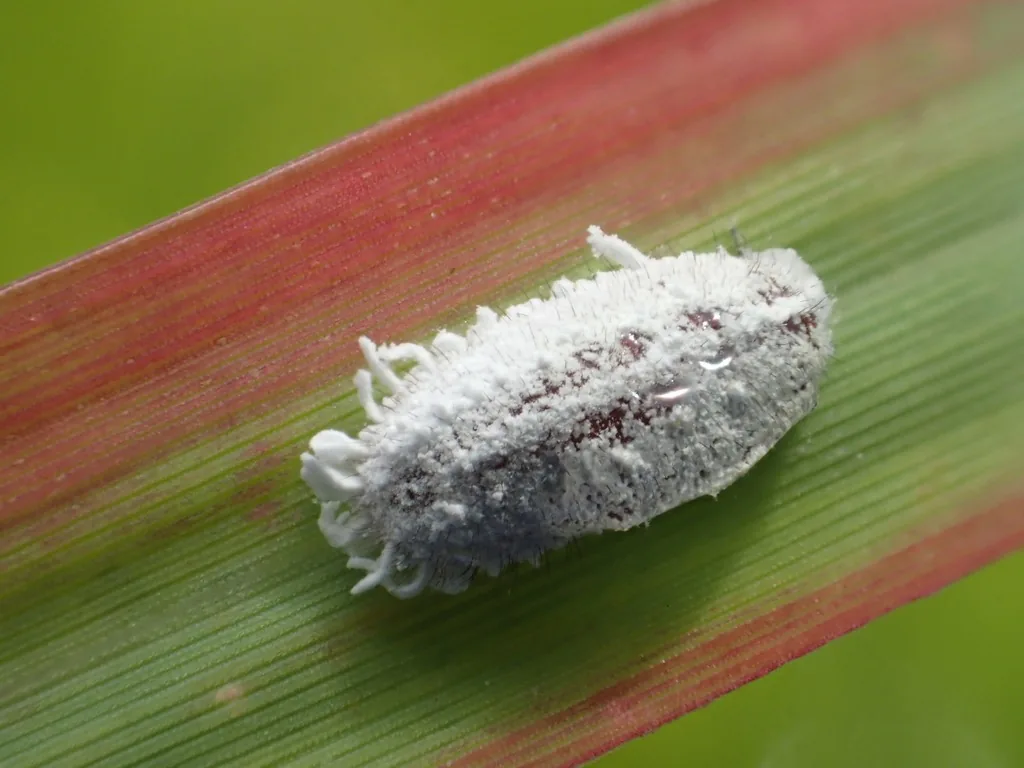
- Adult females are wingless, 3/32 to 3/16 inch (3 to 5 mm) long, with a flat pinkish body under a woolly white wax coat. NC State counts 17 pairs of waxy filaments around the edge of the body, the rear pair the longest; the Connecticut station describes a pair of long waxy tail filaments.[1][2]
- Eggs are tiny (about 1/100 inch), bright orange and laid in dense, cottony white masses: NC State says the summer generation lays them on twigs, pruning cuts and the calyx ends of fruit, and the autumn generation in bark crevices.[1]
- Crawlers look like small females with less wax and no long filaments; males are tiny, gnat-like and rarely seen.[1]
Where it lives
Native to China and Japan, it now occurs through most of the world on pome fruits and is the most common mealybug pest in eastern North America, including Connecticut orchards. In Europe it has been an invasive pest in northern Italy and southern France since the start of this century, where it also infests grapevines, and pheromone traps along highways found it outdoors in Hungary in 2020 to 2021, the northernmost outdoor record in Europe.[1][2][4][5][6]
Biology and life cycle
There are two generations a year, and sources time them a little differently. The Connecticut station says overwintered eggs hatch in late May or early June and the nymphs mature in 4 to 6 weeks; NC State says eggs hatch in late spring and the nymphs finish developing around early July, after which the adults lay eggs that hatch in about 11 days.[2][1]
The second generation matures in early fall (September or October, per the Connecticut station) and lays the eggs that spend the winter. The Connecticut station says the eggs overwinter; NC State says that in some cases adults overwinter as well.[2][1]
Damage and signs
- Heavy infestations reduce tree vigor, according to the Connecticut station. NC State says fruit damage comes from mealybugs in the calyx, whose honeydew grows black sooty mold on the fruit surface; mealybugs in the calyx are also a contamination problem in processed fruit.[2][1]
- Italian researchers describe it as a primary orchard pest in northern and northwestern China.[5]
Health risk
It feeds on plant sap, and no cited source describes any risk to people or pets.[1][2]
Control
Prevention
Both sources say Comstock mealybugs usually don't cause enough damage to need control. To monitor, NC State suggests peeling loose bark in the dormant season to look for eggs and crawlers, wrapping sticky tape on limbs during the growing season to catch crawlers, and checking fruit calyxes at regular intervals.[2][1]
Biological control
Parasitic wasps have been used against it: French researchers note biological control programs succeeded in central Asia and North America in the second half of the 20th century, and selected the parasitoids Allotropa burrelli and Acerophagus malinus as candidates for France. In Italian laboratory tests the parasitoid Anagyrus vladimiri, already used against vine mealybug, parasitized about half of the Comstock mealybugs offered to it.[4][5]
Pesticides
If treatment is needed, NC State says early-season insecticide sprays are effective against eggs and crawlers, but once adults are inside the fruit calyx they are nearly impossible to remove. Follow the label of any product used.[1]
Common questions
- What are the cottony white tufts in the bark crevices of my apple tree?
- They may be Comstock mealybug egg masses, which hold tiny orange eggs under white wax.[1]
- Why is my catalpa or mulberry sticky and black?
- Comstock mealybugs feed on catalpa and mulberry, and their honeydew grows black sooty mold.[1]
Sources
- NC State Extension, “Comstock Mealybug.” content.ces.ncsu.edu/comstock-mealybug-1 (accessed 2026-11-13)
- Connecticut Agricultural Experiment Station, “Plant Pest Handbook: Apple (Malus).” portal.ct.gov/caes/plant-pest-handbook/ppha/apple-malus (accessed 2026-11-13)
- Global Biodiversity Information Facility (GBIF), “Pseudococcus comstocki (Kuwana, 1902) (GBIF Backbone Taxonomy).” api.gbif.org/v1/species/2092925 (accessed 2026-11-13)
- PLoS One (via PubMed), “Investigating biological control agents for controlling invasive populations of the mealybug Pseudococcus comstocki in France (Malausa et al., 2016) (abstract).” pubmed.ncbi.nlm.nih.gov/27362639/ (accessed 2026-11-13)
- Insects (via PubMed), “Old parasitoids for new mealybugs: host location behavior and parasitization efficacy of Anagyrus vladimiri on Pseudococcus comstocki (Ricciardi et al., 2021) (abstract).” pubmed.ncbi.nlm.nih.gov/33803668/ (accessed 2026-11-13)
- Biodiversity Data Journal (via PubMed), “Integrative method to detect invasive mealybug species on highways in Hungary: evidence for northward spread of Comstock mealybug (Szita et al., 2025) (abstract).” pubmed.ncbi.nlm.nih.gov/40979751/ (accessed 2026-11-13)