On this page
How to identify it
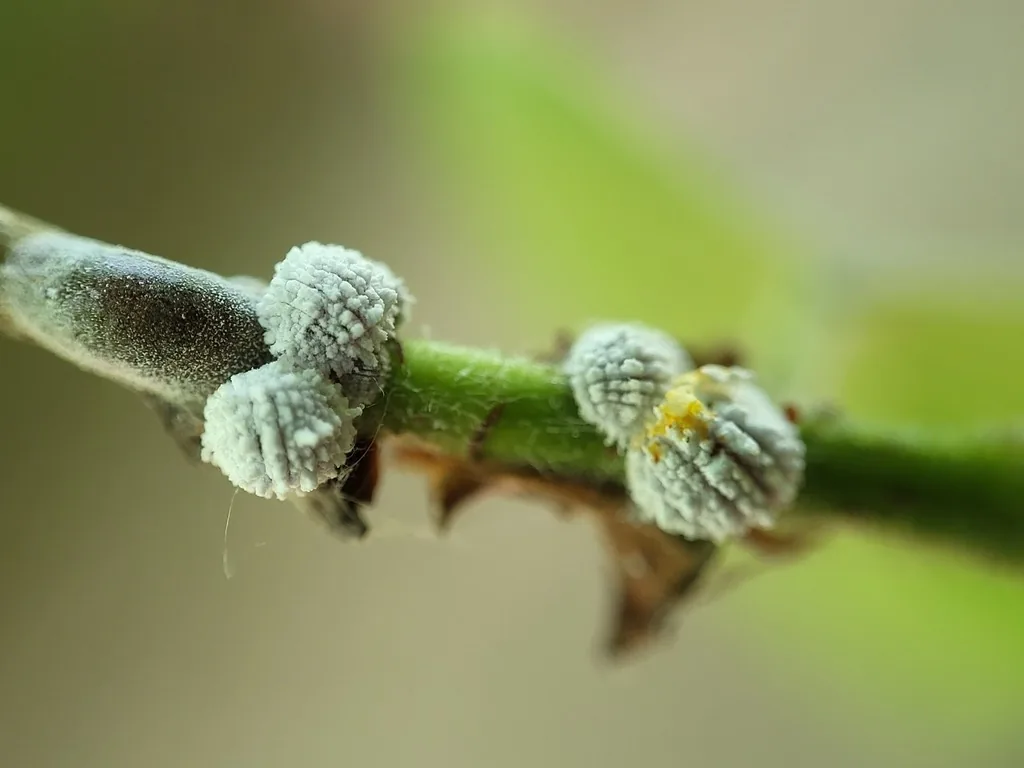
- Adult females are about 1/8 inch long, with round, red bodies covered in white wax; South Dakota State describes them as small, fuzzy, white insects on hawthorn twigs. Males are small, gnat-like and winged and are seen in spring.[2][1][3][4]
- The young (crawlers) are red or brown, smaller and more elongated than adult females, and feed on the leaves in early summer.[2][1]
- In winter look on the trunk: the overwintering nymphs sit in bark crevices and produce a little mealy secretion that gives infested bark a speckled look.[1][2]
- Infested trees often show conspicuous sticky honeydew and black sooty mold.[2][1]
Where it lives
It is widely distributed through the U.S. Midwest, the North Atlantic states and some western states, and South Dakota State has reported it on hawthorns in South Dakota. Colorado State describes it as introduced in Colorado, where it has become an important pest as hawthorns have been planted more widely, but has not seen it in native hawthorn stands. GBIF holds 52 U.S. records since 1990, most from New York (33) and Colorado (7).[1][3][2][4][5]
Biology and life cycle
It feeds only on plants in the rose family. Hawthorn is its most common host, and as of the 2000 study it had been reported only from hawthorn in Colorado; other recorded hosts include mountain ash, serviceberry or juneberry (Amelanchier), cotoneaster, quince and certain Prunus. Serious injury has been linked only to certain hawthorns.[1][2][4][3]
Late-stage nymphs overwinter in bark crevices, mostly on the trunk. In Fort Collins in 1998 they became active around bud swell in late March, then migrated to feeding sites at the bases of buds and in twig crotches from mid-April, with the peak in early May. Winged males appeared on the trunk in early April, and mating went on over the following month.[1][2]
Females mature in late May or early June and swell with hundreds of maturing eggs; in the Colorado study they averaged 180 maturing eggs at the peak, around June 10. The eggs hatch inside the mother, and crawlers appear from late May, and some keep appearing into October.[2][1][4]
Crawlers feed on the leaves, then move to sheltered spots on the twigs for much of the summer. In fall the late-stage nymphs return to the trunk and larger branches to overwinter. Wet, cool weather delays the spread of the crawlers.[2][1]
The 2000 study found one generation a year in Colorado. Colorado State notes that egg-laying females and hatching have been seen in late September, which suggests either a second generation or a long egg-laying period.[1][2]
In late summer large numbers often move back onto the leaves, where they bunch up in leaf folds, before heading to the trunk to overwinter in September and October.[4]
Damage and signs
- The mealybugs suck sap from twigs and small branches and produce large amounts of honeydew, which grows black sooty mold and makes trees unsightly.[2][1]
- Heavy infestations can cause severe leaf loss, twig dieback and weakened trees, and sometimes kill trees, although Colorado State says the insect does not usually cause significant injury.[2][1]
- Hawthorns vary in how badly they are hit. English, Arnold and thornless cockspur hawthorns appear most susceptible, and landscape trees are more often attacked than native stands.[2]
Health risk
Colorado State and the 2000 study describe it only as a pest of hawthorns and related trees and don't mention any risk to people or pets.[2][1]
Control
Prevention
Choose resistant hawthorns. In the Colorado study, Crataegus phaenopyrum 'Cordata' stayed highly resistant, and Crataegus x mordenensis 'Snowbird', Crataegus succulenta macracantha and Crataegus ambigua also showed substantial resistance.[1]
Often no spray is needed: South Dakota State says infestations are rarely dense enough to warrant treatment, and Colorado State says the insect does not usually cause significant injury. Malathion or insecticidal soap in spring are options, but they have trouble getting through the waxy coat.[3][2]
Biological control
Lady beetles and green lacewing larvae prey on hawthorn mealybugs and can often hold them to acceptable levels without insecticides. In the Colorado study, lady beetles fed heavily on the nymphs as they left the trunk in spring; no parasites were found.[2][1]
Pesticides
Timing is critical. The wax coating and bark crevices protect the mealybugs, so sprays work best in spring when the overwintered nymphs migrate from the trunk to the twigs. Colorado State's 2014 fact sheet names the insect growth regulators pyriproxyfen and buprofezin as likely effective and gentle on natural enemies and pollinators, and adding horticultural oil helps sprays penetrate the wax; in the 2000 study oil consistently improved results. Dormant oil goes on the trunk and the undersides of branches, where they overwinter, and late summer or early fall treatments give some control.[4][2][1]
Systemic neonicotinoids (imidacloprid or thiamethoxam soil drenches, dinotefuran trunk sprays) can control the mealybug, but they move into pollen and nectar and hawthorn flowers draw many honey bees. Colorado State says not to use them until after bloom; South Dakota State suggests an imidacloprid soil drench just after leaf-out and warns it will kill pollinators that visit the flowers (see where the sources disagree).[4][2][3]
Where the sources disagree
How serious: the 2000 study calls it very damaging on Colorado hawthorns; Colorado State's pest page says it does not usually cause significant injury; South Dakota State says infestations are rarely dense enough to warrant treatment.[1][2][3]
Move to the trunk: Colorado State says the nymphs migrate to overwintering sites during September and October; in the 2000 Fort Collins study migration to the trunks was first noted on 9 November.[2][4][1]
Generations: the 2000 study found one generation a year; Colorado State reports egg-producing females and egg hatch in late September, suggesting a second generation or a long egg-laying period.[1][2]
Systemic timing: Colorado State says not to apply neonicotinoids until after bloom; South Dakota State suggests an imidacloprid soil drench in spring just after leafing out.[4][2][3]
Common questions
- Why is my hawthorn sticky and black?
- Hawthorn mealybugs are one cause, especially in Colorado. They produce large amounts of sticky honeydew, which grows black sooty mold. Look for small red, white-waxy mealybugs on the twigs and at the bases of buds, and for speckled patches in the bark crevices of the trunk in winter.[2][1]
- When should I spray for hawthorn mealybug?
- In spring, when the overwintered nymphs move from the trunk to the twigs; in Fort Collins in 1998 this ran from mid-April to late May, peaking in early May. Dormant oil on the trunk and branch undersides can be effective. Don't apply systemic insecticides until the tree has finished blooming.[1][2]
- Which hawthorns resist hawthorn mealybug?
- In Colorado trials, Crataegus phaenopyrum 'Cordata' was highly resistant, and Crataegus x mordenensis 'Snowbird', Crataegus succulenta macracantha and Crataegus ambigua were substantially resistant. English, Arnold and thornless cockspur hawthorns appear most susceptible.[1][2]
- Do I have to treat hawthorn mealybug?
- Often not. South Dakota State says infestations are rarely heavy enough to need treatment, and lady beetles and lacewing larvae can keep numbers down. Treat when honeydew, sooty mold or twig dieback is a real problem, and time it for the spring move from trunk to twigs.[3][2]
Sources
- International Society of Arboriculture, “Observations on the Biology and Control of the Hawthorn (Two-Circuli) Mealybug, Phenacoccus dearnessi (King) (Cranshaw, Jevremovic, Sclar and Mannix; Arboriculture & Urban Forestry 26(4):225-229, 2000).” auf.isa-arbor.com/content/26/4/225 (accessed 2026-11-13)
- Colorado State University Agricultural Biology, “Hawthorn mealybug, Phenacoccus dearnessi.” agsci.colostate.edu/agbio/ipm-pests/hawthorn-mealybug/ (accessed 2026-11-13)
- South Dakota State University Extension, “Tree Pest Alert, August 9, 2023 (Volume 21, Number 25).” extension.sdstate.edu/sites/default/files/2023-08/S-00014-91.pdf (accessed 2026-11-13)
- Colorado State University, Department of Agricultural Biology, “Hawthorn Mealybug (Colorado Insect of Interest, December 2014 revision).” webdoc.agsci.colostate.edu/bspm/Hexapoda%20(Insects)/Hawthorn%20Mealybug%20December%202014%20Revision.pdf (accessed 2026-11-13)
- Global Biodiversity Information Facility (GBIF), “Phenacoccus dearnessi: U.S. occurrence records since 1990 by state (GBIF occurrence search).” api.gbif.org/v1/occurrence/search?taxonKey=2096303&country=US&hasGeospatialIssue=false&occurrenceStatus=PRESENT&year=1990%2C2026&facet=stateProvince&facetLimit=400&limit=0 (accessed 2026-11-13). State counts are records reported, not abundance. 52 records on 2026-11-13.
- Global Biodiversity Information Facility (GBIF), “Phenacoccus dearnessi King, 1901 (GBIF Backbone Taxonomy).” api.gbif.org/v1/species/2096303 (accessed 2026-11-13)
- iNaturalist, “Phenacoccus dearnessi taxon page (order and family).” www.inaturalist.org/taxa/898096 (accessed 2026-11-08)