On this page
How to identify it
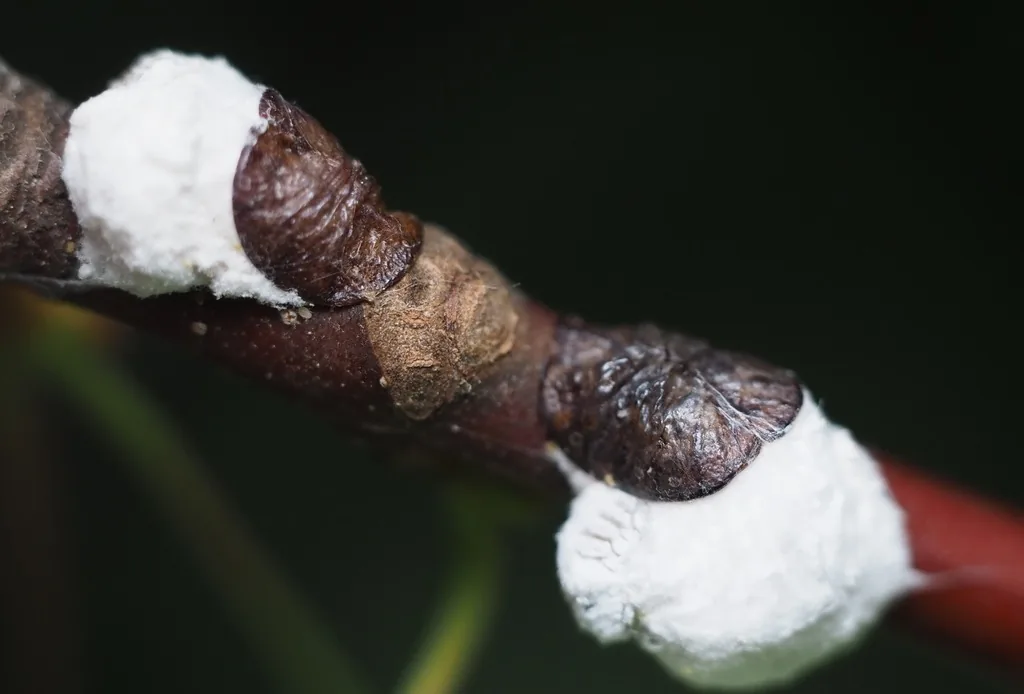
- The stage most people spot is the brown adult female with a large white cottony egg sac sticking out behind her. Badly infested trees look as if they've been strung with popcorn.[1][2]
- Size depends on the source: Minnesota Extension gives 1/8 inch (2 to 3 mm) for flat females without egg sacs, while Penn State says mature females are convex and 3 to 6 mm long.[1][2]
- Penn State says each egg mass usually holds 1,000 to 1,500 eggs. Males are tiny winged insects.[2]
Look-alikes
| Look-alike | How to tell them apart |
|---|---|
| Other scale insects | Scale species differ in timing, so identify the species to know when crawlers are active.[1] |
Where it lives
Minnesota Extension lists it among the scales found on deciduous trees in Minnesota, and Penn State calls it one of the largest and most conspicuous soft scales attacking ornamental deciduous plants.[1][2]
Biology and life cycle
Sources describe the overwintering stage differently: immature, flat females on twigs (Minnesota Extension) or second-instar nymphs on the bark of twigs and branches (Penn State). Minnesota says they begin growing in May and egg sacs appear by early June; Penn State says females finish developing in June and lay eggs through late summer.[1][2]
Crawlers hatch from mid-June through mid-July (Penn State) or late June to early July (Minnesota Extension) and settle on the undersides of leaves to feed. Males mature and mate in late summer, and before the leaves drop the young females move back to the twigs to spend the winter. There is one generation a year.[2][1]
Silver maple is the favorite host. Others include boxelder and other maples, honeylocust, linden (basswood), white ash, dogwood, locust, hackberry, sycamore, birch, elm, willow and poplar.[2][1]
In New York vineyards, Cornell researchers collected it, along with another soft scale and a mealybug, under loose grapevine bark and found grapevine leafroll viruses in the scale and mealybug vectors they tested, with virus sequences matching those of the vines they fed on.[4]
Damage and signs
- Sources disagree on how much it hurts trees. Minnesota Extension says it causes no significant damage because natural enemies control it well. Penn State says heavy populations cause twig and branch dieback, can sometimes kill a whole tree, and may make leaves fall early. Both note heavy honeydew and black sooty mold.[1][2]
Health risk
It feeds on tree sap, and no cited source describes any risk to people or pets.[1][2]
Control
Prevention
To time crawler sprays, Minnesota Extension suggests shaking an infested branch over white paper or putting double-sided tape on infested branches, and checking at least weekly until crawlers appear.[1]
Biological control
Lady beetles and tiny parasitic wasps usually keep it below damaging numbers, so Minnesota Extension says most trees need no treatment. Soaps and oils spare these natural enemies.[1]
Pesticides
If treatment is needed, horticultural oil smothers overwintering scales: Penn State says early spring before new growth, and Minnesota Extension says late fall and early spring. Crawler sprays go on in late June and early July.[2][1]
Penn State warns that some insecticides can injure soft maples and says not to use insecticidal soap on Japanese maples. Minnesota Extension lists imidacloprid in fall or dinotefuran in spring as systemic options and says to apply systemic products after flowering to protect bees.[2][1]
Where the sources disagree
Damage: Minnesota Extension says it causes no significant damage to plant health because natural enemies control it well, while Penn State says heavy populations cause twig and branch dieback and, under severe conditions, can kill the entire tree.[1][2]
Overwintering stage: Minnesota Extension says immature, flat females on twigs, Penn State second-instar nymphs on the bark of twigs and branches.[1][2]
Crawler hatch: Penn State gives mid-June through mid-July, Minnesota Extension late June to early July.[2][1]
Dormant oil timing: Penn State says early spring before new growth starts, Minnesota Extension late fall and early spring.[2][1]
Female size: Minnesota Extension gives 1/8 inch (2 to 3 mm) for flat females without egg sacs, Penn State 3 to 6 mm for mature, convex females.[1][2]
Hosts: Minnesota Extension lists maples (especially silver), honeylocust, linden and other hardwoods, Penn State a longer list of deciduous trees, and Cornell researchers found it under grapevine bark in New York vineyards.[1][2][4]
Scientific name: the GBIF Backbone Taxonomy accepts Neopulvinaria innumerabilis, while Minnesota Extension and the Cornell study use Pulvinaria innumerabilis.[3][1][4]
Common questions
- What are the white cotton balls on my maple twigs?
- Most likely cottony maple scale egg sacs, which show up on twigs by early June.[1][2]
- Will it hurt my maple?
- Usually not much, according to Minnesota Extension, since natural enemies keep it down. Penn State cautions that severe infestations can cause dieback and, rarely, kill a tree.[1][2]
Sources
- University of Minnesota Extension, “Scale insects (Yard and garden insects).” extension.umn.edu/garden-and-home/yard-and-garden/yard-and-garden-insects/scale-insects (accessed 2026-11-13)
- Penn State Extension, “Cottony Maple Scale.” extension.psu.edu/cottony-maple-scale (accessed 2026-11-13)
- Global Biodiversity Information Facility (GBIF), “Neopulvinaria innumerabilis (Rathvon, 1854) (GBIF Backbone Taxonomy).” api.gbif.org/v1/species/4484535 (accessed 2026-11-13)
- Phytopathology, 2009 (via PubMed), “Diversity of ampeloviruses in mealybug and soft scale vectors and in grapevine hosts from leafroll-affected vineyards (abstract).” pubmed.ncbi.nlm.nih.gov/19740031/ (accessed 2026-11-13)