On this page
How to identify it
- Females are oval and tan to yellowish; Rutgers notes a brown outer ring, and NC State says young females have a dark central stripe and turn dark brown with age. Size estimates vary (see where the sources disagree).[4][1][2]
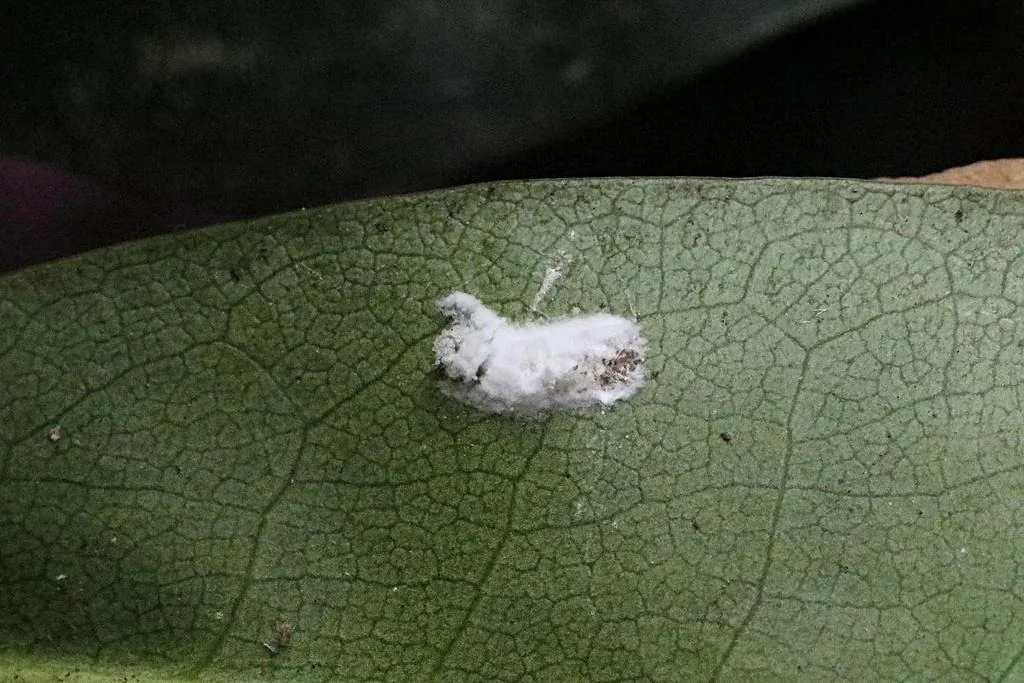
- The white egg sac forms beneath and behind the female and is at least twice her length. It stays stuck to the leaf after she dies and falls off.[1][2][4]
- Mature females and their egg sacs are found mostly on leaf undersides, and the egg sacs are usually the first thing people notice.[2][4]
- Crawlers, the newly hatched young, are pale yellow.[4][3]
Where it lives
NC State says it occurs in Florida and the tropics as well as North Carolina, and extension programs in Massachusetts, New Jersey and Washington also cover it as a landscape and nursery pest.[1][2][4][3]
Biology and life cycle
There is one generation a year. Immatures spend the winter on twigs, or on the leaves and needles of evergreens; females lay eggs in spring, and males, when present, show up in fall.[2][4][1][3]
Each egg sac holds hundreds of eggs (NC State) or up to about 1,000 (UMass). In North Carolina the eggs hatch in late May to early June, and crawlers settle along the veins on the undersides of leaves.[1][2]
Damage and signs
- Camellia, yew and holly are the best-known hosts. UMass also lists euonymus, Japanese maple and pittosporum among preferred hosts, and Rutgers counts hosts in more than 37 plant families. NC State says that in North Carolina it is mostly found on camellia, yew, Chinese holly and jasmine.[2][4][1]
- Honeydew coats the leaves, grows black sooty mold and can draw ants. Infested foliage may turn pale or yellow and plants lose vigor, though UMass says dieback is uncommon.[1][2][3][4]
Health risk
It feeds only on plant sap. NC State, UMass, WSU and Rutgers describe plant damage and mention no risk to people or pets.[1][2][3][4]
Control
Traps and physical control
For light infestations, which UMass says are mostly cosmetic and may need no treatment, hose scales off with a strong jet of water or prune out the worst twigs.[2][3][4]
Biological control
Hyperaspis lady beetles feed inside the egg sacs. NC State says spraying before they leave in June kills the beetles while the eggs stay protected under the wax.[1]
Encourage lady beetles and parasitic wasps by avoiding broad-spectrum insecticides, and control ants, which can guard scales from predators. UMass lists several tiny Coccophagus wasps as parasites but says they don't hold numbers down well.[3][4][2]
Pesticides
Aim sprays at the crawlers, usually in late spring to early summer, and cover twigs and leaf undersides. Horticultural oil works on overwintering nymphs in the delayed-dormant period. UMass advises spraying after bloom to protect pollinators.[3][2][4]
When to call a professional
WSU advises homeowners not to spray the foliage of trees taller than 10 feet and to hire a commercial applicator instead.[3]
Naming
GBIF's backbone taxonomy accepts Pulvinaria floccifera. A 2022 study from Japan revived the name Pulvinaria camelicola for a separate species that had been misidentified as P. floccifera, and UMass notes that its own page needs a taxonomy update.[5][6][2]
Where the sources disagree
Female size: UMass says about 3 mm; NC State says about 3/16 to 1/8 inch; Rutgers says up to 1/8 inch.[2][1][4]
Eggs per sac: NC State says hundreds; UMass says up to about 1,000.[1][2]
When to treat crawlers: NC State suggests June, after the lady beetles have left the egg sacs; UMass and Rutgers time it by heat units, at about 802 to 1,388 growing degree days (base 50°F).[1][2][4]
Name: GBIF accepts Pulvinaria floccifera; a 2022 Japanese study revived Pulvinaria camelicola for a separate species long misidentified as P. floccifera; UMass titles its page 'formerly Pulvinaria camelicola' and says it needs a taxonomy update.[5][6][2]
Common questions
- What are the white fuzzy strips under my camellia leaves?
- Probably the egg sacs of cottony camellia scale, which stay on the leaf after the female dies.[1][2][4]
- When should I treat cottony camellia scale?
- When the crawlers are out. NC State suggests June, after the helpful lady beetles leave the egg sacs. UMass and Rutgers time it by heat units, at about 802 to 1,388 growing degree days (base 50°F).[1][2][4]
Sources
- NC State Extension, “Cottony Camellia Scale Insect (PDIC Factsheet).” content.ces.ncsu.edu/cottony-camellia-scale-1 (accessed 2026-11-13)
- UMass Extension Landscape, Nursery and Urban Forestry Program, “Pulvinaria floccifera (formerly Pulvinaria camelicola; soft scale), Landscape Insect & Mite Guide.” www.umass.edu/agriculture-food-environment/landscape/publications-resources/insect-mite-guide/pulvinaria-floccifera-formerly-pulvinaria-camelicola-soft-scale (accessed 2026-11-13)
- Washington State University Extension, “Yew: Cottony camellia scale (Hortsense).” hortsense.cahnrs.wsu.edu/fact-sheet/yew-cottony-camellia-scale/ (accessed 2026-11-13)
- Rutgers Cooperative Extension, “Cottony Camellia Scale (Pulvinaria floccifera), Nursery IPM.” sites.rutgers.edu/nursery-ipm/cottony-camellia-scale/ (accessed 2026-11-13)
- Global Biodiversity Information Facility (GBIF), “Pulvinaria floccifera (Westwood, 1870) (GBIF Backbone Taxonomy).” api.gbif.org/v1/species/8255921 (accessed 2026-11-13)
- Zootaxa 2022;5115(3):438-450, via PubMed, “The identities of Pulvinaria camelicola Signoret 1873, stat. nov., and the related species Pulvinaria floccifera (Westwood 1870) (Hemiptera: Coccidae) in Japan (Tanaka & Kamitani, 2022).” pubmed.ncbi.nlm.nih.gov/35391357/ (accessed 2026-11-13)
- iNaturalist, “Pulvinaria floccifera taxon page (order and family).” www.inaturalist.org/taxa/396029 (accessed 2026-10-06)