On this page
How to identify it
- The female's cover is brown, elongate and boat- or oyster-shaped, about 1/10 inch (1.5 mm) long, with the shed skin from the first molt at one end. Flip one over and you may find a dozen or so yellow eggs. UF/IFAS describes the female's armor as narrow and elongate with an even darker ridge down the middle; the retained first skin hardens and turns brown, while the female herself stays yellow underneath.[1][2][5]
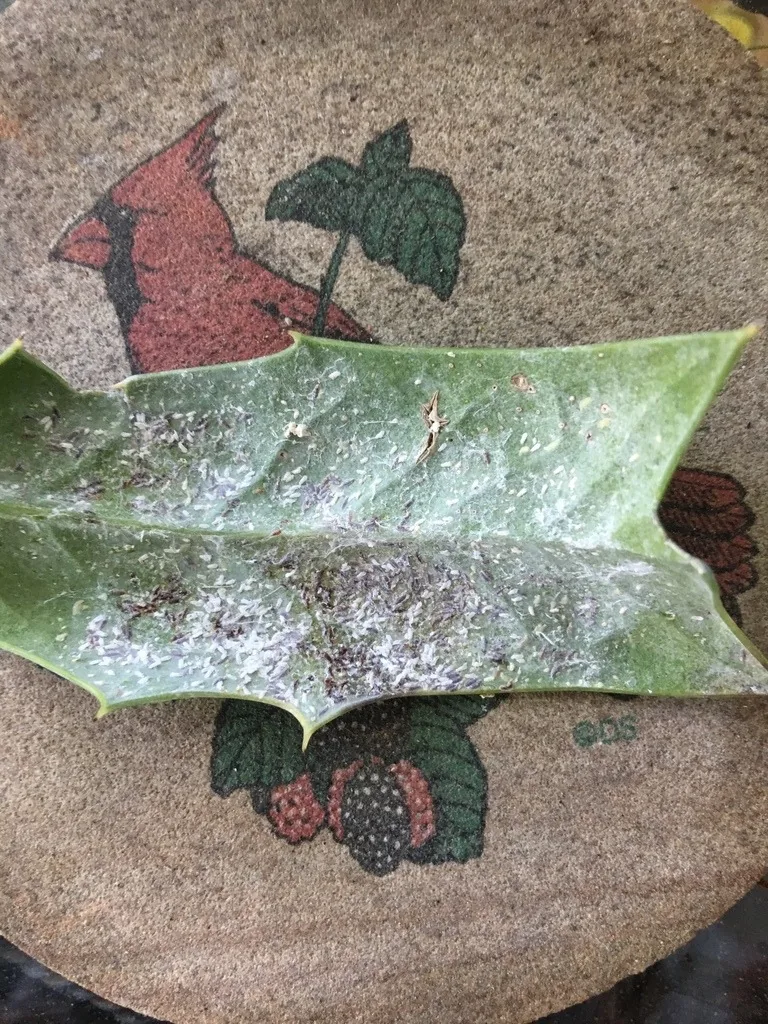
- Male scales are soft, white and narrow with a ridge down the back. When they are crowded, the undersides of the leaves look covered in white, cottony or fuzzy material.[2][1][4]
- Crawlers are flat and yellow. A hand lens helps to see them and newly settled scales. UF/IFAS says crawlers are oval, with six well-developed legs and two antennae.[2][1][5]
- Upper leaf surfaces show yellow splotches or chlorotic spots above the scales.[2][3][1]
- Eggs are shiny yellow and oval, broader at one end, and turn dull yellow just before hatching. Adult males are orange-yellow, with one pair of glossy forewings and no working mouthparts.[5]
Where it lives
It is a serious pest of camellias in the southeastern U.S. and has been reported on camellias in California. ScaleNet lists U.S. records from Alabama to Virginia, west to Texas, Oklahoma and Kansas and north to New York and Massachusetts, as well as from Asia, Central and South America and the Netherlands. UF/IFAS says it is native to Asia, was first described in 1900 from tea plants in India, and was already a pest of camellias in South Carolina by 1908, probably brought in with ornamental camellias. It lists Florida, Georgia, South Carolina, Louisiana, Texas and California, and abroad it has been reported on tea, olive and citrus in India, on Eurya japonica in Japan and on camellias in Argentina.[2][4][5]
Biology and life cycle
Each female lays about 10 to 16 eggs under her cover, in two rows, and they hatch in 7 to 21 days depending on the weather.[2][4]
Crawlers move to newer growth and settle within 2 or 3 days. Females begin laying eggs 41 to 65 days after hatching, and a generation takes about 60 to 70 days.[2][4]
There are several overlapping generations a year in the South. Crawlers can hatch continuously from March to November, and development slows but continues through winter.[2][4]
In Florida it stays active all year, while in colder Georgia and the Carolinas activity slows and there are fewer generations. UF/IFAS says crawlers hatch within 10 days, wander for one to four days before settling, and molt about 10 days later; a female lays her eggs, then shrivels and dies shortly after.[5]
Damage and signs
- Heavy infestations make the whole plant look sickly and sparse: leaves yellow and drop early, growth slows, there are fewer blooms, and cuttings may die before rooting.[2][3][1][4]
- Besides camellias and hollies it has been reported on boxwood, euonymus, dogwood, bottlebrush, ferns, mango, Satsuma orange, orchids, tea and yaupon. UF/IFAS adds citrus, kumquat and olive.[2][3][5]
- Dead scales and damaged leaves often stay on the plant and keep it looking bad. UF/IFAS notes dead scales give off no fluid when squeezed between thumb and forefinger.[5]
Health risk
It feeds on plant sap; none of these sources reports any risk to people or pets.[1][2]
Control
Prevention
Light infestations can be tolerated; Mississippi State notes it is rare to find a camellia with no tea scale and plants can thrive with a few.[1]
On camellias, pruning improves air flow and spray coverage. In cooler climates UF/IFAS says to prune small non-flowering branches growing on major limbs inside the plant between February and March.[5]
Biological control
Native parasitic wasps, including Aphytis diaspidis and two Aspidiotiphagus species, attack tea scale in Florida and Georgia; parasitized scales have exit holes chewed in their armor. Check for them before spraying, and UF/IFAS prefers soaps and oils because they are usually less harmful to the scale's natural enemies.[5]
Pesticides
Spray when crawlers are active, covering the undersides of the leaves heavily. NC State suggests spring, after bloom and once the danger of cold weather has passed. Mississippi State calls for at least two sprays about 10 days apart; NC State says two applications 10 days apart should be enough.[2][1]
Horticultural oil sprays also work but need thorough coverage of the leaf undersides.[1]
Mississippi State says soil-applied systemic treatments containing dinotefuran are especially useful against tea scale; they act slowly but give long-term control. Follow the label for the amount by shrub size.[1]
Where sources disagree
Eggs per female: NC State says 10 to 15, as does UF/IFAS; ScaleNet cites 10 to 16 in Alabama, an average of 32 in India, and 17 to 43 on squash in a Florida laboratory study.[2][5][4]
Spray timing: NC State points to spring after bloom, while Mississippi State ties sprays to whenever crawlers are active, which can be March to November.[2][1][4]
Number of sprays: Mississippi State calls for at least two about 10 days apart and NC State says two applications 10 days apart should be enough, while UF/IFAS says two or three applications 7 to 10 days apart are needed.[1][2][5]
Generation time: ScaleNet and NC State give about 60 to 70 days, while UF/IFAS gives 45 to 65 days depending on temperature.[2][4][5]
Common questions
- Why are my camellia leaves white underneath and yellow on top?
- Tea scale. The white fuzz underneath is made by male scales, the brown specks are females, and their feeding causes the yellow blotches on top.[1][2]
- When should I treat?
- Spray when crawlers are active, at least twice about 10 days apart, with thorough coverage of leaf undersides; NC State favors spring after bloom. A systemic soil treatment is a slower, longer-lasting option.[1][2]
- Does tea scale attack hollies?
- Yes. It is a serious pest of Chinese and Japanese hollies as well as camellias.[2][1][3]
- How can I tell if the tea scale on my camellia is dead?
- Dead scales give off no fluid when squeezed between thumb and forefinger, and scales killed by parasitic wasps have small exit holes in their armor. Dead scales can stay on the leaves long after treatment.[5]
Sources
- Mississippi State University Extension, “Tea Scale Vol. 2, No. 26.” extension.msstate.edu/newsletters/bugs-eye-view/2016/tea-scale-vol-2-no-26 (accessed 2026-11-11)
- NC State Extension, “Pests of Camellia (Insect and Related Pests of Shrubs).” content.ces.ncsu.edu/pests-of-camellia (accessed 2026-11-11)
- Clemson Cooperative Extension Home & Garden Information Center, “What is it? Wednesday (tea scale on camellia; quotes HGIC 2053, Camellia Diseases & Insect Pests).” hgic.clemson.edu/what-is-it-wednesday-24/ (accessed 2026-11-11)
- ScaleNet (USDA ARS Systematic Entomology Laboratory and partners), “Fiorinia theae (catalogue entry: hosts, distribution, biology, economic importance).” scalenet.info/catalogue/Fiorinia%20theae/ (accessed 2026-11-11)
- University of Florida IFAS Extension (EDIS), “Tea Scale, Fiorinia theae Green, EENY250/IN522 (C. Miller; Featured Creatures).” ask.ifas.ufl.edu/publication/IN522 (accessed 2026-11-14)
- iNaturalist, “Fiorinia theae taxon page (order and family).” www.inaturalist.org/taxa/1043502 (accessed 2026-10-06)