On this page
How to identify it
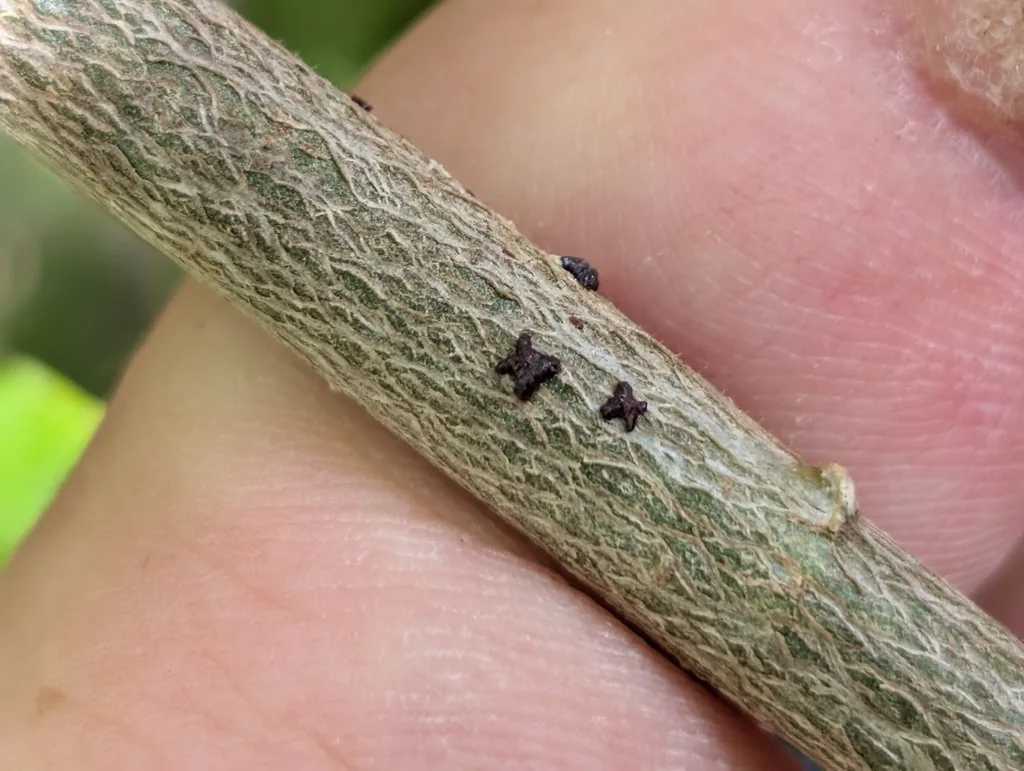
- The resinous cover is globe-shaped with four lobes, light to dark reddish brown, and about 1.5 mm long by 1.0 mm wide. Young scales are the most lobed and often look like a 'fat bow tie'. UF/IFAS describes mature females as about 1.5 to 2 mm long and about as wide, with two pairs of prominent lobes that give an x-shaped look a practiced eye can see without magnification.[2][7]
- Crowded scales run together into masses that form a dark crust over twigs, usually on young branches under about 2 cm thick. Old scales often look black because of sooty mold. UF/IFAS calls the cover extremely hard, brittle and glossy, and says the scale has not been seen on foliage.[2][1][4][7]
- The crawlers (first stage) are elongate-oval, deep red and about 0.2 mm long; the lobed pattern develops in the second stage. UF/IFAS says males have not been observed in Florida.[7]
Look-alikes
| Look-alike | How to tell them apart |
|---|---|
| Mexican lac scale | Florida's other lac scale, native to Mexico and Texas and known in Florida from Lee, Orange and Seminole counties, mostly on acacias, wild tamarind and other legumes and sometimes on wax myrtle. Its hard, glossy cover has four to six lobe-like projections, and UF/IFAS says the lobate lac scale is easily told apart by its bow tie-shaped cover.[8] |
Where it lives
First found in the US in Florida in 1999 (it had been identified in the Bahamas in 1992), it is established in South Florida, where Florida's agriculture department lists Broward, Collier, Miami-Dade, Hendry, Indian River, Lee, Martin, Monroe, Palm Beach and St. Lucie counties. It was found on Oahu, Hawaii, in October 2012. UF/IFAS dates the first Florida find to August 1999, on a hibiscus in Davie (Broward County); by October 2002 it had been recorded from Lake Worth south to Homestead, a distance of 128 km, and up to 28 km inland.[2][1][4][7]
Biology and life cycle
The crawlers have no wings but can be carried to new plants on air currents and by animals such as birds. UF/IFAS adds that moving infested plants from place to place is a key factor in its spread through urban areas.[1][7]
It belongs to the lac scale family (Kerriidae), whose resinous secretions are the source of lac, the basis of shellac. The family is mainly tropical; only a few species occur in US deserts. UF/IFAS notes that no lac scale is native to Florida and that most species in the family, this one included, produce nothing of commercial value.[2][1][7]
It feeds on an unusually wide range of hosts; a study of scales on three host plants found widespread shifts in gene activity depending on the host.[5][2]
Damage and signs
- It mainly attacks woody broadleaf plants. By 2003 it had been recorded on 94 of 155 native South Florida woody species and roughly as many landscape and crop plants; Florida's agriculture department later counted more than 190 woody hosts.[1][2]
- Heavy infestations make plants look unhealthy, cause leaf drop and can kill some species. Common South Florida natives such as wax myrtle, cocoplum and myrsine have been hit in yards and in conservation areas including Everglades National Park.[1][4]
- In Oahu's urban landscape, surveys had recorded it on 111 host plant species by 2018, and the number was still increasing.[4]
- Florida's agriculture department notes it has not been a major pest in nurseries.[2]
- UF/IFAS counted more than 120 host species in 44 families in Florida as of October 2002, including 39 Florida natives, one conifer (southern red cedar) and one palm (Phoenix roebelenii).[7]
- Hosts UF/IFAS calls highly susceptible include the natives wax myrtle, cocoplum, buttonwood, strangler fig, myrsine, red bay and wild coffee; the ornamentals black olive, Indian laurel and Benjamin fig; and the fruit trees lychee, mango and star fruit.[7]
- It settles on twigs and small branches, usually under 2 cm thick. On wax myrtle UF/IFAS counted up to 42 mature females per 1 cm of twig, with sooty mold coating the branches and patches of foliage; dense infestations bring branch dieback, and badly infested shrubs and small trees have died.[7]
- UF/IFAS found heavy infestations on many species in tropical hardwood hammocks in Broward County, including 28 km inland at the eastern edge of the Everglades, and warned that Caribbean natural areas would be threatened if it reached them.[7]
Health risk
It feeds on plants; none of the sources reports harm to people or pets.[2][1][4]
Control
Prevention
Shipments of ornamental and crop plants are the main route for spread beyond Florida, toward the Caribbean, California and Hawaii; it has since been found on Oahu.[1][4]
Biological control
Biological control is the likeliest answer for natural areas, where spraying is costly and impractical. USDA researchers were evaluating parasitoids from India and Thailand by 2005, but Hawaii's agriculture department reported in 2025 that no effective biological control agent had yet been identified and that existing natural enemies are absent or ineffective in Florida and Hawaii. UF/IFAS saw no evidence of natural enemies in Florida and called biological control the only viable long-term option.[1][3][7]
Pesticides
Insecticides can protect landscape and crop plants. In Hawaii, imidacloprid injected into the trunk prevented infestation on Chinese banyans for at least 22 months and reduced existing infestations on weeping figs for at least 20 months. Follow the label.[1][4]
An early University of Florida trial at its Fort Lauderdale research center found that a root drench of the systemic insecticide imidacloprid controlled the scale on large Benjamin fig trees. Follow the label.[7]
Where sources disagree
Where it comes from: Don't Move Firewood describes it as native to India and Sri Lanka, and Florida's agriculture department lists its world distribution as Sri Lanka, India and the Bahamas; Hawaii's agriculture department calls it native to Southeast Asia and says its precise origin is uncertain. UF/IFAS also gives India and Sri Lanka.[1][2][3][7]
How many hosts: 94 of 155 native woody species plus roughly as many non-natives by 2003 (Don't Move Firewood), more than 190 woody hosts in Florida (Florida's agriculture department), and more than 300 species in southern Florida and the Bahamas (Hawaii's agriculture department, 2025). UF/IFAS counted more than 120 species in 44 families in Florida as of October 2002.[1][2][3][7]
Name: UF/IFAS's lobate lac scale profile uses Paratachardina lobata lobata, while UF/IFAS's newer Mexican lac scale profile and Florida's agriculture department use P. pseudolobata.[7][8][2]
Common questions
- What is the dark crust on my wax myrtle twigs in South Florida?
- A dark, hard crust of tiny reddish-brown, bow-tie shaped scales on wax myrtle or cocoplum twigs is likely lobate lac scale.[2][1]
- Can lobate lac scale kill shrubs?
- Yes. High-density infestations can kill plants, and wax myrtle, cocoplum and myrsine are among those affected.[1][4]
- Where on the plant does lobate lac scale settle?
- On the woody parts of twigs and small branches, usually under 2 cm thick, and less often on main stems. UF/IFAS has not seen it on leaves.[7]
- Is it the same as the Mexican lac scale?
- No. The Mexican lac scale is Florida's other lac scale, found in a few counties mostly on acacias and wild tamarind. Its cover lacks the lobate lac scale's bow-tie shape.[8]
Sources
- Don't Move Firewood (The Nature Conservancy), “Lobate Lac Scale (pest page, F. Campbell).” www.dontmovefirewood.org/pest_pathogen/lobate-lac-scale-html/ (accessed 2026-11-11)
- Florida Department of Agriculture and Consumer Services, Division of Plant Industry, “Pest Alert: Lobate lac scale, Paratachardina pseudolobata (FDACS-P-01686; Hamon and Hodges).” ccmedia.fdacs.gov/content/download/68152/file/Pest_Alert_-_Paratachardina_pseudolobata,_Lobate_lac_scale.pdf (accessed 2026-11-11)
- Hawaii Department of Agriculture and Biosecurity, “Annual Report on the Biosecurity Program, Report to the Thirty-Third Legislature, 2026 Regular Session (December 2025).” dab.hawaii.gov/wp-content/uploads/2025/10/Act-236-2025-Biosecurity-Report.pdf (accessed 2026-11-11)
- International Journal of Tropical Insect Science, “Lobate lac scale, Paratachardina pseudolobata, in Hawaii's urban landscape: Hosts and management (2018; abstract).” link.springer.com/article/10.1017/S174275841700025X (accessed 2026-11-11)
- PLoS One, via PubMed, “Gene expression plasticity across hosts of an invasive scale insect species (Christodoulides et al. 2017).” pubmed.ncbi.nlm.nih.gov/28472112/ (accessed 2026-11-11)
- iNaturalist, “Paratachardina pseudolobata taxon page (order and family).” www.inaturalist.org/taxa/498129 (accessed 2026-11-11)
- University of Florida IFAS Extension, EDIS (Featured Creatures), “Lobate Lac Scale, Paratachardina lobata lobata (Chamberlin), EENY-276/IN471 (Featured Creatures).” ask.ifas.ufl.edu/publication/IN471 (accessed 2026-11-14)
- University of Florida IFAS Extension, EDIS (Featured Creatures), “The Mexican Lac Scale, Tachardiella mexicana (Comstock), EENY 552/IN990 (Featured Creatures).” ask.ifas.ufl.edu/publication/IN990 (accessed 2026-11-14)