On this page
How to identify it
- Look at the center of the plant: the larvae feed on tissue in the center of the bromeliad and consume the core of the rosette, which often kills it before it can flower.[2][3]
- The biggest plants are hit first. Females lay their eggs in the leaves of tree-dwelling bromeliads and prefer the largest rosettes, so smaller plants nearby may be spared while large ones die.[3]
- Larger native species are the main targets: the giant airplant (Tillandsia utriculata), the cardinal airplant (T. fasciculata) and Guzmania monostachia have all been heavily affected.[2][3]
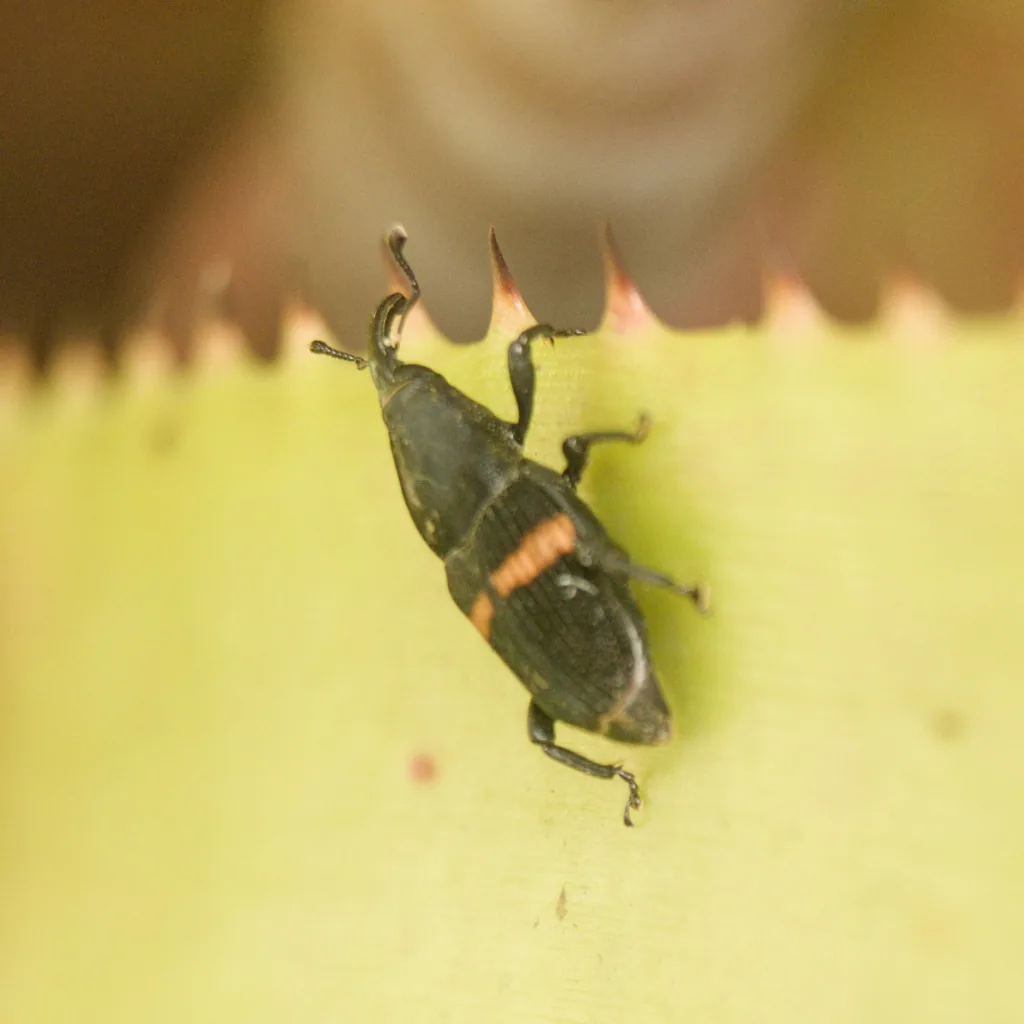
- Adults are 11 to 16 mm (0.4 to 0.6 in) long and black, with a single yellow or orange band across the wing covers above the middle. UF/IFAS adds that in males the first two abdominal segments underneath are indented and may be brownish, while in females they are flat and always black.[5]
- Eggs are elongate, about 2 mm long and 1 mm wide, white at first, then yellow and finally light brown. Larvae are cream-colored grubs with a dark head, and they usually pupate in the center of the plant's stem inside a fibrous cocoon of shredded plant material.[5]
- UF/IFAS lists the signs of attack: adult feeding marks on the leaves, browning leaves, a light brown, gelatinous material covering the entrance holes of the larval tunnels, and central leaves rotting at the base so they pull out easily. Large holes in the base can make the plant fall from its perch on the tree.[5]
Look-alikes
| Look-alike | How to tell them apart |
|---|---|
| Florida bromeliad weevil (Metamasius mosieri) | A native weevil, considerably smaller and red and black, with two black spots about midway on the red upper half of the wing covers. UF/IFAS calls it an occasional, minor pest of ornamental bromeliads that lives at very low densities in the wild, and says it does not typically kill the plant.[6][7] |
| Silky cane weevil (Metamasius hemipterus sericeus) | The third Metamasius in Florida: 9 to 14 mm long, red or orange and black with a variable pattern. UF/IFAS says it was first reported in Miami-Dade County in 1984 and is a pest of sugarcane, bananas and ornamental palms.[5] |
Where it lives
An introduced weevil, first detected in South Florida in 1989. GBIF's 1990-2026 U.S. records (94 in all) come from Florida only (1 state on the map). In Everglades National Park it was reported soon after its discovery but has not been seen there since the early 1990s. UF/IFAS says it was described from Mexico and probably reached Florida in a shipment of bromeliads from Veracruz. It was first found in 1989 at a Fort Lauderdale nursery and within two months was established in northern Broward and southern Palm Beach counties; by 1991 it was in four southern Florida counties, by 1999 in 12 more, and by December 2009 in 23 counties, as far north as Volusia. It was also found in Belize in 2010 and 2014.[2][3][4][5]
Biology and life cycle
Adult females lay eggs in the leaves of epiphytic (tree-dwelling) bromeliads. When the eggs hatch, the larvae bore into the plant and feed on the available tissue, including the growing point (meristem).[3]
Because weevils destroy the growing point, a giant airplant often dies before its single attempt at reproduction. Species that make side shoots (pups), such as the cardinal airplant and Guzmania monostachia, may still regrow from them after an attack.[3]
At Myakka River State Park in Sarasota County, researchers tracked giant and cardinal airplants monthly from June 2001, about one year after the weevil was first found there, to June 2005 to measure its impact.[3]
Reared on pineapple stem in the lab at 26°C, it took about eight weeks from egg to adult: about 8.3 days as an egg, 36.4 days as a larva over five stages and 11.8 days as a pupa. Females began laying after about 28.9 days and lived an average of 156.4 days.[5]
Larvae, pupae and adults are found year-round in southern Florida, so UF/IFAS says there are probably three to four overlapping generations a year. It estimates the shortest generation in the field at 10 weeks and the average at 13 to 17 weeks.[5]
Females feed mostly on leaves, sometimes on flowers, and cut slits in the leaves near their feeding sites to lay eggs one at a time. Newly hatched larvae eat leaf tissue on their way down to the base, then tunnel into the growing stem. Several can develop in one plant, but larger larvae attack smaller ones they meet.[5]
In natural areas it mainly attacks Tillandsia utriculata, T. fasciculata and T. paucifolia, and it has also been seen on T. balbisiana, T. flexuosa, T. variabilis, T. simulata, Catopsis and Guzmania. It seems limited to bromeliads big enough to feed a larva, so UF/IFAS says small natives such as T. recurvata and T. usneoides probably won't be attacked.[5]
In greenhouses it has mined and killed many cultivated bromeliads, including Aechmea, Guzmania and Neoregelia cultivars, Cryptanthus, Dyckia and pineapple (Ananas comosus). Adults will also feed on T. ionantha, a Mexican and Central American air plant, without laying eggs in it.[5]
Damage and signs
- All three large native Florida bromeliads (T. utriculata, T. fasciculata and G. monostachia) have been heavily affected and are listed as endangered in Florida. The giant airplant is of the most concern, because each rosette flowers and sets seed only once.[3]
- Over three decades of weevil attack, giant airplants have begun flowering at smaller rosette sizes. Smaller rosettes make fewer seeds, and a 2025 model found that with weevils present the plant needs higher germination rates to keep a viable population.[3]
- Tank bromeliads matter to other wildlife: their leaf bases hold water used by tree frogs, mosquito larvae, centipedes and even snakes, and each rosette can hold dozens of invertebrate species, at least 15 of which live only in the water held by tank bromeliads native to Florida.[2][3]
- Because of the weevil, Florida added T. utriculata and T. fasciculata to its endangered plant list under the 1998 Florida Administrative Code. UF/IFAS says T. utriculata, which reproduces mainly by seed, has suffered most, while T. fasciculata's offsets help it escape to some extent.[5]
- With no natural enemies in Florida, the weevil has done far more damage to bromeliads there than anywhere in its native range. UF/IFAS ranks it, along with habitat loss and illegal collecting, among the greatest threats to Florida's native bromeliads.[5][7]
- In ornamental nurseries the larvae kill some species outright, and the weevil has also infested private bromeliad collections.[5]
Health risk
It is a plant pest. The National Park Service and the 2025 study describe harm only to bromeliads, not to people or pets.[2][3]
Control
Prevention
Check large bromeliads regularly for damage in the center of the rosette, since the weevil chooses the biggest plants first. The sources here give no tested treatment for gardens; the study's authors call for conservation efforts to keep the weevil from causing a significant loss of biodiversity.[3][2]
To keep more bromeliad weevils out of Florida, UF/IFAS says the most effective step is to import only seeds of Neotropical bromeliads; dipping imported plants in insecticides labeled for beetles reduces the risk, though the effect on eggs is unknown. At least 20 other weevil species attack bromeliads in Central and South America.[5]
Biological control
Spraying isn't practical in natural areas, where the plants grow high in trees and many sites are parks. UF/IFAS says biological control is the best hope: a tachinid fly from Honduras, Lixadmontia franki, parasitizes the larvae, and Federal and State release permits were issued in 2007, with releases beginning at the end of June 2007.[5]
Pesticides
For nursery ornamentals in infested areas, UF/IFAS recommends a reduced concentration of an insecticide labeled for beetle adults and grubs, applied as a spray or dip every two to three months to prevent infestation. It notes this rests on general principles, because no chemical trials have been run against this weevil. Follow the label.[5]
Where the sources disagree
Cardinal airplant: the 2025 study counts T. fasciculata among the heavily affected species; UF/IFAS says it appears more resistant than T. utriculata and its offsets help its populations escape to some extent, though damage to flowering plants can be highly destructive.[3][5]
Florida bromeliad weevil size: UF/IFAS's Mexican bromeliad weevil fact sheet gives 6 to 9 mm; its Florida bromeliad weevil fact sheet gives 6 to 11 mm.[5][6]
Everglades: UF/IFAS says the weevil has entered the Everglades region; the National Park Service says it has not been seen in Everglades National Park itself since the early 1990s.[5][2]
Common questions
- What is killing the big air plants on trees in South Florida?
- If large air plants are dying from the center out, the Mexican bromeliad weevil is a likely cause. Its larvae eat the core of the rosette, and it has made the giant airplant endangered in Florida.[3][2]
- Is the Mexican bromeliad weevil still in the Everglades?
- The Park Service says it was reported in Everglades National Park soon after it was discovered in 1989 but has not been seen there since the early 1990s. Elsewhere in South Florida, such as Myakka River State Park, it has been studied for years.[2][3]
- Is Florida's native bromeliad weevil a problem too?
- Rarely. UF/IFAS calls Metamasius mosieri an occasional, minor pest of ornamental bromeliads that lives at very low densities in the wild and does not typically kill the plant, unlike the Mexican bromeliad weevil.[6][7]
Sources
- iNaturalist, “Metamasius callizona taxon page (order and family).” www.inaturalist.org/taxa/510263 (accessed 2026-11-11)
- U.S. National Park Service, “Bromeliads (Everglades National Park: Learn About the Park).” www.nps.gov/ever/learn/nature/bromeliads.htm (accessed 2026-11-11)
- PLoS Computational Biology, via PubMed Central, “Campbell AM, Kula AC, Jabaily RS, Oberle B, Sidoti B, Capaldi A, Bodine EN (2025), Predicting potential recovery of the endangered bromeliad Tillandsia utriculata: an agent-based modeling approach, PLoS Computational Biology 21(6):e1013157.” pmc.ncbi.nlm.nih.gov/articles/PMC12184934/ (accessed 2026-11-11). Open-access full text (PMC12184934; PubMed 40493719).
- Global Biodiversity Information Facility (GBIF), “Metamasius callizona (Mexican bromeliad weevil): occurrence records in the U.S., 1990-2026 (GBIF occurrence search).” api.gbif.org/v1/occurrence/search?taxonKey=1170711&country=US&hasGeospatialIssue=false&occurrenceStatus=PRESENT&year=1990%2C2026&facet=stateProvince&facetLimit=400&limit=0 (accessed 2026-11-11). State counts are records reported (iNaturalist research-grade, museum specimens, surveys), not abundance.
- University of Florida IFAS Extension, EDIS (Featured Creatures), “Mexican Bromeliad Weevil, Metamasius callizona (Chevrolat), EENY-161/IN318 (Featured Creatures).” ask.ifas.ufl.edu/publication/IN318 (accessed 2026-11-14)
- University of Florida IFAS Extension, EDIS (Featured Creatures), “Florida Bromeliad Weevil, Metamasius mosieri Barber, EENY-209/IN366 (Featured Creatures).” ask.ifas.ufl.edu/publication/IN366 (accessed 2026-11-14)
- University of Florida IFAS Extension, EDIS, “Florida's Native Bromeliads, CIR 1466/UW205.” ask.ifas.ufl.edu/publication/UW205 (accessed 2026-11-14)