On this page
How to identify it
- Adults are about 1.4 to 1.6 mm long, with a yellow body, dark red eyes and white wings crossed by a faint brownish band. They fly up when the plant is disturbed but are short-lived and not the best stage for judging an infestation. UF/IFAS's identification guide describes the wing band as faint gray to light brown and notes that this species does not produce obvious wax.[5][1][6]
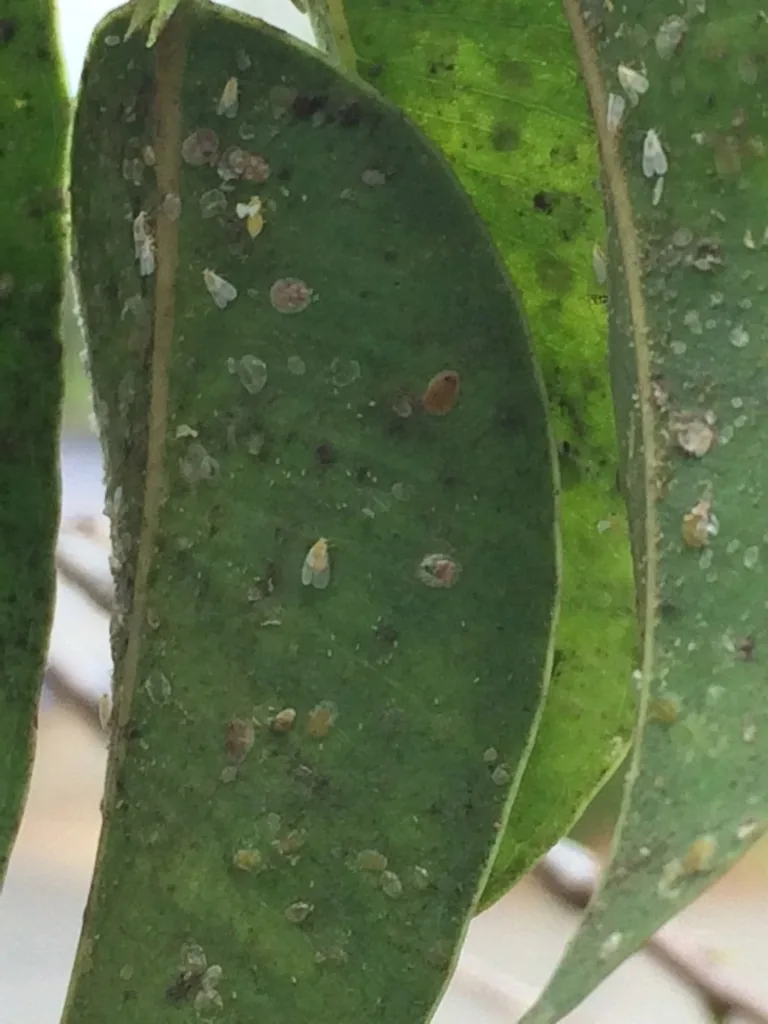
- Check the leaves for nymphs: flat, oval and transparent to light green at first, then yellower and more rounded with visible red eyes. The last stage is about 1.3 mm long. Empty pupal cases and parasitized nymphs are also signs.[1][5]
- Leaves turn yellow before they drop, and by the time a hedge is losing leaves, the whitefly has usually been there for several months.[1][5]
- Unusually for a whitefly, its eggs and nymphs occur on both the upper and lower leaf surfaces. Eggs are yellow to light brown, kidney-shaped on a thin stalk, and laid in dense groups mostly along the midvein. UF/IFAS's 2018 identification guide also says immatures may be on both surfaces and describes the eggs as long and yellowish, laid along the midrib on the underside of leaves.[4][3][6]
- Shake an infested branch and small clouds of tiny white, gnat-like adults fly up; leaves may also carry black sooty mold growing on honeydew.[4]
Look-alikes
| Look-alike | How to tell them apart |
|---|---|
| Other whiteflies | More than 75 kinds of whiteflies occur in Florida, but this one has been reported only on ficus.[1] |
Where it lives
Native to South and Southeast Asia. It was first reported in North America attacking ficus in Miami-Dade County in 2007; by 2010 it was in 16 Florida counties, from Monroe north to Brevard, Orange and Hillsborough. California recorded it in 2012, and by 2022 it was established in six southern and central coastal counties. It has spread through Central and South America and the Caribbean, including Mexico, Brazil, Jamaica, Puerto Rico and the Cayman Islands, and into the Mediterranean (Cyprus, Italy). Of 172 U.S. GBIF records since 1990, 156 are from California and 15 from Florida. UF/IFAS says it is considered a major pest in Florida.[1][2][5][7][4][8][6]
Biology and life cycle
The life cycle takes about a month: eggs are laid mostly on the undersides of leaves, the tiny crawlers wander briefly before settling to feed, and the nymphs stay in place until the adults emerge. The UF/IFAS guide adds that there are four immobile nymphal stages and that the whole life cycle takes about 30 days.[1][6]
Later stages on fallen leaves can survive and emerge as adults that attack more ficus.[1]
Development speeds up with heat: the immature stages take about 97 days at 15 C (59 F) but about 25 days at 30 C (86 F), and adults live only about 2.5 to 8 days.[4]
Adults fly poorly, so natural spread is limited; long-distance spread is mainly in the plant trade, and immature stages can also move on fallen or pruned foliage. California finds it often in nurseries.[4][7]
Damage and signs
- It is most often found on weeping fig (Ficus benjamina) and F. microcarpa; some other ficus appear unsuitable for it.[1][2][5]
- Hosts reported include weeping fig (F. benjamina, preferred), Cuban laurel (F. microcarpa), strangler fig (F. aurea), council tree (F. altissima), Indian banyan (F. bengalensis), F. binnendijkii, F. maclellandii and fiddle-leaf fig (F. lyrata); it has also been reported on azalea, which needs confirmation. It is not known to feed on edible fig (F. carica). A 2017 UF/IFAS Featured Creatures bulletin also lists F. elastica, F. racemosa, F. pumila and F. carica among at least eleven host species and says F. benjamina appears to be the preferred host in Florida.[4][3][7][9]
- The 2010 UF/IFAS landscape fact sheet listed F. microcarpa 'Green Island', F. religiosa, edible fig (F. carica), fiddle-leaf fig (F. lyrata), creeping fig (F. pumila) and F. elastica 'Burgundy' as apparently unaffected.[1]
- Constant sap feeding yellows the foliage and spoils the look of trees; branch dieback varies and probably depends on the plant's overall health.[5][1]
- Most defoliated trees and hedges grow new leaves, but dead branches need to be pruned out.[1]
- High populations can stunt young trees, and repeated defoliation and regrowth reduce plant health. CDFA notes it has not had significant impacts in Los Angeles County, possibly because of parasitism.[3][4][7]
- Left untreated it can cause severe defoliation and, in some cases, branch dieback and ultimately plant death; on susceptible plants dense infestations can stunt growth.[9][6]
Health risk
It develops only on ficus; none of the sources reports harm to people or pets, though large numbers of adults around street trees can be a nuisance.[1][3]
Control
Prevention
Check ficus regularly for nymphs, since an infestation is easier to manage before it builds up and strips the plant.[1]
Sanitation
Prune infested hedges less to reduce stress, and either leave clippings on the property or bag them so the whiteflies aren't spread.[1]
Biological control
Natural enemies matter for long-term control. In Florida the fact sheet counted at least 2 parasitoids, 5 beetle predators and lacewings attacking it; the parasitoids Encarsia protransvena and Amitus bennetti have been recorded on it there, and E. protransvena now also attacks it in Italy. The tiny lady beetle Delphastus pallidus eats its nymphs. Avoid broad-spectrum sprays that kill them. In December 2014 a UF/IFAS survey found the parasitoid Baeoentedon balios, its first known New World record, attacking ficus whitefly in Homestead; in 2015 and 2016 surveys of untreated hedges in Broward, Miami-Dade, Monroe and Palm Beach counties it was the dominant parasitoid. Its adults also kill many nymphs by probing and feeding on them, and UF/IFAS considers coccinellid beetles and lacewings important predators.[1][2][10][11][9][6]
On a Florida weeping fig hedge, repeated foliar sprays of the fungal biopesticide PFR-97 (Isaria fumosorosea) cut whitefly numbers about as well as an Admire Pro soil drench (imidacloprid) and did not harm the parasitoids present.[12]
UF/IFAS advises checking for natural enemies before heavy pruning or spraying, since insecticides can be severely harmful to parasitoids. In its surveys of sprayed hedges the parasitoid survived mostly at the edges, where coverage was less thorough, and unsprayed refuges can help natural enemies persist.[9]
Pesticides
Where ficus is at risk, the UF/IFAS fact sheet points to a systemic neonicotinoid applied to the soil or trunk, preferably in spring, which should give about a year of control; it lists dinotefuran (Safari) and imidacloprid (Merit) among the options. Foliar sprays give quick knockdown on hot spots but last only a few weeks and need repeating about every 7 to 10 days; don't use the same insecticide on the leaves as in the soil, and follow the label, including its limits near water.[1][12]
Where sources disagree
Which leaf surface: the UF/IFAS fact sheet describes eggs and nymphs on leaf undersides, while UC Riverside and the GB Non-native Species Secretariat guide say immature stages occur on both upper and lower surfaces. A 2013 Mexican report found more nymphs on the upper surface of a weeping fig sample. Check both sides. UF/IFAS's 2018 identification guide sides with both surfaces.[1][3][4][5][6]
Ficus microcarpa: the Florida fact sheet listed the 'Green Island' cultivar as apparently unaffected, while Asian and Mexican records find the whitefly commonly on F. microcarpa.[1][2][5]
Fiddle-leaf fig: the 2010 Florida fact sheet listed F. lyrata as apparently unaffected, but UC Riverside and the Caribbean field guide list it as a host. A 2017 UF/IFAS bulletin also lists F. lyrata as a host.[1][3][4][9]
How serious: the Caribbean guide calls it an economic pest of ficus in Florida, India, Brazil and Israel, while CDFA says it has not had significant impacts in Los Angeles County and proposed downgrading its rating.[4][7]
Edible fig: CDFA and the Caribbean guide say it is not known to feed on F. carica, and the 2010 fact sheet listed it as apparently unaffected, but a 2017 UF/IFAS bulletin includes F. carica among its host species.[7][4][1][9]
Common questions
- Why is my ficus hedge losing all its leaves?
- In South and Central Florida, yellowing leaves followed by heavy leaf drop on a ficus hedge often mean ficus whitefly; check the leaves for nymphs and empty pupal cases.[1]
- Will a bare ficus hedge come back?
- In most cases trees and hedges grow new leaves; prune out any dead branches.[1]
- Where did the ficus whitefly come from?
- It is native to South and Southeast Asia, including India, Myanmar, China and Taiwan, and was described from India in 1931.[2][5]
- Is the ficus whitefly in California?
- Yes. It was found in 2012 and is established in Los Angeles, Orange, Riverside, San Bernardino, San Diego and San Luis Obispo counties. CDFA proposed lowering its pest rating to C in 2022.[7][3]
- Will it attack my edible fig?
- It is not known to feed on edible fig (Ficus carica). One 2017 UF/IFAS bulletin, however, lists F. carica among its hosts; see where the sources disagree.[7][4][1][9]
- Is there a natural enemy that controls ficus whitefly?
- Several attack it. UF/IFAS surveys found Encarsia protransvena, Amitus bennetti and Baeoentedon balios in South Florida, with B. balios dominant in 2015 and 2016, but none alone is enough to stop severe damage, so protect them by limiting sprays.[9]
Sources
- UF/IFAS Tropical Research and Education Center (fact sheet, February 2010), “Ficus Whitefly Management in the Landscape (C. Mannion and H. Glenn, February 2010; copy hosted by the University of Arizona Arizona Pest Management Center).” cales.arizona.edu/apmc/docs/Ficus-Whitefly-(Feb2010)-Fact-Sheet.pdf (accessed 2026-11-14)
- Journal of Hymenoptera Research 46: 85-90, “A new species of Encarsia developing on ficus whitefly Singhiella simplex in China and Taiwan (Ko, Shih, Schmidt & Polaszek 2015).” jhr.pensoft.net/article/5155/ (accessed 2026-11-14)
- University of California, Riverside, Center for Invasive Species Research, “Ficus Whitefly.” cisr.ucr.edu/invasive-species/ficus-whitefly (accessed 2026-11-14)
- GB Non-native Species Secretariat (Fera Science), “Field Guide to Invasive Alien Plant Pests in the Caribbean UK Overseas Territories, Part 4: Hemiptera (6.23 Ficus whitefly).” www.nonnativespecies.org/assets/Field_Guide_invasives_pests_in_Caribbean_UKOTs_Part_4_Hemiptera.pdf (accessed 2026-11-14)
- Dugesiana 20(2): 81-82, Universidad de Guadalajara, “First records of ficus whitefly Singhiella simplex for Tamaulipas and Nayarit, Mexico (Myartseva, Coronado Blanco & Ruiz Cancino 2013).” dugesiana.cucba.udg.mx/index.php/DUG/article/view/4089 (accessed 2026-11-14)
- University of Florida/IFAS Extension (EDIS), “Pest Identification Guide: Ficus Whitefly, Singhiella simplex, ENY993/IN1203 (5/2018).” journals.flvc.org/edis/article/download/105518/120658 (accessed 2026-11-14). PDF read on journals.flvc.org; the ask.ifas.ufl.edu page (IN1203) carries only a summary and its PDF link redirects back.
- California Department of Food and Agriculture, “California Pest Rating Proposal: Singhiella simplex, ficus whitefly (2022).” blogs.cdfa.ca.gov/Section3162/wp-content/uploads/2022/10/Singhiella-simplex.pdf (accessed 2026-11-14)
- Global Biodiversity Information Facility (GBIF), “Singhiella simplex: U.S. occurrence records since 1990, by state.” api.gbif.org/v1/occurrence/search?taxonKey=8294603&country=US&hasGeospatialIssue=false&occurrenceStatus=PRESENT&year=1990%2C2026&facet=stateProvince&facetLimit=400&limit=0 (accessed 2026-11-14). Counts from the GBIF occurrence API, read 2026-11-14.
- University of Florida/IFAS Extension (Featured Creatures), “Balios Eulophid, Baeoentedon balios Wang, Huang & Polaszek, EENY-676/IN1169.” ask.ifas.ufl.edu/publication/IN1169 (accessed 2026-11-14)
- Insects 16(1), 2025 (Cerasa et al.), via PubMed, “New record of Encarsia protransvena and confirmed occurrence of Encarsia hispida as parasitoids of Singhiella simplex in Italy.” pubmed.ncbi.nlm.nih.gov/39859621/ (accessed 2026-11-14). Cited from the PubMed abstract.
- Insects 17(1), 2026 (Ahmed et al.), via PubMed, “Whitefly species preferences of the predatory ladybird beetle, Delphastus pallidus LeConte.” pubmed.ncbi.nlm.nih.gov/41598944/ (accessed 2026-11-14). Cited from the PubMed abstract.
- Journal of Fungi 5(2), 2019 (Avery et al.), via PubMed, “An ecological assessment of Isaria fumosorosea applications compared to a neonicotinoid treatment for regulating invasive ficus whitefly.” pubmed.ncbi.nlm.nih.gov/31060257/ (accessed 2026-11-14). Cited from the PubMed abstract.
- iNaturalist, “Singhiella simplex taxon page (order and family).” www.inaturalist.org/taxa/501297 (accessed 2026-11-14)