On this page
How to identify it
- Adults are about 2.5 mm long, large for a whitefly, with a pair of irregular light brown bars across the wings. They are gnat-like, take flight easily and can form clouds around infested foliage. UF/IFAS adds that adults are lethargic and that males have long pincer-like structures at the tip of the abdomen.[1][3]
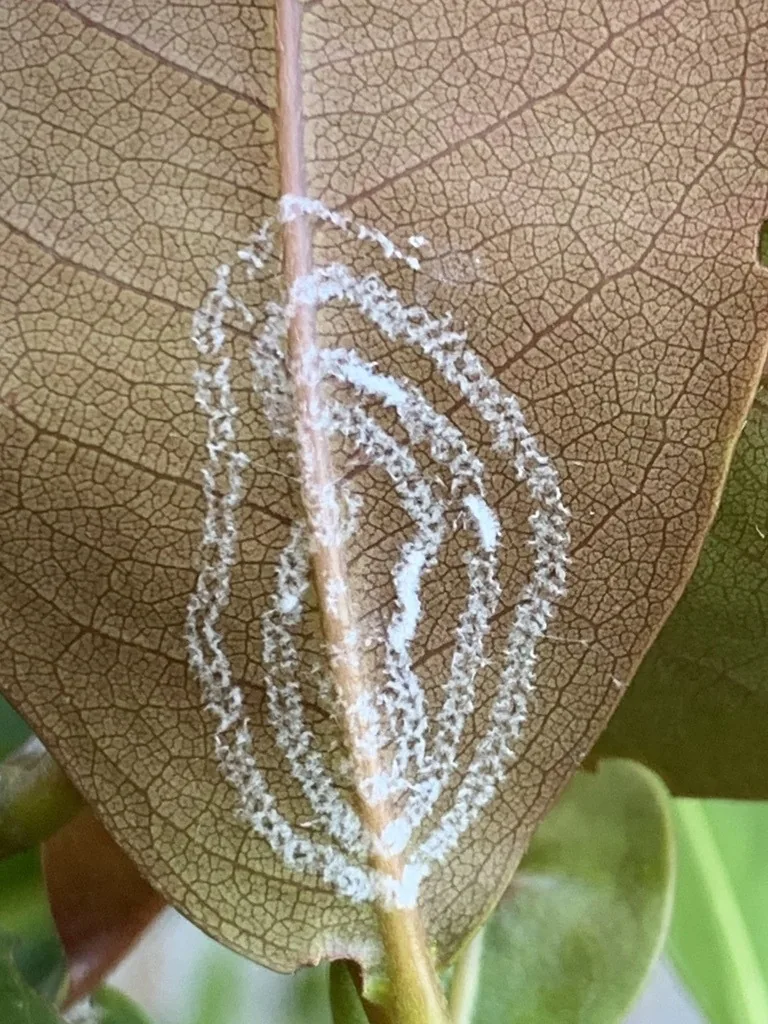
- Females lay eggs in concentric spirals or circles covered with white wax, but every Aleurodicus whitefly in Florida does this, so a spiral alone doesn't confirm the species. UF/IFAS describes the eggs as elliptical and creamy white to dark yellow, and says females sometimes lay them on cars, windows and walls.[1][3]
- Immatures on leaf undersides are about 1.1 mm long, light to golden yellow and covered with fluffy white wax and long glassy wax rods; on palms they often line up along both sides of the midrib. UF/IFAS gives nymphs as about 1.1 to 1.5 mm, depending on the stage, and says their cottony wax and long waxy filaments get denser over time.[1][3]
- Dark brown to nearly black pupal cases on the leaf usually mean the whitefly has been parasitized. Certain identification needs a slide-mounted specimen.[1]
- UF/IFAS lists five developmental stages. Only the first, the crawler, can move; it settles to feed on plant sap, and the later immature stages stay put, starting out flat and oval and becoming more domed.[3]
Look-alikes
| Look-alike | How to tell them apart |
|---|---|
| Giant whitefly | The giant whitefly (Aleurodicus dugesii) and spiraling whitefly (A. dispersus) look much like it in life and also lay eggs in waxy spirals; Florida's Division of Plant Industry says separating them requires slide-mounting the pupal stage.[1] |
| Common whiteflies | Its large size and the light brown bars across the wings set the adult apart from the small all-white whiteflies found on most garden plants. UF/IFAS says adults are about three times larger than the common whiteflies.[1][3] |
Where it lives
It is thought to be native to Central America (described from Belize) and was first collected in Florida in Miami-Dade County in March 2009. By late 2011 Florida's Division of Plant Industry also had records from Broward, Monroe, Indian River and Polk counties, and USDA ARS, citing the Division, later reported it damaging hosts in 17 Florida counties. U.S. GBIF records come from Florida plus one from Hawaii. It has since invaded South and Southeast Asia: Indian sources date its first report there to 2016 or 2017, and a 2023 survey found it damaging coconuts across coastal Bangladesh. UF/IFAS adds Mexico and Guatemala to its native range. It says that until 2011, 75% of the samples Florida's Division of Plant Industry received came from Miami-Dade County, that the worst damage was reported from Broward, Collier, Lee, Martin, Monroe, Miami-Dade, Palm Beach and St. Lucie counties, and that it has since moved inland as far as Orlando.[1][2][4][5][6][7][3]
Biology and life cycle
It feeds on a very wide range of plants: Florida listed over 60 hosts by 2012 and USDA ARS 96 by June 2012. Gumbo limbo and palms, especially coconut, are hit hardest, along with avocado, Florida black olive and Calophyllum; mango, guava and many ornamentals are also listed. UF/IFAS says Division of Plant Industry host records from 2009 to 2012 were 22% palms, 16% gumbo limbo, 10% Calophyllum, 9% avocado, 4% black olive and 3% mango, with coconut making up 44% of the palm records. By June 2015 it had been found on at least 118 plant species, though not all of them are true hosts that support its whole life cycle.[1][2][3]
In a Florida study on bird of paradise plants, females caged in groups laid about 156 eggs each; unmated females produced only male offspring, and the highest mortality came in the crawler stage.[8]
When numbers get very high, females lay eggs on almost any surface, including plants the young can't develop on, so egg spirals sometimes appear on leaves with no later stages.[1]
UF/IFAS reports a life cycle of about 30 days at 27°C (about 81°F) in University of Florida studies.[3]
Damage and signs
- Feeding stresses plants by removing water and nutrients, and the honeydew grows sooty mold that further cuts photosynthesis. UF/IFAS adds that heavy sooty mold may disrupt photosynthesis, and that the honeydew draws ants and wasps that protect the whiteflies from their natural enemies.[1][9][3]
- Homeowners deal with honeydew, sticky wax and dead whiteflies falling on cars, patios, furniture and into pools, where they can clog filters. UF/IFAS says debris in pools can affect water chemistry, and that dried sooty mold does not wash off easily and may need pressure washing or professional cleaning.[1][3]
- On coconut in Bangladesh, infested palms had fewer leaves and nuts, and the nuts were smaller with less water.[7]
Health risk
It feeds only on plants. Florida's Division of Plant Industry notes that the honeydew attracts other insects, including stinging ants, but describes no direct risk to people. UF/IFAS likewise treats it as a plant pest and a nuisance.[1][3]
Control
Prevention
UF/IFAS stresses regular monitoring, so populations can be kept below damaging levels while simple steps such as washing still work.[3]
Traps and physical control
On small plants, a jet of water or a detergent spray dislodges many of the immatures, but this is temporary and impractical on large trees and palms. UF/IFAS says pressure washing with water early in an infestation, repeated at regular intervals, removes many eggs and immatures; take care not to damage the plants. Soaps and horticultural oils also work but need thorough coverage and repeat applications.[1][3]
Biological control
A parasitic wasp, Encarsia guadeloupae, and the whitefly-eating lady beetle Nephaspis oculata attack it in Florida, and very high parasitism rates have been seen. Ants tending the whiteflies can drive these natural enemies away. UF/IFAS names a second parasitic wasp, Encarsia noyesii, along with E. guadeloupae and the lady beetle Nephaspis, as the most promising natural enemies. They are not sold commercially, but often turn up on infested plants on their own and are spreading northward.[1][3]
Pesticides
Systemic insecticides applied as soil drenches or trunk injections give good control, but Florida's Division of Plant Industry says reapplication is needed because untreated trees nearby reinfest treated ones. UF/IFAS says soil and trunk applications by licensed professionals give longer-term control, while contact sprays on foliage knock whiteflies down quickly but typically last only a few weeks. Because insecticides can kill the natural enemies, use them only when necessary and follow the label.[1][3]
In Florida trials the insect growth regulator buprofezin, alone or with the fungus Isaria fumosorosea, reduced populations for more than five weeks alone and more than seven weeks combined, and coconut studies in India found integrated programs with sticky traps, starch washes, plant oils and fungi cut infestations.[10][9]
Where the sources disagree
Immature size: Florida's Division of Plant Industry gives immatures as about 1.1 mm long, while UF/IFAS gives nymphs as 1.1 to 1.5 mm depending on the stage.[1][3]
Host count: Florida's Division of Plant Industry listed over 60 hosts and USDA ARS 96 by 2012, while UF/IFAS cites at least 118 plant species by June 2015, noting that not all are true hosts.[1][2][3]
Common questions
- What are the white wax spirals under my palm leaves?
- Most likely whitefly eggs. In South Florida the rugose spiraling whitefly is a common cause, but all Aleurodicus whiteflies there lay eggs in waxy spirals, so the spiral alone isn't proof.[1]
- Will it kill my trees?
- Florida's Division of Plant Industry describes stress and decline from heavy infestations, and on coconut it cuts leaf and nut production, but most of the trouble homeowners see is the honeydew, wax and sooty mold.[1][7]
- Why is my car covered in black sticky film under the palms?
- UF/IFAS says honeydew, sticky wax, sooty mold and dead whiteflies fall onto cars, patios and furniture below infested plants. Dried sooty mold does not wash off easily and may need pressure washing.[3]
Sources
- Florida Department of Agriculture and Consumer Services, Division of Plant Industry, “The Rugose Spiraling Whitefly, Aleurodicus rugioperculatus Martin, a New Exotic Whitefly in South Florida (Pest Alert DACS-P-01745, I. C. Stocks and G. Hodges, 2012).” ccmedia.fdacs.gov/content/download/25204/file/aleurodicus-rugioperculatus-pest-alert.pdf (accessed 2026-11-11)
- USDA Agricultural Research Service, “Aleurodicus rugioperculatus (rugose spiraling whitefly): publication record with interpretive summary and technical abstract.” www.ars.usda.gov/research/publications/publication/?seqNo115=299810 (accessed 2026-11-11)
- University of Florida IFAS Extension (EDIS), “Rugose Spiraling Whitefly, Aleurodicus rugioperculatus Martin, EENY578/IN1015 (V. Kumar, C. L. McKenzie, C. Mannion, I. Stocks, T. Smith and L. S. Osborne; Featured Creatures).” ask.ifas.ufl.edu/publication/IN1015 (accessed 2026-11-14)
- Global Biodiversity Information Facility (GBIF), “Aleurodicus rugioperculatus: occurrence records, 1990-2026 (GBIF occurrence search).” api.gbif.org/v1/occurrence/search?taxonKey=8026152&hasGeospatialIssue=false&occurrenceStatus=PRESENT&year=1990%2C2026&facet=stateProvince&facet=country&facetLimit=400&limit=0 (accessed 2026-11-11). Counts are records reported (iNaturalist research-grade, museum specimens, surveys), not abundance; the U.S. state split uses the same query with country=US.
- Pest Management Science, via PubMed, “Maruthadurai R, Das B, Ramesh R (2023), Predicting the invasion risk of rugose spiraling whitefly, Aleurodicus rugioperculatus, in India based on CMIP6 projections by MaxEnt, Pest Management Science 79(1):295-305.” pubmed.ncbi.nlm.nih.gov/36151887/ (accessed 2026-11-11). Cited from the PubMed abstract.
- OMICS, via PubMed, “Muliyar Krishna R et al. (2025), The genome sequence of the rugose spiraling whitefly (Aleurodicus rugioperculatus Martin), OMICS 29(8):394-403.” pubmed.ncbi.nlm.nih.gov/40664507/ (accessed 2026-11-11). Cited from the PubMed abstract.
- Journal of Economic Entomology, via PubMed, “Swarnaa IJ, Sheheli S, Finch EA, Khan MAM (2023), Invasion of rugose spiraling whitefly (Hemiptera: Aleyrodidae) across Bangladesh coastal region causes widespread damage to coconut plants, Journal of Economic Entomology 116(3):864-871.” pubmed.ncbi.nlm.nih.gov/37000444/ (accessed 2026-11-11). Cited from the PubMed abstract.
- Journal of Economic Entomology, via PubMed, “Taravati S, Mannion C (2016), Effect of aggregation and cage setting on some life-history parameters of Aleurodicus rugioperculatus (Hemiptera: Aleyrodidae), Journal of Economic Entomology 109(1):249-254.” pubmed.ncbi.nlm.nih.gov/26494708/ (accessed 2026-11-11). Cited from the PubMed abstract.
- Frontiers in Insect Science, via PubMed, “Borbaruah P et al. (2026), Integrated evaluation of plant oils, entomopathogenic fungi and insecticides against rugose spiralling whitefly (Aleurodicus rugioperculatus Martin) on coconut, Frontiers in Insect Science 6:1829366.” pubmed.ncbi.nlm.nih.gov/42344313/ (accessed 2026-11-11). Cited from the PubMed abstract.
- Journal of Economic Entomology, via PubMed, “Kumar V et al. (2018), Assessing compatibility of Isaria fumosorosea and buprofezin for mitigation of Aleurodicus rugioperculatus (Hemiptera: Aleyrodidae), an invasive pest in the Florida landscape, Journal of Economic Entomology 111(3):1069-1079.” pubmed.ncbi.nlm.nih.gov/29546290/ (accessed 2026-11-11). Cited from the PubMed abstract.
- iNaturalist, “Aleurodicus rugioperculatus taxon page (order and family).” www.inaturalist.org/taxa/204448 (accessed 2026-11-11)