On this page
How to identify it
- Adults are up to 3/16 inch (about 4 mm) long, large for a whitefly. UC IPM describes them as white with light brown wing markings; its photo captions call the pattern mottled gray. Hawaii's agriculture department says the wings are highly patterned and held tent-like over the body.[1][2]
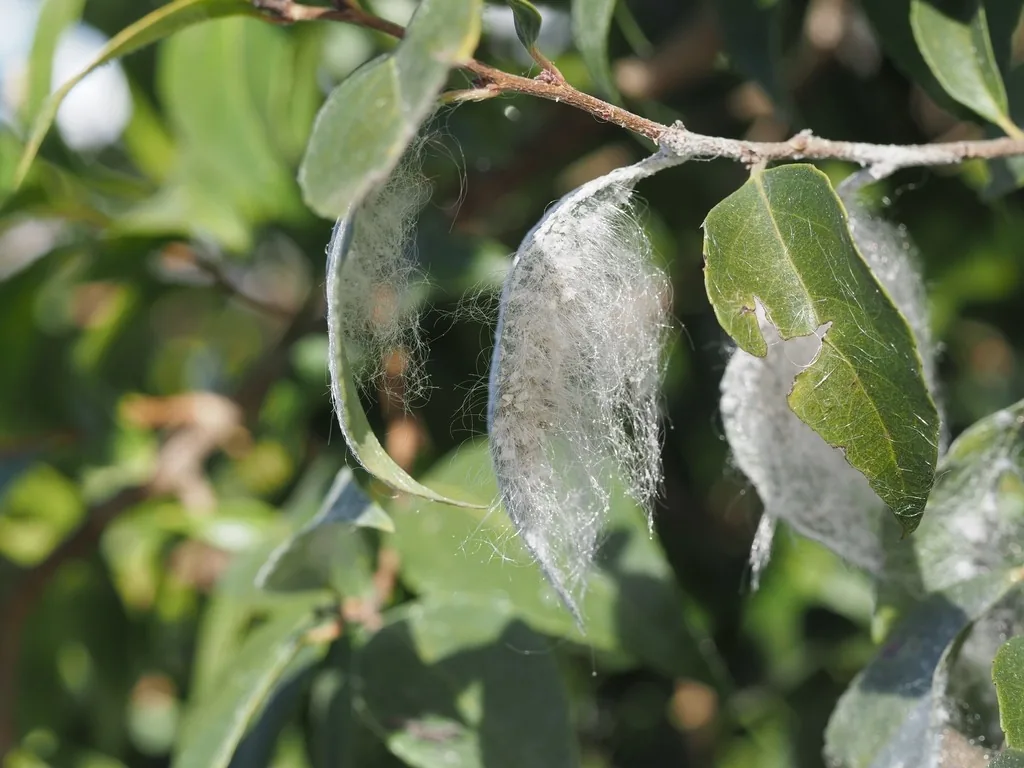
- Adults lay eggs in spirals of wax on leaf undersides; nymph wax filaments often reach 2 inches and can top 10 inches out of the wind.[1]
- Nymphs are oval, yellowish and immobile. Their wax is heaviest in the third and fourth stages and is often mistaken for a fungus.[1]
Look-alikes
| Look-alike | How to tell them apart |
|---|---|
| Spiraling whitefly (Aleurodicus dispersus) | Hawaii's agriculture department says spiraling whitefly has few wing markings and holds its wings flat, while giant whitefly wings are highly patterned and held tent-like.[2] |
Where it lives
Native to Mexico, it reached Texas in 1991 and is established in California, Arizona, Florida, Louisiana and Hawaii. In California it was found in San Diego in 1992 and has spread north to the Bay Area and the southern Sacramento Valley; in Hawaii it was found at Honolulu airport in 2002 and reached Kauai, the Big Island and Maui by 2004.[1][2]
Biology and life cycle
Life stages are egg, four nymph stages and a winged adult, mostly on leaf undersides.[1]
Adults feed in groups and most stay on the plant where they emerged, so infestations cluster.[1]
Damage and signs
- Heavy feeding causes early leaf aging, leaf drop and dieback, and honeydew grows sooty mold. UC IPM says affected plants may be weakened but rarely die.[1]
- UC IPM's most affected hosts include begonia, hibiscus, bird of paradise, orchid tree, banana, mulberry, xylosma and some citrus and avocado.[1]
- In Hawaii, wax blown off infested plants can stick to outdoor furniture.[2]
Health risk
It feeds on plant sap. UC IPM, UC Riverside and Hawaii's agriculture department treat it only as a plant pest and don't mention any risk to people or pets.[1][3][2]
Control
Prevention
It prefers shady spots, so grow susceptible plants in full sun. UC IPM says yellow hibiscus is less preferred than red hibiscus, giant bird of paradise and xylosma.[1]
Sanitation
Remove infested leaves early and seal them in plastic bags, or adults keep emerging from them.[1]
Traps and physical control
A strong stream of water on leaf undersides, weekly when numbers are high, worked as well as several insecticides in comparisons.[1]
Biological control
Native predators don't keep it in check, but parasitic wasps introduced from Texas and Mexico in the 1990s are now established, and UC IPM finds no evidence that buying and releasing natural enemies helps.[1]
Pesticides
Before using any insecticide, check nymphs for parasitoid exit holes or a dark color. If spraying, UC IPM suggests insecticidal soap or oil.[1]
Research on its parasitic wasps
A 2018 Environmental Entomology study found it completed development only between 15 and 28°C (59 to 82°F), with adult survival highest at 25°C (77°F).[4]
UC IPM says Entedononecremnus krauteri was released from Texas in 1995 and is now the least effective; Encarsia noyesi and Idioporus affinis, brought from Mexico in 1996, do most of the work.[1]
A 2018 study found I. affinis parasitized all nymph stages but preferred the third, E. noyesi skipped the first and preferred the fourth, and E. krauteri used only the last two, which may help the three coexist. A 2021 study found all three developed between 15 and 30°C.[5][6]
Where the sources disagree
How much harm it does: UC IPM says giant whitefly feeding rarely causes plant death; UC Riverside says feeding leads to defoliation, stunting and plant death; Hawaii's agriculture department says heavy infestations usually result in the decline of plants.[1][3][2]
How many hosts: UC Riverside calls it a pest of more than 50 common ornamentals with a potential host list of around 200 plants; a 2018 study lists more than 300 plant species in the U.S.[3][4]
When it reached Florida and Louisiana: UC Riverside says it was found in both in 1996; Hawaii's agriculture department gives 1996 for Florida and lists Louisiana without a date.[3][2]
Which wasps matter: in California, UC IPM credits Encarsia noyesi and Idioporus affinis, brought from Mexico in 1996; in Hawaii, the agriculture department says Encarsia guadeloupae gave only a low level of control and that Idioporus affinis, found in 2003, is providing excellent control.[1][2]
Common questions
Sources
- University of California Statewide IPM Program, “Giant Whitefly (Pest Notes).” ipm.ucanr.edu/home-and-landscape/giant-whitefly/ (accessed 2026-11-13)
- Hawaii Department of Agriculture, Plant Pest Control Branch, “Giant Whitefly, Aleurodicus dugesii Cockerell (New Pest Advisory No. 02-04, updated June 2004).” dab.hawaii.gov/pi/files/2013/01/npa02-04-giantwf.pdf (accessed 2026-11-13)
- University of California, Riverside, Center for Invasive Species Research, “Giant Whitefly.” cisr.ucr.edu/invasive-species/giant-whitefly (accessed 2026-11-13)
- Peer-reviewed literature (PubMed), “Temperature-Dependent Development and Survival of Giant Whitefly Aleurodicus dugesii (Hemiptera: Aleyrodidae) Under Constant Temperatures (Schoeller EN et al., Environmental entomology, 2018).” pubmed.ncbi.nlm.nih.gov/30188988/ (accessed 2026-11-13)
- Environ Entomol 2018;47(6):1493-1500, via PubMed, “Host Stage Preferences of Encarsia noyesi, Idioporus affinis, and Entedononecremnus krauteri: Parasitoids of the Giant Whitefly Aleurodicus dugesii (2018).” pubmed.ncbi.nlm.nih.gov/30165469/ (accessed 2026-11-13)
- Environ Entomol 2021;50(1):192-201, via PubMed, “The Effects of Temperature and Host Stage on Development Rate of Parasitoids of Giant Whitefly Aleurodicus dugesii (2021).” pubmed.ncbi.nlm.nih.gov/33269382/ (accessed 2026-11-13)
- Global Biodiversity Information Facility (GBIF), “Aleurodicus dugesii Cockerell, 1896 (GBIF Backbone Taxonomy).” api.gbif.org/v1/species/7741971 (accessed 2026-11-13)
- iNaturalist, “Aleurodicus dugesii taxon page (order and family).” www.inaturalist.org/taxa/367947 (accessed 2026-10-06)