On this page
How to identify it
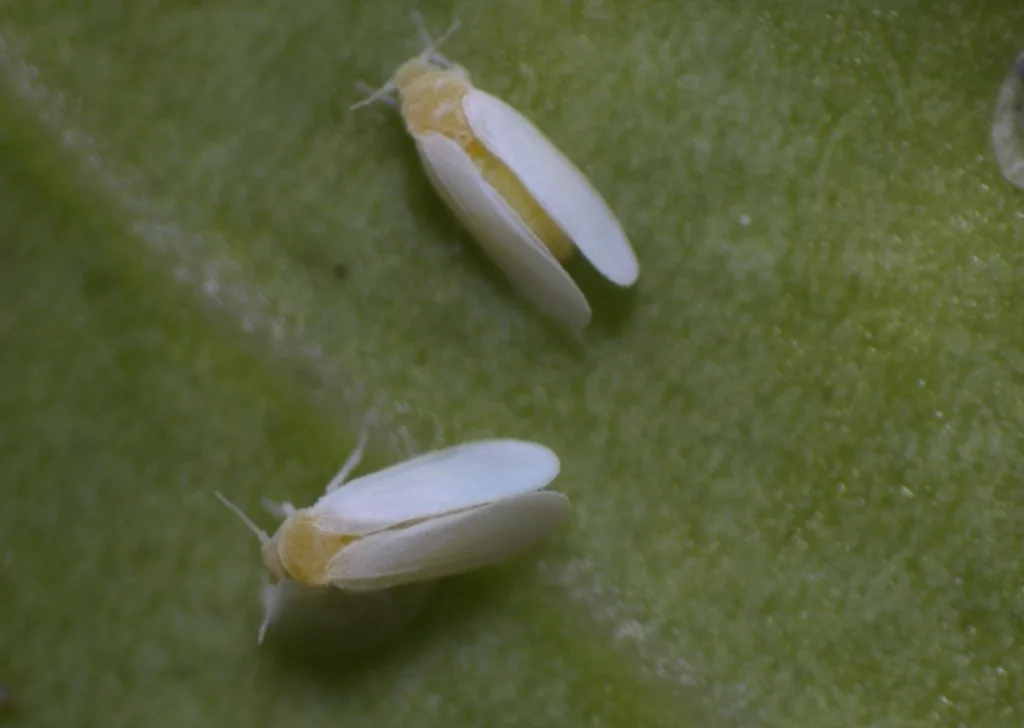
- Adults are about 0.8 mm (males) to 1.2 mm (females) long, with a yellowish body and white wings under a fine, whitish, powdery wax. UF/IFAS measures females at 0.96 mm and males at 0.82 mm, and says new adults are soft and whitish-yellow, their wings turning iridescent white within a few hours as the powdery wax is laid down.[1][4][2][5]
- They hold their wings tilted rooflike over the body, usually with a small gap down the middle of the back.[2][4]
- Eggs are yellow, partly inserted in the underside of the leaf, and turn purplish brown just before hatching. Unlike other whiteflies, females don't lay them in a circle. UF/IFAS says each egg is about 0.21 mm long, with a short stalk the female inserts into the leaf and through which the egg takes up moisture; the far end turns dark brown just before hatching.[1][5]
- Crawlers have legs and antennae and lose them at the first molt; later nymphs are flat, scale-like and fixed in place. The last stage, the pupa or red-eyed nymph, is oval, whitish and soft, tapers down to the leaf and has few or no long wax filaments. UF/IFAS says the crawler is about 0.27 mm long, whitish-green with two yellow spots, and usually moves only a few centimeters; the later, immobile nymphs are greenish-yellow and grow from 0.365 to 0.662 mm. The red-eyed stage is more convex and more yellow.[1][2][5]
- Colonies make almost no white wax, unlike most other whiteflies found on cucurbits.[2]
Look-alikes
| Look-alike | How to tell them apart |
|---|---|
| Greenhouse whitefly | Larger, with wings held flatter over the back and no gap where they meet; its pupae carry many long wax filaments, and its eggs are often laid in a circle or crescent. UF/IFAS says greenhouse whiteflies hold their wings more loosely, the sides of their red-eyed nymphs stand straight up from the leaf instead of bulging slightly, and under a microscope their upper and lower eyes are completely divided.[1][2][6][5] |
Where it lives
The silverleaf whitefly attacks a wide range of plants in the United States. In the Southeast it is the most common and destructive whitefly in nurseries, with adults active from mid-July to mid-October; in California it is a major problem in the southern desert and an increasing one in the southern San Joaquin Valley. Krause-Sakate and colleagues report MEAM1 established throughout the United States. UF/IFAS says it is found throughout the southern United States, overwinters outdoors as far north as South Carolina and infests greenhouses farther north in the United States and Canada; worldwide it is a pest in tropical and warm temperate regions.[1][2][7][5]
Biology and life cycle
A female lays 50 eggs in cold conditions to 400 in warm ones on the undersides of leaves; they hatch in 4 to 12 days, depending on temperature, into crawlers that settle down to feed.[1]
There are four nymphal stages; adults emerge from the last, through a T-shaped slit in a healthy whitefly's case, and live about a month. A complete life cycle takes 16 to 31 days.[1][4]
Bemisia tabaci is a complex of more than 40 look-alike species. The invasive MEAM1 and MED members are the most widespread and economically important.[8][7]
In California, populations peak in late summer and begin to decrease by November.[2]
It is an introduced pest that escaped its natural enemies; native parasites and predators attack it but don't keep it below damaging numbers.[2]
UF/IFAS says mating happens within a few hours of adults emerging, and unmated females lay eggs that produce only males. At 25 degrees C eggs hatch in six to seven days; the crawler molts two to three days later, the second and third stages each last about two to three days, and the fourth and red-eyed stages together last five to six days.[5]
Most adults just fly up the same plant or to the next one, but UF/IFAS says some, usually raised on aging plants, migrate up to several kilometers, and these flights can be massive enough to badly infest newly planted crops.[5]
Damage and signs
- Sap feeding causes severe yellowing, stunting, drying and early leaf drop, and young plants rarely survive heavy infestations.[1][2]
- Sticky honeydew grows black sooty mold that cuts photosynthesis, makes plants unsightly and can make fruit unmarketable.[1][2]
- It spreads plant viruses. In California it has transmitted lettuce infectious yellows virus and squash leaf curl virus in cucurbits; in the Southeast both MEAM1 and MED transmit tomato yellow leaf curl virus, and MEAM1 also transmits cucurbit leaf crumple virus and sida golden mosaic virus. In Florida, UF/IFAS lists tomato yellow leaf curl virus, bean golden mosaic virus, squash vein yellowing virus, cucurbit leaf crumple virus and cucurbit yellow stunting disorder virus as the main concerns.[2][3][5]
- Its feeding turns squash leaves whitish or silver, which gives the insect its name. Wisconsin says it causes phytotoxemia in poinsettia because it extracts more sap than other whiteflies.[2][9]
- Hosts include poinsettia, begonia, hibiscus, gerbera, lantana, verbena, chrysanthemum, salvia, roses, cole crops, cotton, cucurbits, tomatoes and peppers; adults are especially drawn to blooming plants with yellow flowers. UF/IFAS counts over 500 host species in 74 plant families; in Florida it is a major pest of tomato, peppers, squash, cucumber, beans, eggplant, watermelon and cabbage, and it also attacks potato, peanut, soybean and cotton.[1][4][5]
- Feeding by the nymphs, not the adults, causes plant disorders. UF/IFAS describes squash silverleaf, in which new leaves turn silvery as the upper skin separates from the cells beneath, and tomato irregular ripening, which leaves fruit streaked outside or white and hard inside; both were first noted in Florida in 1987. Others include lettuce leaf yellowing, carrot light root, pepper streak and Brassica white stem.[5]
Health risk
It feeds only on plants; none of these sources reports any harm to people or pets.[1][2]
Control
Prevention
Don't bring home infested transplants; UC IPM says that is how the silverleaf whitefly spread to new parts of California. Inspect new plants, keep them apart for a while before planting, and check the undersides of leaves regularly.[2][1][10]
Silver reflective plastic mulch laid at planting reduces the number of whiteflies landing on melon leaves and delays their buildup; in desert areas remove it when summer heat gets excessive.[2][4]
UF/IFAS says smooth-leaved varieties of many plants, and glossy crucifers such as broccoli and collard, are less favored for egg laying, and some tomato varieties tolerate tomato yellow leaf curl virus, though no variety is highly resistant to the whitefly itself.[5]
Sanitation
Remove heavily infested leaves, old plant residues and weeds such as field bindweed to reduce nymphs and pupae.[1][2]
For tomato yellow leaf curl virus, UF/IFAS advises home gardeners to destroy and dispose of tomato plants showing symptoms so they can't infect healthy plants, and to remove crop residue, especially tomato plants, after harvest.[5]
Traps and physical control
Yellow sticky cards at canopy height catch adults and show when they arrive, but UC IPM says counting adults on leaves gives a more accurate picture than trap catches.[1][2]
Biological control
Lacewing larvae, lady beetles, minute pirate bugs, bigeyed bugs and parasitic wasps such as Eretmocerus eremicus attack it, and the tiny lady beetle Delphastus catalinae eats its eggs and nymphs. UF/IFAS says that in Florida natural enemies keep it below damaging levels where no insecticides are used, with Encarsia and Eretmocerus wasps the most common parasitoids; a round hole in an empty nymphal case, instead of a T-shaped slit, means a wasp came out.[1][2][5]
Pesticides
Sprays must reach the undersides of the leaves. The University of Georgia and Missouri both say control takes 4 to 5 applications at 5- to 7-day intervals, rotating products with different modes of action because whiteflies build resistance. Follow the label of any product used. UF/IFAS advises home gardeners to treat before populations reach outbreak levels, spraying the nymphs with insecticidal soap or oil and covering the undersides of the leaves.[1][10][5]
Where it occurs
Krause-Sakate and colleagues report MEAM1 established throughout the United States and MED documented in 27 states, and MED has recently been found outside greenhouses in Florida and Georgia.[7][3]
In colder climates whiteflies die outdoors, but they keep breeding through the year indoors and in greenhouses.[10][4]
Where sources disagree
Name: the University of Georgia treats Bemisia argentifolii as the same insect as B. tabaci biotype B; Wisconsin lists the silverleaf whitefly (B. argentifolia) separately from the sweet potato whitefly (B. tabaci).[1][9]
Size: the University of Georgia gives 0.8 to 1.2 mm; UC IPM says whiteflies on cucurbits are about 0.06 inch (1.5 mm) long; UF/IFAS measures females at 0.96 mm and males at 0.82 mm.[1][2][5]
Quarantine for new plants: the University of Georgia suggests 1 to 2 weeks; Missouri says a few days.[1][10]
Egg pattern: the University of Georgia says females don't lay eggs in a circle; UF/IFAS says they often lay them in a semicircle as they swivel around a feeding site.[1][5]
Egg color: the University of Georgia says eggs are yellow and turn purplish brown before hatching; UF/IFAS says they are pearly white when laid and darken, the tip turning dark brown.[1][5]
Eggs and lifespan: the University of Georgia gives 50 to 400 eggs per female and an adult life of about a month; UF/IFAS says females live 10 to 24 days and lay 66 to 300 eggs, depending on host plant and temperature.[1][5]
Natural enemies: UC IPM says native parasites and predators don't keep it below damaging numbers in California; UF/IFAS says that in Florida it rarely reaches outbreak levels where no insecticides are applied.[2][5]
Common questions
- What are the tiny white bugs that fly up from my plants?
- Clouds of tiny white insects rising from the undersides of leaves are whiteflies; small, yellowish ones with rooflike wings on vegetables or ornamentals such as lantana are likely silverleaf whiteflies.[1][2][10]
- Why are my plant's leaves sticky and black?
- Whiteflies excrete sugary honeydew, and black sooty mold grows on it.[1][2]
- Why are my squash leaves turning silver?
- Silverleaf whitefly feeding often turns squash leaves whitish or silver; check the leaf undersides for whiteflies and their nymphs.[2]
- How can I tell if whitefly nymphs have been parasitized?
- Look at the empty cases on the leaf undersides. UF/IFAS says a healthy adult whitefly leaves through a T-shaped slit, while a round hole means a parasitic wasp emerged instead.[5]
Sources
- University of Georgia Department of Entomology, “Silverleaf Whitefly: A Pest in Nursery and Greenhouse Ornamental Crops (April 2023).” site.caes.uga.edu/entomologyresearch/2023/04/silverleaf-whitefly-a-pest-in-nursery-and-greenhouse-ornamental-crops (accessed 2026-11-12)
- University of California Statewide IPM Program, “Whiteflies (Cucurbits, Pest Management Guidelines).” ipm.ucanr.edu/agriculture/cucurbits/whiteflies/ (accessed 2026-11-12)
- Viruses, via PubMed, “Differential Transmission of Old and New World Begomoviruses by MEAM1 and MED Cryptic Species of Bemisia tabaci (2022).” pubmed.ncbi.nlm.nih.gov/35632844/ (accessed 2026-11-11)
- University of California Statewide IPM Program, “Whiteflies (Pest Notes, Home and Landscape).” ipm.ucanr.edu/home-and-landscape/whiteflies/ (accessed 2026-11-11)
- University of Florida IFAS Extension (EDIS), “Sweetpotato Whitefly B Biotype, Bemisia tabaci (Gennadius), EENY-129/IN286 (H. J. McAuslane and H. A. Smith; Featured Creatures).” ask.ifas.ufl.edu/publication/IN286 (accessed 2026-11-14)
- University of Minnesota, College of Food, Agricultural and Natural Resource Sciences (Horticultural IPM), “Greenhouse Whitefly.” ncipmhort.cfans.umn.edu/greenhouse-whitefly (accessed 2026-11-11)
- Journal of Economic Entomology, via PubMed, “First detection of Bemisia tabaci MED in Oklahoma and development of a high-resolution melting assay for MEAM1 and MED discrimination (Krause-Sakate et al. 2025).” pubmed.ncbi.nlm.nih.gov/39673486/ (accessed 2026-11-11)
- PLoS One, via PubMed, “Evidence of the association between the Q2 mitochondrial group of Bemisia tabaci MED species and low competitive displacement capability (Rossitto De Marchi et al. 2023).” pubmed.ncbi.nlm.nih.gov/36634115/ (accessed 2026-11-11)
- University of Wisconsin-Madison Extension (Wisconsin Horticulture), “Whiteflies.” hort.extension.wisc.edu/articles/whiteflies/ (accessed 2026-11-11)
- University of Missouri Extension, “Managing Whiteflies on Indoor and Outdoor Plants (G7275).” extension.missouri.edu/publications/g7275 (accessed 2026-11-11)
- iNaturalist, “Bemisia tabaci taxon page (order and family).” www.inaturalist.org/taxa/199414 (accessed 2026-11-11)