On this page
How to identify it
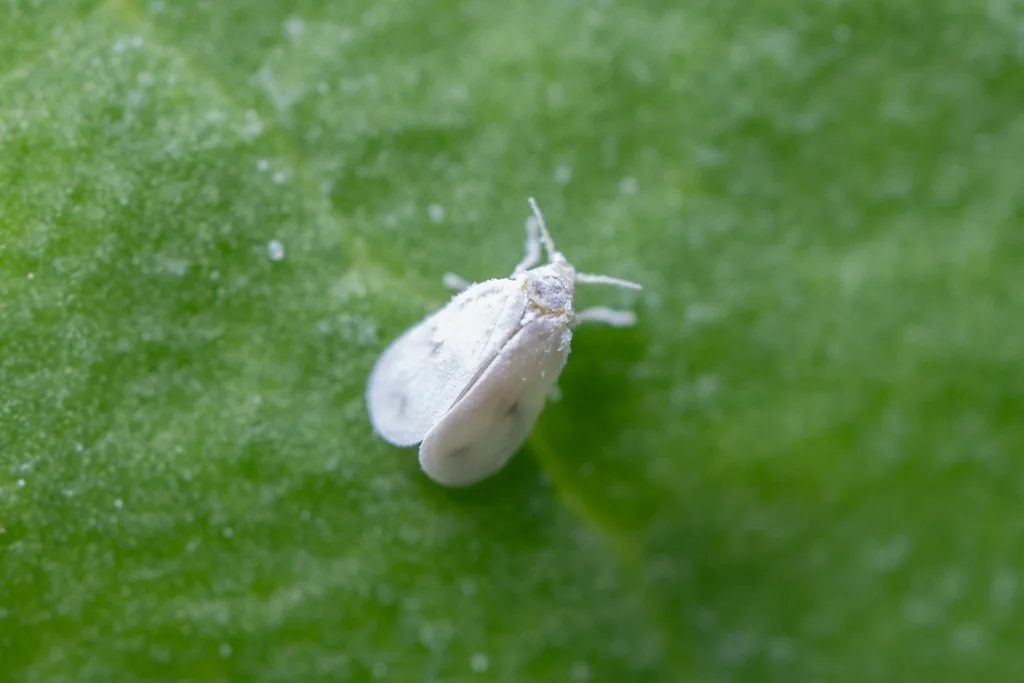
- Adults are tiny, white and mothlike, with white wings and a waxy white thorax; when abundant they fly up in clouds. The PNW handbook puts them under 0.05 inch, while the Oregon Department of Agriculture and the RHS say about 1.5 mm (1/16 inch).[1][2][3]
- Nymphs are whitish green, flat and oval, and covered with dense wax.[1]
- Each forewing has a faint dark bar, often broken into two spots, so in the field look for two pale gray blotches per wing.[2]
- Eggs are laid in a circle or semicircle on a patch of wax, leaving circular waxy marks on the undersides of leaves.[2]
Look-alikes
| Look-alike | How to tell them apart |
|---|---|
| Greenhouse whitefly | Greenhouse whitefly has longer wings, a yellow thorax and a much wider host range. The RHS says glasshouse and viburnum whiteflies are rarely found on brassicas, and glasshouse whitefly won't feed on brassicas outdoors.[1][3] |
Where it lives
It's originally from Europe and has spread to Russia, Taiwan, Australia, New Zealand, Bermuda, Brazil and Africa. It has been in the northeastern U.S. since at least 1993, was found in California in 2001 and in a southeast Portland backyard in 2014.[2][4]
Biology and life cycle
Adults spend winter on the undersides of host leaves, including nearby related weeds, and can spend the whole year on one plant. The RHS says adults are active all year.[1][2][3]
When problems persist, check nearby brassica weeds; as they mature or die off, whiteflies move to more valuable plants.[1]
There are two to six generations a year. Eggs hatch in about 12 days, nymphs pass through three stages, and the immobile fourth stage, often called a pupa, has red eyes and lasts about 10 days.[2]
Sources differ on hosts. The Oregon Department of Agriculture says it feeds on plants in several families, including alfalfa and clover, though brassicas are its main hosts; the RHS says it's found only on brassicas. In a greenhouse study it laid the most eggs on winter oilseed rape and did worst on white cabbage.[2][3][4]
It travels mainly on live plants, but wind can also carry it.[2]
Damage and signs
- Damage is usually limited to curled, yellowed outer leaves and sooty mold on honeydew, especially on ornamental kale. Eggs, nymphs and wax also lower the quality of leafy crops, and large populations can cause leaf drop.[1][2]
- Sources disagree on plant viruses. The PNW handbook says adults and nymphs can spread a great number of viruses, while the Oregon Department of Agriculture says it isn't known to carry any plant disease.[1][2]
- The RHS says it's often not a serious problem, but sooty mold on sprout buttons and kale leaves can be.[3]
Health risk
It feeds on plants; none of the sources mentions any risk to people.[1][2][3]
Control
Prevention
Monitor with yellow sticky traps next to suspect plants, and look closer when paper wasps and yellowjackets patrol the beds. When problems persist, check nearby brassica weeds, since whiteflies move to crops as the weeds die off.[1]
Keep them out
Isolate new plants until you've checked them for eggs, nymphs and pupae, since adults may not be present on arrival.[1]
Biological control
Sources disagree about Encarsia formosa. The PNW handbook calls this wasp and predatory Delphastus beetles effective, but the RHS says cabbage whitefly isn't a host for Encarsia formosa; native Encarsia species do parasitize it, and German research found Encarsia tricolor to be its main parasitoid.[1][3][5]
The RHS suggests tolerating light infestations and encouraging ladybirds, wasps and ground beetles. German studies found natural enemies often arrive late or in low numbers on cabbage, and perennial plants such as wood avens that host other whiteflies can build them up.[3][5]
Common questions
- What are the tiny white flies swarming my kale?
- Likely cabbage whiteflies; when abundant they fly up in clouds from brassica plants, and you'll find waxy egg circles under the leaves.[1][2]
- How is cabbage whitefly different from greenhouse whitefly?
- Greenhouse whitefly has longer wings, a yellow thorax and a much wider host range.[1]
- Will Encarsia wasps control cabbage whitefly?
- Sources disagree. The PNW handbook lists Encarsia formosa as effective, but the RHS says cabbage whitefly isn't a host for it.[1][3]
Sources
- Pacific Northwest Pest Management Handbooks (OSU, WSU, University of Idaho), “Emerging Insect Pests in the Pacific Northwest: Cabbage whitefly (2016).” pnwhandbooks.org/insect/emerging-insect-pests/emerging-insect/cabbage-whitefly-2016 (accessed 2026-11-13)
- Oregon Department of Agriculture, “Pest Alert: Cabbage Whitefly, Aleyrodes proletella.” www.oregon.gov/oda/Documents/Publications/IPPM/CabbageWhiteflyAlert.pdf (accessed 2026-11-13)
- Royal Horticultural Society (UK), “Cabbage whitefly (RHS Advice).” www.rhs.org.uk/biodiversity/cabbage-whitefly (accessed 2026-11-13)
- Journal of Economic Entomology, 2019 (via PubMed), “Life History Parameters of Aleyrodes proletella (Hemiptera: Aleyrodidae) on Different Host Plants (abstract).” pubmed.ncbi.nlm.nih.gov/30380046/ (accessed 2026-11-13)
- Insects, 2021 (via PubMed), “Conservation of Non-Pest Whiteflies and Natural Enemies of the Cabbage Whitefly Aleyrodes proletella on Perennial Plants for Use in Non-Crop Habitats (abstract).” pubmed.ncbi.nlm.nih.gov/34564214/ (accessed 2026-11-13)
- Global Biodiversity Information Facility (GBIF), “Aleyrodes proletella (Linnaeus, 1758) (GBIF Backbone Taxonomy).” api.gbif.org/v1/species/4484303 (accessed 2026-11-13)