On this page
How to identify it
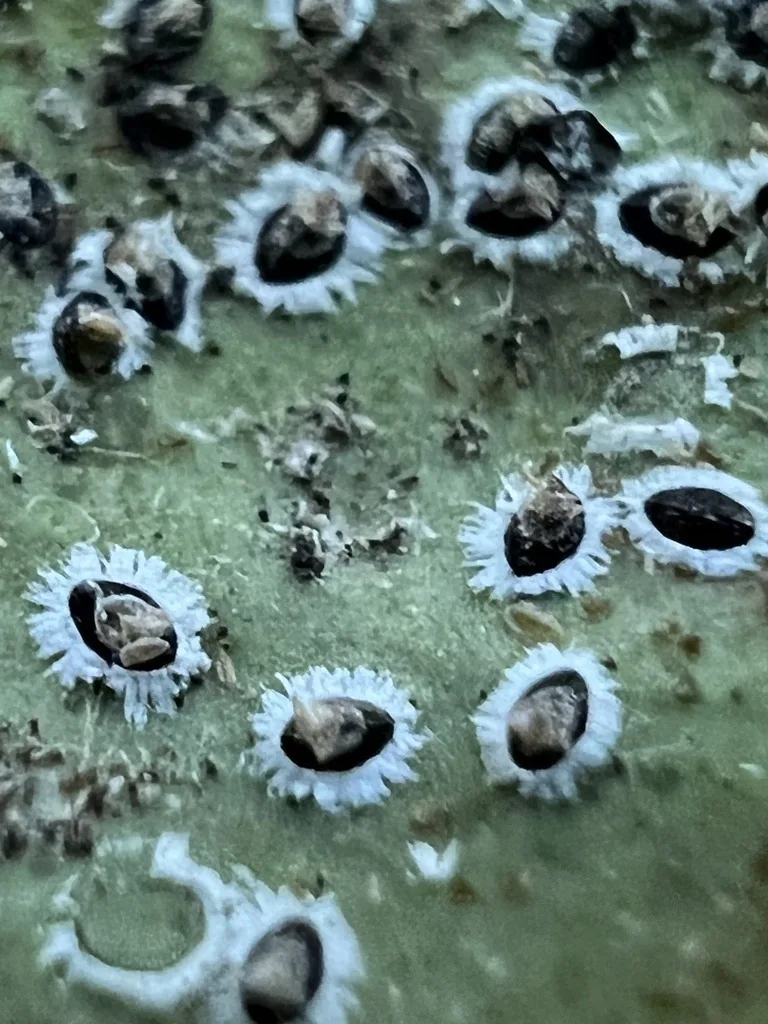
- The late-stage nymphs, called pupae, are round to oval, shiny black and ringed with a white wax fringe that lies out flat rather than curling over the body; they are often mistaken for scale insects.[1][2][3]
- Adults are tiny. NC State describes them as pale gray with darker gray spots, jagged lines and markings on the forewings; UC IPM describes reddish to gray wing markings, including a blotch at the base and tip of each wing.[1][3]
- Young crawlers are tiny and yellow; once they settle they stay in one spot until the adult emerges.[1]
- The pupae often still carry their earlier shed skins on top, though some lose them. The pupa is really the fourth and last nymph stage, which Ohio State notes is called a pupa even though whiteflies have no true pupal stage.[1][2]
Look-alikes
| Look-alike | How to tell them apart |
|---|---|
| Armored and soft scales | Scales can look similar from a distance, but mulberry whitefly pupae have the distinctive white fringe and give rise to tiny winged adults.[2][1] |
| Redbanded whitefly | On avocado in California, the redbanded whitefly's pupal fringe curls over the body, while the mulberry whitefly's extends out flat.[3] |
Where it lives
NC State calls it a minor pest of shrubs and trees in North Carolina, Ohio State found it on hollies in southwest Ohio, and UC IPM lists it as the fourth most abundant of five whitefly species on avocado in California.[1][2][5]
Biology and life cycle
Females insert just the tip of each egg into the underside of a leaf, and crawlers hatch about two weeks later.[1]
Nymphs feed in one spot, growing larger and darker with each molt, and the new adult emerges a month or more after the crawler settles.[1]
It has multiple, sometimes overlapping, generations a year.[2]
NC State lists American holly, avocado, boxelder, citrus, flowering dogwood, mountain laurel, mulberry, Norway and red maple, Virginia sweetspire and wax myrtle; Ohio State adds mahonia, hackberry and sweetgum, and UC IPM says it has hosts in over a dozen plant families.[1][2][5]
Damage and signs
- Whiteflies suck sap from the leaves and excrete honeydew, on which black sooty mold often grows.[1][2]
- Most references say it rarely causes significant injury to woody ornamentals, and Ohio State found no symptoms on infested large-leaved hollies. On small-leaved Japanese holly ('Glory'), though, an infestation caused stippling and loss of older leaves that could be mistaken for spider mite injury.[2][1]
- On avocado, UC IPM says whitefly honeydew collects dust and attracts ants, which interfere with the natural enemies that control whiteflies.[5]
Health risk
It feeds on plant sap, and no cited source describes any risk to people or pets.[1][2]
Control
Biological control
Whiteflies have many predators, parasites and diseases. UC IPM says parasitic wasps (Cales, Encarsia and Eretmocerus species) are the most important and usually keep whiteflies on avocado under very good biological control unless ants, dust or insecticides disrupt them.[1][5]
Pesticides
Sources differ on spraying. For landscape plants, NC State says treatment is probably unnecessary unless whiteflies become tremendously abundant; it is not particularly resistant to pesticides, insecticidal soaps work well on adults and horticultural oils give some control of nymphs. For avocado orchards UC IPM recommends no pesticides for whiteflies, saying treatment often doesn't work and can be followed by a resurgence, especially after broad-spectrum insecticides.[1][5]
Common questions
- What are the black spots with white fringes under my holly leaves?
- Most likely mulberry whitefly pupae, the late nymph stage, which are often mistaken for scale insects.[2][1]
- Do I need to spray for mulberry whitefly?
- Usually not. NC State calls it more a curiosity than a pest and suggests treating only if it becomes tremendously abundant.[1]
Sources
- NC State Extension, “Mulberry Whitefly (PDIC Factsheet).” content.ces.ncsu.edu/mulberry-whitefly (accessed 2026-11-13)
- Ohio State University Extension, “Mulberry Whitefly "Pupae" Can Present an ID Challenge (Buckeye Yard & Garden onLine).” bygl.osu.edu/index.php/node/763 (accessed 2026-11-13)
- University of California Statewide IPM Program, “Whitefly species that occur on avocado in California (identification figure; archived page).” ipm.ucanr.edu/PMG/FIG/avo-whiteflies.html (accessed 2026-11-13)
- Global Biodiversity Information Facility (GBIF), “Tetraleurodes mori (Quaintance, 1899) (GBIF Backbone Taxonomy).” api.gbif.org/v1/species/8132564 (accessed 2026-11-13)
- University of California Statewide IPM Program, “Whiteflies (Avocado Pest Management Guidelines, UC ANR Publication 3436).” ipm.ucanr.edu/agriculture/avocado/whiteflies/ (accessed 2026-11-13)