On this page
How to identify it
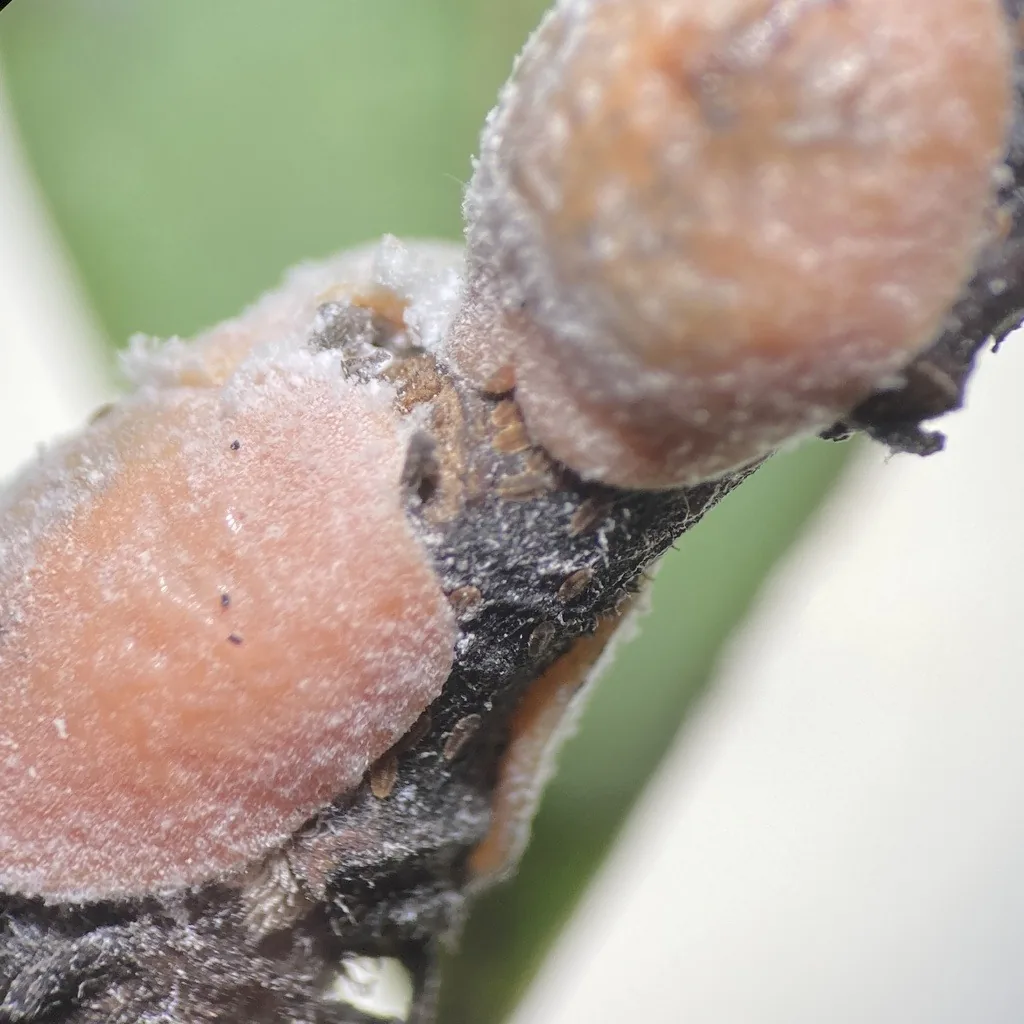
- Adult females are about 1/2 inch (12 mm) across, smooth, elliptical and convex, and pinkish-orange to brown under a white, waxy coating.[1][2]
- Overwintering nymphs are dark gray with a red-brown ridge down the middle.[1][2]
- On heavily infested trees, twigs that are normally light green can look swollen and purple.[2]
Look-alikes
| Look-alike | How to tell them apart |
|---|---|
| Other scale insects | Scale species differ in when their crawlers are active, so identify the species before timing any spray. Magnolia scale is unusually large and lives only on magnolia.[1][2] |
Where it lives
Native to the United States and widely distributed in the eastern states. It feeds only on magnolia; Penn State says it prefers star, cucumbertree, lily and saucer magnolias and attacks other cultivars less often.[2][1]
Biology and life cycle
Nymphs overwinter on one- or two-year-old twigs and mature in late July to early August, when small, fly-like males emerge, mate and die.[1][2]
Females give birth to live young (crawlers) in late August or early September. The crawlers wander briefly, then settle on young twigs to overwinter. There is one generation a year.[2][1]
Damage and signs
- Feeding weakens twigs and branches and slows growth; Penn State adds that it can reduce leaves and flowers and cause twig and branch dieback. Heavy infestations can kill branches or whole plants.[1][2]
- The scales give off large amounts of honeydew that coats the magnolia and the plants below and grows black sooty mold. The honeydew draws ants, wasps, yellowjackets and other insects.[1][2]
Health risk
Magnolia scale feeds only on plants, and neither Minnesota nor Penn State Extension describes a risk to people. Its honeydew can draw wasps and yellowjackets to the tree.[1][2]
Control
Biological control
Lady beetles and tiny parasitic wasps usually keep scales below damaging numbers. Penn State notes that lady beetle larvae and adults give some natural control in late summer and that pesticide sprays can interfere with it.[1][2]
Pesticides
Populations can build up within one generation, so treat the same season you find them. Minnesota Extension advises horticultural oil in late fall and early spring against overwintering nymphs; Penn State recommends an early spring dormant oil after the danger of freezing nights has passed but before the buds open.[1][2]
For crawlers, insecticidal soap or horticultural oil has minimal impact on natural enemies. Penn State puts the crawler window at late August through September.[1][2]
Minnesota Extension says the scale can be managed effectively when fall and spring oil sprays are combined with a systemic insecticide in spring.[1]
Ants and magnolia scale
Ants collect the honeydew and guard the scales. A University of Kentucky study found ten ant species tending magnolia scale in central Kentucky, and many of them attacked lacewing larvae that came near.[3]
Keeping ants off the tree helped. On star magnolia, sticky bands plus basal trunk sprays against ants cut magnolia scale numbers by 82% after one year compared with untreated plants.[3]
Common questions
- What are the big waxy bumps on my magnolia?
- Probably magnolia scale. Adult females are about 1/2 inch across, pinkish-orange to brown and covered in white wax, and they live only on magnolia.[1][2]
- Why is everything under my magnolia sticky and black?
- Magnolia scale produces a lot of honeydew, which coats the tree and the plants below and grows black sooty mold.[1][2]
Sources
- University of Minnesota Extension, “Scale insects (Yard and garden insects).” extension.umn.edu/garden-and-home/yard-and-garden/yard-and-garden-insects/scale-insects (accessed 2026-11-13)
- Penn State Extension, “Magnolia Scale.” extension.psu.edu/magnolia-scale (accessed 2026-11-13)
- Environ Entomol 2010;39(6):1829-1837, via PubMed, “Ant-exclusion to promote biological control of soft scales (Hemiptera: Coccidae) on woody landscape plants (2010).” pubmed.ncbi.nlm.nih.gov/22182548/ (accessed 2026-11-13)
- Global Biodiversity Information Facility (GBIF), “Neolecanium cornuparvum (Thro, 1903) (GBIF Backbone Taxonomy).” api.gbif.org/v1/species/2092616 (accessed 2026-11-13)
- iNaturalist, “Neolecanium cornuparvum taxon page (order and family).” www.inaturalist.org/taxa/507879 (accessed 2026-10-06)