On this page
How to identify it
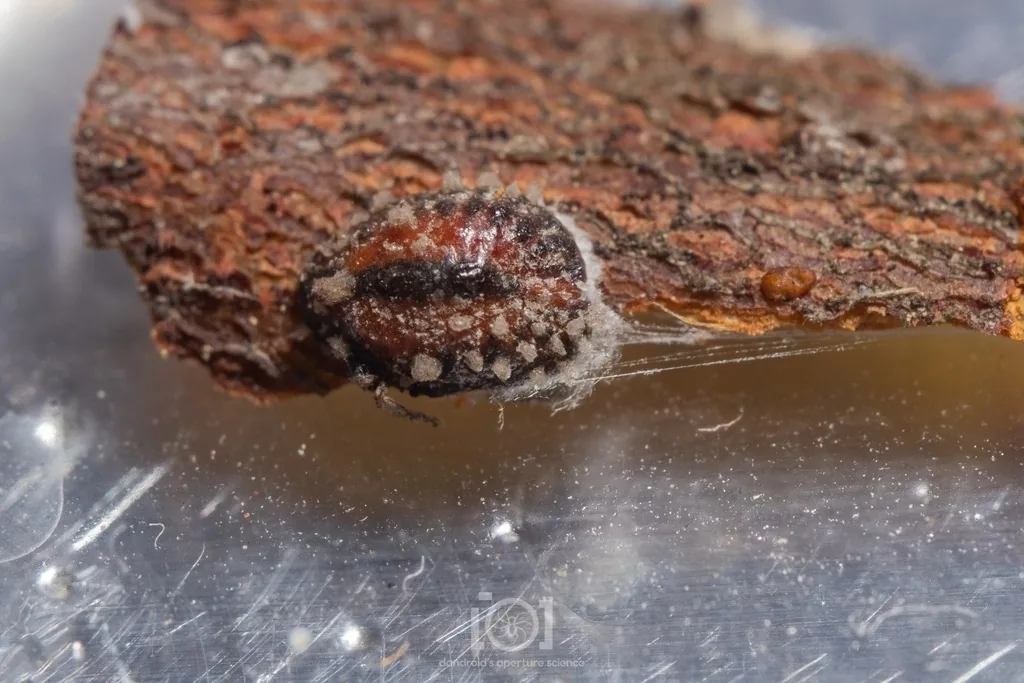
- Mature females are round to elongate oval, up to a little over 1/8 inch long, dark red to yellow, and usually dotted with small plates of glassy wax.[1][2]
- Before laying eggs a female is slightly convex; when fully mature she is rounder and rather flat.[2]
- In late spring she produces a white, fluffy, fairly flat egg sac two to four times as long as her body, filled with hundreds of pale orange eggs.[1][2]
- Look on roots as well as stems: the scale is often collected from both.[1]
Look-alikes
| Look-alike | How to tell them apart |
|---|---|
| Cottony camellia scale | Both scales have been called 'cottony taxus scale'. Cottony azalea scale has been reported almost entirely from heath-family plants (azaleas, rhododendrons, blueberries, huckleberry and Lyonia), which is why NC State considers the taxus name a poor fit for it.[1] |
Where it lives
It is known only from the United States, with records from Alabama, Florida, Virginia, Maryland, the District of Columbia, New York and New Hampshire, and NC State has collected it in North Carolina. Florida's Division of Plant Industry says the species is not submitted often; its 2023 record came from Orange County. GBIF holds just 4 U.S. records since 1990 (Florida 3, District of Columbia 1), so it is probably under-reported.[2][1][3][4]
Biology and life cycle
Young, mated females spend the winter on the plant and resume development in spring. They lay eggs in their white sacs, usually in late April or early May, and the eggs hatch from late May through early June.[1]
The nymphs feed through the growing season, pushing their slender mouthparts through the bark to reach the sugary phloem, and they pass the excess sugar out as sticky honeydew.[1]
Recorded hosts are blueberries (including Vaccinium arboreum), huckleberry, rhododendrons and azaleas (including Rhododendron nudiflorum) and Lyonia ferruginea, all in the heath family. It was recently found on white titi in North Carolina, probably a new host, and Florida's Division of Plant Industry, which knows it on Vaccinium arboreum, V. ashei and V. pallidum, recorded it on deerberry (Vaccinium stamineum) on a nature trail in Winter Garden in April 2023, a new Florida host record.[1][2][3]
Tiny parasitic wasps usually kill many of the nymphs that settle above the soil line; those on the roots are better protected.[1]
Damage and signs
- Honeydew from the scales grows black sooty mold, which further disfigures heavily infested plants, and the white egg sacs themselves are conspicuous in late spring.[1]
Health risk
NC State, ScaleNet and Florida's Division of Plant Industry treat it only as a plant pest; none mentions bites or other risk to people or pets.[1][2][3]
Control
Biological control
Parasitic wasps are a major check on this scale, so prefer treatments that leave beneficial insects alone.[1]
Pesticides
Treat the crawlers: on the stems they are completely susceptible to sprays from late May through early June, and NC State calls the first week of June a very good time. Horticultural or summer oil is a good choice because it is relatively safe for people and pets and leaves little residue to harm beneficial insects. Wait until new growth has hardened off a little, spray thoroughly, and spray again two weeks later for late-hatching crawlers; in hot, dry weather spray in the cool of morning or evening and water the plants beforehand.[1]
If the scale is back the next year, survivors on the roots may be the source. NC State suggests treating the shrubs and the soil around them with a systemic insecticide such as imidacloprid.[1]
Common questions
- What are the white, fluffy patches on my azalea stems in May?
- In late spring cottony azalea scale females lay their eggs in flat, white, fluffy sacs at least twice as long as the scale itself, which makes them easy to notice.[1][2]
- When should I spray for cottony azalea scale?
- When the crawlers are out, from late May through early June; NC State suggests the first week of June, with a second spray two weeks later.[1]
- Why did the scale come back after I sprayed?
- Crawlers feeding on the roots are protected from both sprays and parasitic wasps, and they can restart the infestation the following year.[1]
- Is cottony azalea scale harmful to people or pets?
- No. It is a plant pest; none of the sources reports any risk to people or pets. NC State notes horticultural oil, its suggested crawler spray, is relatively safe for people and pets.[1][2][3]
- Can it be on my blueberries?
- Yes. Blueberries, including sparkleberry (Vaccinium arboreum), are recorded hosts, and Florida's Division of Plant Industry has found it on several wild Vaccinium species, most recently deerberry.[1][2][3]
Sources
- NC State Extension, “Cottony Azalea Scale (PDIC factsheet).” content.ces.ncsu.edu/cottony-azalea-scale (accessed 2026-11-12)
- ScaleNet (scale insect database begun at the USDA ARS Systematic Entomology Laboratory), “ScaleNet catalogue: Pulvinaria ericicola McConnell.” scalenet.info/catalogue/Pulvinaria%20ericicola/ (accessed 2026-11-12)
- Florida Department of Agriculture and Consumer Services, Division of Plant Industry, “Entomology Section plant and arthropod records, ENTO 62(2) (PDF).” ccmedia.fdacs.gov/content/download/113947/file/ento_62_2.pdf (accessed 2026-11-12)
- Global Biodiversity Information Facility (GBIF), “Pulvinaria ericicola: U.S. occurrence records since 1990 by state (GBIF occurrence search).” api.gbif.org/v1/occurrence/search?taxonKey=5163787&country=US&hasGeospatialIssue=false&occurrenceStatus=PRESENT&year=1990%2C2026&facet=stateProvince&facetLimit=400&limit=0 (accessed 2026-11-12)
- iNaturalist, “Pulvinaria ericicola taxon page (order and family).” www.inaturalist.org/taxa/1257205 (accessed 2026-11-09)