On this page
How to identify it
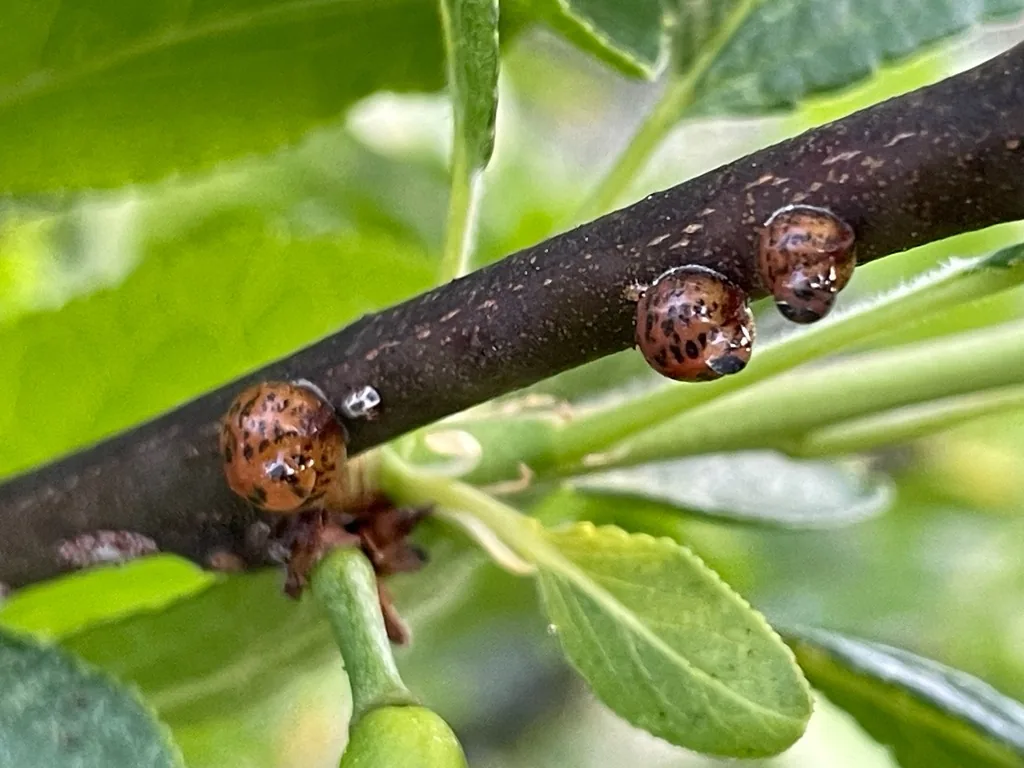
- Mature females are highly convex, almost spherical, 3 to 5 mm (about 1/6 inch) wide, and for most of the year dark chestnut brown and shiny with many darker sunken spots, so a row of them looks like beads on the stem.[1][2]
- A fun one to watch: for a short time in late spring, just before laying eggs, the females change color to yellowish or orange with seven or eight black crossbands or blotches and a diffuse orange or red stripe down the middle.[1][2]
- Unlike the soft scales it resembles, Kuno scale has a broad internal lip or shelf-like margin where the body attaches to the twig; pry a female off and look at the underside to see it.[1][2]
- Nymphs are flat and yellow or brown with large wax plates and a fringe of wax, found in summer mostly along the veins on the undersides of leaves. Elongate, translucent male cocoons about 1/12 inch long can be common on twigs.[1][2]
Look-alikes
| Look-alike | How to tell them apart |
|---|---|
| Calico scale | A related Eulecanium soft scale that UC lists on liquidambar, box elder, maple, stone fruit and walnut; Kuno scale is the one with shiny chestnut brown, bead-like females and a broad internal attachment lip on the underside.[3][1][2] |
| European fruit lecanium (brown apricot scale) | Another brown soft scale of stone fruit, walnut and many trees; Kuno scale is told by its almost spherical shape, the spring black banding and the internal lip on the underside.[3][1] |
| Frosted scale | Another soft scale UC lists on walnut, ash, birch, elm, locust, pistachio, rose and sycamore; Kuno scale is nearly spherical and shiny brown with the black spring banding.[3][2] |
Where it lives
ScaleNet records Kuno scale from China, Japan and South Korea and, in the United States, from California, where UC IPM says it mostly occurs in the San Francisco Bay Area and Sacramento Valley. GBIF holds 71 U.S. records since 1990: 61 from California, plus Ohio, Colorado and Nevada.[2][1][5]
Biology and life cycle
One generation a year. Nymphs overwinter on twigs and mature into adults from March through early May. Eggs laid beneath the female hatch in spring into crawlers that move out to the leaves and settle along the veins on the undersides for the summer; the nymphs return to the twigs before the leaves drop in fall.[1][2]
Its main garden host is plum. UC lists cotoneaster, pyracantha, rose, walnut and other woody Rosaceae as rarely damaged hosts, and ScaleNet's host list also includes cherry, almond, peach, quince, hawthorn, apple, currant and horse chestnut.[1][2]
It sucks phloem sap from leaves and twigs and can become abundant quickly. ScaleNet calls it a minor pest of ornamentals in California but a potential pest in the state.[1][2]
Many small parasitic wasps attack it: ScaleNet lists Coccophagus, Metaphycus, Encyrtus, Microterys and Blastothrix species among its recorded enemies, and ants among its associates.[2]
Damage and signs
Health risk
No source describes any effect on people or pets. UC IPM and ScaleNet treat it only as a plant pest; the nuisance is sticky honeydew, sooty mold and the ants it draws.[1][2]
Control
Prevention
Check plum twigs in winter and spring for the shiny brown beads, and watch for honeydew, sooty mold and ants, which signal a growing population. UC advises oil only where the scale has been abundant.[1]
Biological control
Control the ants. UC IPM says ants attack the natural enemies of scale insects. In Kentucky landscape trees infested with calico scale, a close relative, sticky trunk bands plus basal trunk sprays cut honeydew-seeking ants by 92-100%, lacewing larvae and spiders increased, 54 and 69% fewer scale nymphs survived after the first and second seasons, and sooty mold dropped.[1][4]
Pesticides
If the scale has been abundant, spray horticultural oil on branch terminals and twigs during the delayed dormant period, as buds begin to swell, or thoroughly drench the undersides of the leaves in early summer when the nymphs are there. Do not spray fully dormant plum or walnut trees with oil, do not apply oil when temperatures will exceed 90 F, and do not treat trees that have been short of soil moisture.[1]
Common questions
- What are the shiny brown balls stuck along my plum twigs?
- Most likely Kuno scale: adult females are nearly spherical, dark shiny brown, about 1/6 inch across and look like beads on the stem. Lift one off; a broad internal lip on the underside confirms it.[1][2]
- Is Kuno scale harmful to people or pets?
- No source reports any harm to people or pets. It is a plant pest whose honeydew makes surfaces sticky and grows black sooty mold.[1][2]
- Why is my tree covered in sooty mold and ants?
- Kuno scale produces copious honeydew, which grows blackish sooty mold and feeds ants. Keeping ants off the trunk lets the scale's natural enemies recover; in a Kentucky study of related soft scales, excluding ants meant more lacewing larvae, fewer surviving scale nymphs and less sooty mold.[1][4]
- Where is Kuno scale found?
- ScaleNet records it from China, Japan, South Korea and, in the United States, California. GBIF holds 71 U.S. records since 1990, 61 of them from California, with a few from Ohio, Colorado and Nevada.[2][5]
Sources
- University of California Statewide IPM Program, “Kuno Scale (Home and Landscape pest page).” ipm.ucanr.edu/home-and-landscape/kuno-scale/ (accessed 2026-11-12)
- ScaleNet (scale insect database begun at the USDA ARS Systematic Entomology Laboratory), “ScaleNet catalogue: Eulecanium kunoense (Kuwana, 1907).” scalenet.info/catalogue/Eulecanium%20kunoense/ (accessed 2026-11-12)
- University of California Statewide IPM Program, “Pest Notes: Scales, UC ANR Publication 7408.” ipm.ucanr.edu/home-and-landscape/scales/ (accessed 2026-11-12)
- Environ Entomol 2010;39(6):1829-37, via PubMed, “Ant-exclusion to promote biological control of soft scales (Hemiptera: Coccidae) on woody landscape plants.” pubmed.ncbi.nlm.nih.gov/22182548/ (accessed 2026-11-12)
- Global Biodiversity Information Facility (GBIF), “Eulecanium kunoense: U.S. occurrence records since 1990 by state (GBIF occurrence search).” api.gbif.org/v1/occurrence/search?taxonKey=8244775&country=US&hasGeospatialIssue=false&occurrenceStatus=PRESENT&year=1990%2C2026&facet=stateProvince&facetLimit=400&limit=0 (accessed 2026-11-12)
- iNaturalist, “Eulecanium kunoense taxon page (order and family).” www.inaturalist.org/taxa/81854 (accessed 2026-11-10)