On this page
How to identify it
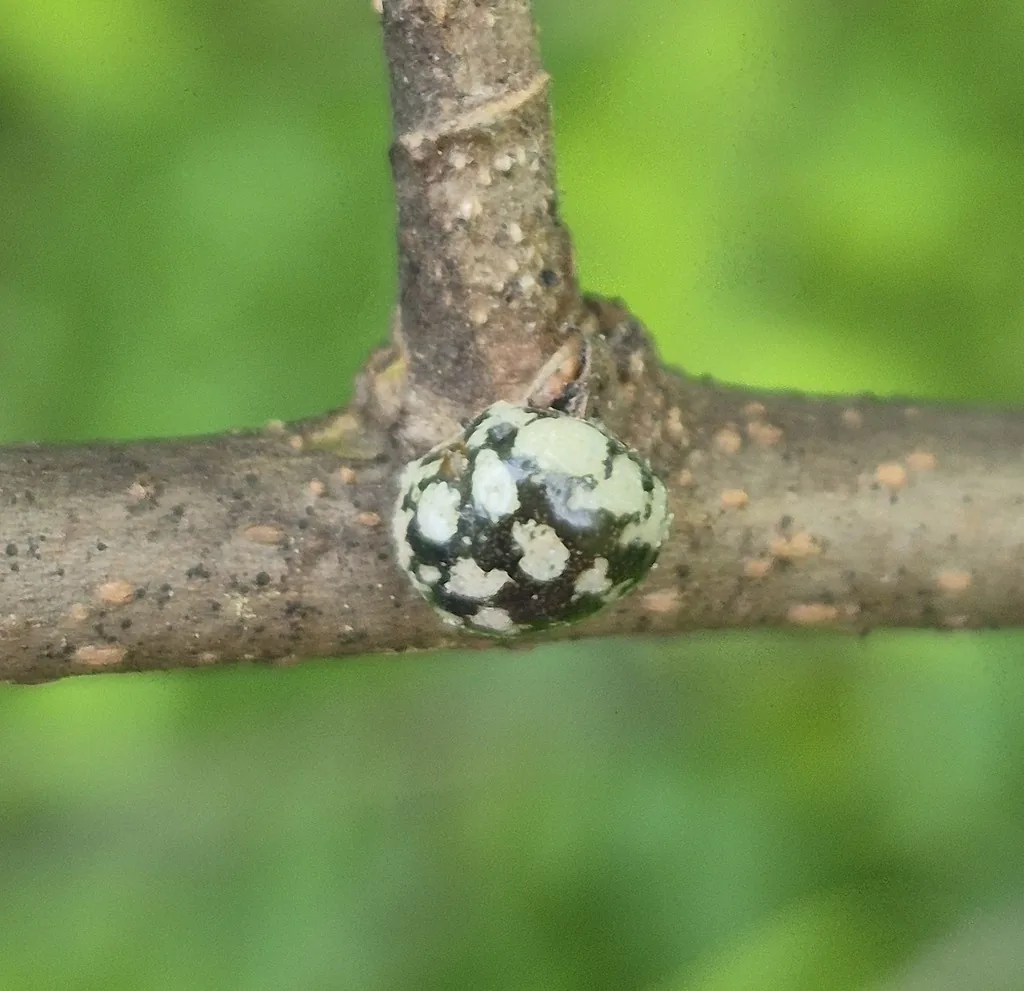
- Mature females are puffy and globular, black or dark brown with rows of white or yellow blotches. Most sources say about 1/4 inch; Delaware gives 6-8 mm.[1][2][3][4]
- Crawlers start out pink (Delaware says pinkish-white) and turn yellow as they age; the nymphs that spend winter on twigs are small and dark.[1][3][2][4]
- After egg-laying the females die and turn dull brown. Live scales ooze liquid when crushed; dead ones are dry.[1]
Look-alikes
| Look-alike | How to tell them apart |
|---|---|
| European fruit lecanium | Rutgers says dead, darkened calico scale females are often mistaken for European fruit lecanium. Live calico scales are boldly blotched with white or yellow.[4][2] |
Where it lives
Rutgers calls it a native soft scale. A Kentucky study found it on 16 host species in six plant families; Kentucky Extension lists crabapple, elm, honeylocust, maple, oak, dogwood, redbud, sweetgum and stone fruit, and Delaware adds star magnolia and pear. UC IPM says liquidambar is the preferred host in California.[4][5][1][3][2]
Biology and life cycle
Sources differ on the overwintering stage: Kentucky Extension says immature crawlers, while UC IPM, Rutgers and a Kentucky field study say second-stage nymphs on the bark. Females swell in spring and lay eggs from late April into May.[1][2][4][5][3]
Rutgers says each female lays many hundreds or possibly thousands of eggs; the Kentucky study counted about 3,700 to 4,700 on average. It reproduces without males and has one generation a year.[5][4]
Crawlers settle on leaves, often along the veins on the undersides, and move back to twigs in autumn (mid-September to mid-October).[1][5][3][4]
Damage and signs
- Feeding causes leaf yellowing and twig dieback, and honeydew draws ants and wasps. Delaware says heavy infestations cause early leaf drop and stunting, and can kill trees.[1][3]
- UC IPM says low numbers don't harm trees, but liquidambar may decline after several years of heavy infestation in a row.[2]
Health risk
It feeds on trees; none of the extension sources mentions any risk to people.[1][2][3]
Control
Prevention
Scales thrive on stressed plants, so water and fertilize to keep trees healthy, but don't overdo fertilizer, which favors scale buildup. UC IPM says control is rarely needed except on liquidambar.[1][2]
Traps and physical control
Scrubbing branches with a brush or scraping off females can remove the scales, though it may take repeated effort.[1][3]
Ants guard calico scale from its enemies. In a Kentucky trial, sticky trunk bands plus basal trunk sprays cut ants by more than 90%, and surviving scale nymphs fell by about half or more, with less sooty mold.[6]
Biological control
The Kentucky study found 14 parasitic wasp species and a lady beetle attacking it, and crawler sprays in late May or June didn't line up with the main parasitoid flight. Rutgers advises against blanket cover sprays that kill beneficials.[5][4]
Pesticides
Sources differ on sprays. Systemic insecticides have given variable results, so treatments usually target crawlers, and Delaware says chemical control works when aimed at active crawlers. UC IPM and Kentucky say horticultural oil works, but Rutgers says oils, including dormant oil, don't control it well. UC IPM says not to use oil on plum or walnut, and Kentucky warns oils and soaps can burn Japanese maple.[1][3][2][4]
Monitoring
Sources give different crawler timing: Kentucky Extension says June and July, Rutgers late June into July, and the Kentucky field study found first hatch on May 21-26.[1][4][5]
Delaware puts crawler hatch at about 519-902 growing degree days (base 50 F), which may line up with full bloom of 'Miss Kim' lilac.[3]
To catch crawlers, wrap black electrical tape (sticky side out) or double-sided tape near the scales and check it often.[1]
Common questions
- What's dripping sticky sap from my honeylocust?
- Possibly honeydew from calico scale. Look for puffy black-and-white scales on the twigs.[1][2]
- Will a systemic treatment work?
- Results have been variable, so treatments usually aim at crawlers.[1][4]
- Does horticultural oil work on calico scale?
- Sources disagree. UC IPM and Kentucky Extension say oil can work, especially on crawlers, while Rutgers says oils, including dormant oil, don't control it well.[2][1][4]
Sources
- University of Kentucky Entomology (ENTFACT), “The Challenges of Calico Scale Control (ENTFACT-466).” entomology.mgcafe.uky.edu/ef466 (accessed 2026-11-13)
- UC Statewide IPM Program (UC IPM), “Calico Scale (Home and Landscape).” ipm.ucanr.edu/home-and-landscape/calico-scale/ (accessed 2026-11-13)
- University of Delaware Cooperative Extension, “Calico Scale (fact sheet).” www.udel.edu/academics/colleges/canr/cooperative-extension/fact-sheets/calico-scale/ (accessed 2026-11-13)
- Rutgers Cooperative Extension (Plant & Pest Advisory), “Some Key Soft Scale Pests in the Landscape (Plant & Pest Advisory).” plant-pest-advisory.rutgers.edu/some-key-soft-scale-pests-in-the-landscape/ (accessed 2026-11-13)
- Journal of Economic Entomology, 2005 (via PubMed), “Life history and natural enemy associations of calico scale (Homoptera: Coccidae) in Kentucky (abstract).” pubmed.ncbi.nlm.nih.gov/16156572/ (accessed 2026-11-13)
- Environmental Entomology, 2010 (via PubMed), “Ant-exclusion to promote biological control of soft scales (Hemiptera: Coccidae) on woody landscape plants (abstract).” pubmed.ncbi.nlm.nih.gov/22182548/ (accessed 2026-11-13)
- Global Biodiversity Information Facility (GBIF), “Eulecanium cerasorum (Cockerell, 1900) (GBIF Backbone Taxonomy).” api.gbif.org/v1/species/8259617 (accessed 2026-11-13)