On this page
How to identify it
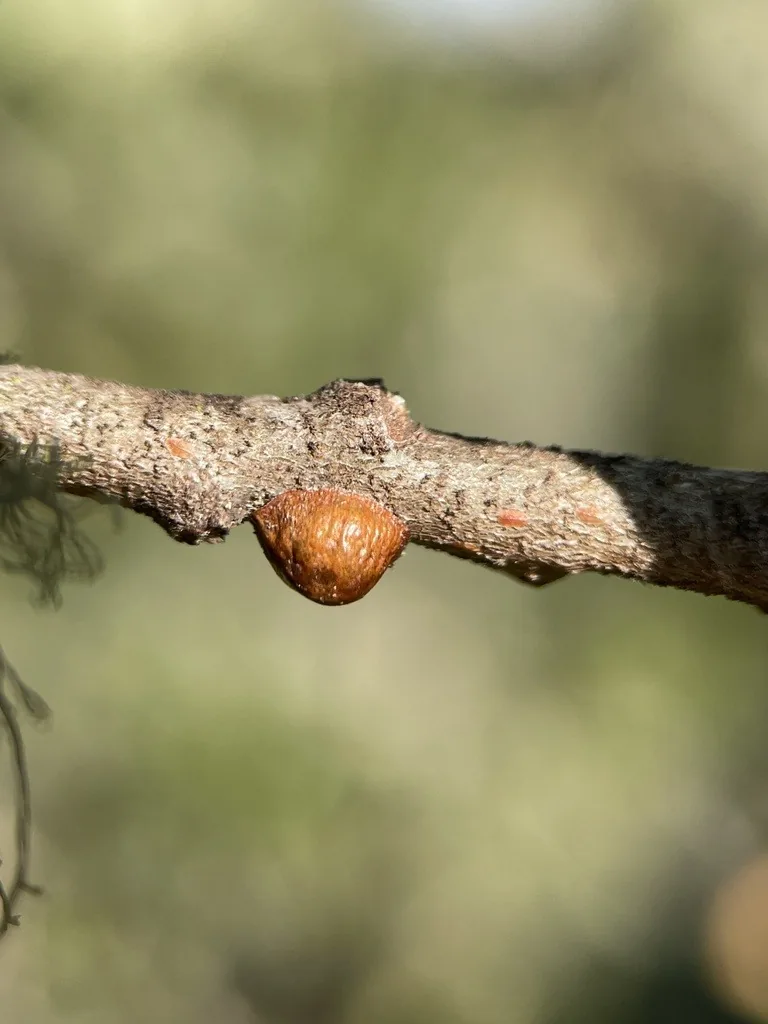
- Females start flat and brown and become hard, rounded and helmet-shaped as they mature. Kentucky gives a width of 1/8 to 1/6 inch; UMass gives 4 to 7 mm long for oak lecanium, which usually has a pair of humps on its back.[1][2][3]
- Lecanium scale is a group of closely related species that are hard to tell apart. The most common in Minnesota is European fruit lecanium (Parthenolecanium corni); oak lecanium (P. quercifex) is the other well-known one, and UMass notes that some experts suspect a complex of hidden species.[1][2][3]
- Sticky leaves and furniture, black sooty mold, and ants, wasps and flies visiting the honeydew are often the first things people notice.[2][3]
Look-alikes
| Look-alike | How to tell them apart |
|---|---|
| Other scale insects | Scale species differ in timing, so identify the species to know when crawlers are active.[1] |
Where it lives
Found across the eastern United States and common in Minnesota. Hosts include oak, maple, crabapple, hickory, birch, redbud and fruit trees.[1][2][3]
Biology and life cycle
Second-stage nymphs overwinter on twigs. Females lay eggs under their shells in May and June, according to Minnesota and UMass. In a South Carolina study, eggs hatched earlier, from mid-April to early June.[1][3][4]
Crawlers move to the leaves and feed along the veins on the undersides, then return to the twigs in late summer or fall. There's one generation a year.[1][3][2][4]
In the South Carolina study the females reproduced without mating and averaged about 1,000 eggs each; UMass says published counts range from dozens to several thousand.[4][3]
Damage and signs
- Heavy infestations reduce vigor and cause stunted, yellowed leaves, leaf drop and dieback of twigs, branches and sometimes whole plants. The honeydew falls on cars, decks and outdoor furniture and grows black sooty mold.[1][2][3]
- Stressed trees fare worse: UMass points to drought-stressed urban trees, and Kentucky says over-fertilizing favors the scales.[3][2]
Health risk
No cited source describes any risk to people or pets; the scales feed on plant sap. Their honeydew can make outdoor furniture and cars sticky.[1][2]
Control
Prevention
Kentucky suggests black electrical tape (sticky side out) or double-sided tape near the scales to catch the first crawlers, then treating after the first find.[2]
Traps and physical control
Prune out small infestations or heavily infested branches. UMass says lightly infested trees help support natural enemies, so the goal shouldn't be to wipe the scale out entirely.[2][3]
Biological control
Lady beetles, parasitic wasps and other natural enemies often keep numbers low. Southeastern researchers found 21 kinds of parasitoids and 12 predators; Coccophagus lycimnia was the most common parasitoid in South Carolina, North Carolina and Virginia, and parasitism of nymphs reached 59 to 92 percent in South Carolina.[1][3][5]
Pesticides
Horticultural oil in late fall or early spring smothers overwintering nymphs, and UMass calls dormant oil a reduced-risk choice that spares natural enemies. Kentucky cautions that oil may fail where layers of old scale covers have built up.[1][3][2]
Insecticidal soap or oil timed to crawlers in June and July has little effect on natural enemies.[1]
Minnesota and Kentucky differ a little on systemic timing. Minnesota lists imidacloprid in fall or dinotefuran in spring; Kentucky says imidacloprid from mid-October through November has worked against lecanium scales and that April to May is also used. Minnesota advises against soil systemics where flowers that bees visit grow next to the tree.[1][2]
Common questions
- What are the brown bumps on my oak twigs?
- Often lecanium scales, rounded brown soft scales about 1/8 to 1/6 inch wide.[1][2]
- When should I treat?
- Dormant oil in late fall or early spring, or soap or oil on crawlers in June and July in Minnesota. Crawlers can appear earlier farther south; a South Carolina study saw eggs hatch from mid-April.[1][4]
- Why is my car sticky under the oak tree?
- Lecanium scales and other soft scales drip sugary honeydew onto cars, patios and furniture below, and black sooty mold can grow on it.[2][3]
Sources
- University of Minnesota Extension, “Scale insects (Yard and garden insects).” extension.umn.edu/garden-and-home/yard-and-garden/yard-and-garden-insects/scale-insects (accessed 2026-11-13)
- University of Kentucky Entomology, “ENTFACT-430: Lecanium Scales.” entomology.mgcafe.uky.edu/ef430 (accessed 2026-11-13)
- UMass Extension, Center for Agriculture, Food, and the Environment, “Parthenolecanium quercifex (Insect & Mite Guide).” www.umass.edu/agriculture-food-environment/landscape/publications-resources/insect-mite-guide/parthenolecanium-quercifex (accessed 2026-11-13)
- Journal of Economic Entomology, 2017 (via PubMed), “Life History of Parthenolecanium spp. in Urban Landscapes of the Southeastern United States (abstract).” pubmed.ncbi.nlm.nih.gov/28854655/ (accessed 2026-11-13)
- Journal of Economic Entomology, 2018 (via PubMed), “Natural Enemy Communities and Biological Control of Parthenolecanium spp. in the Southeastern United States (abstract).” pubmed.ncbi.nlm.nih.gov/29912368/ (accessed 2026-11-13)
- Global Biodiversity Information Facility (GBIF), “Parthenolecanium (genus) (GBIF Backbone Taxonomy).” api.gbif.org/v1/species/2090525 (accessed 2026-11-13)
- Global Biodiversity Information Facility (GBIF), “Parthenolecanium corni (GBIF Backbone Taxonomy).” api.gbif.org/v1/species/4484527 (accessed 2026-11-13)