On this page
How to identify it
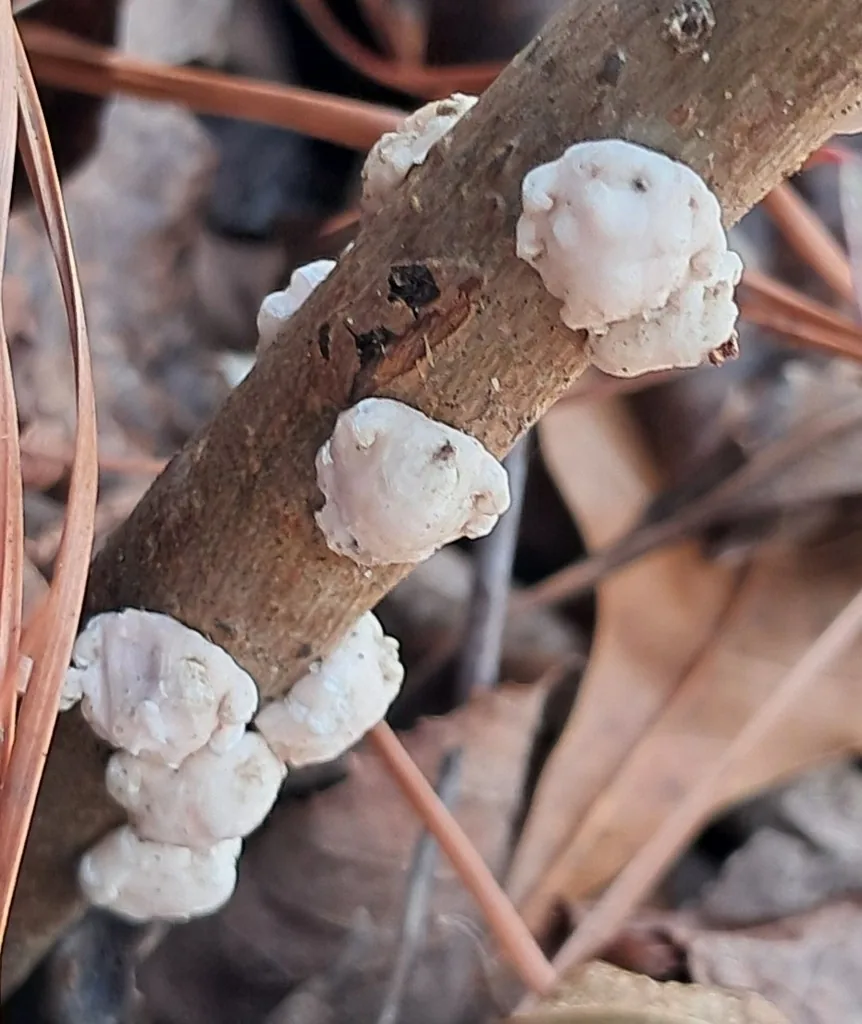
- Adult females are hemispherical white wax covers up to about 1/4 inch across, sometimes pinkish white, over a reddish-brown body. There are no males.[2][1]
- Young scales look like cameos, with white wax only partly covering the body; UGA says the second stage looks star-shaped. Crawlers are flat and rusty or pinkish red.[2][1]
- Bees, wasps, hornets and ants busy in dense shrubs are often a clue, because they're drawn to the scale's honeydew.[1]
Look-alikes
| Look-alike | How to tell them apart |
|---|---|
| Florida wax scale | A close relative in the same genus that UGA covers alongside Indian wax scale. UGA gives it a wider range, from Florida to New York and west to New Mexico.[1] |
| Other soft scales | Lecanium scales are brown, semi-globular soft scales 1/8 to 1/6 inch wide, without a thick white wax cover.[4][2] |
Where it lives
Native to Asia. UGA says it's common in the eastern United States from Florida to Maryland, and Rutgers covers it as a nursery pest in New Jersey. In Europe it was first reported in Italy in 2001 and was found established in Campania, southern Italy, in 2023 and 2024.[3][1][2]
Biology and life cycle
Rutgers lists one generation a year, and UGA says the same for central and north Georgia, with more than one possible in south Georgia. Adult females overwinter on the bark.[2][1]
UGA says each female lays 1,200 to 2,000 eggs under her wax cover in late winter and early spring, and crawlers hatch from mid-May to early June in Georgia.[1]
The sources differ on where young scales settle. UGA says crawlers often settle on the upper side of leaves before moving down to the stems, while Rutgers says all life stages are found on twigs and branches, not on foliage.[1][2]
In Italy, where it has been reported since 2001, researchers describe it as a sessile scale with one generation a year that spreads mainly through the trade in ornamental plants.[3]
Damage and signs
- A 2026 Italian study puts its hosts in more than 60 plant families. Favorites named by Rutgers and UGA include Japanese and Chinese holly, boxwood, euonymus, spirea, flowering quince and barberry; UGA adds firethorn, and Rutgers adds inkberry, blue hollies and Japanese maple.[3][2][1]
- Feeding produces sticky honeydew and black sooty mold, then yellowing, early leaf drop, weak growth and branch dieback. UGA says plants with severe infestations may die.[2][1]
Health risk
No cited source describes any risk to people or pets; it feeds on plant sap. Its honeydew does attract bees, wasps and hornets.[1][2]
Control
Prevention
From May, check females every one to two weeks so you catch the short crawler window, and inspect new plants before you buy them.[1]
Avoid very susceptible plants such as 'Burford' holly. UGA cites a study in which several hollies, including Ilex crenata (Japanese holly) and I. glabra (inkberry), showed some resistance, yet Rutgers lists both among the scale's hosts.[1][2]
Traps and physical control
Prune out heavily infested twigs and branches, and pick scales off by hand when there are only a few.[1]
Biological control
Rutgers names parasitic wasps, lady beetles and other predatory beetles, and lacewings as natural enemies. In the Italian survey, no parasitoids emerged from field samples.[2][3]
Pesticides
The wax shields every stage except crawlers, so horticultural oil, insecticidal soap and other contact sprays work only while crawlers are out. UGA warns that contact sprays also kill beneficial insects and can lead to flare-ups of other pests. Rutgers says dormant oil is less effective because the adults overwinter under their wax, and lists horticultural oil (not dormant oil) and insect growth regulators for the crawler stage.[1][2]
UGA says systemic insecticides are generally compatible with predators but can harm bees visiting the plant. Rutgers notes that in New Jersey, neonicotinoids may be applied in commercial settings only by licensed applicators.[1][2]
Common questions
- What are the white gummy lumps on my holly twigs?
- Often Indian wax scale: adult females look like white wads of gum about 1/4 inch across stuck to the twigs.[2][1]
- When should I spray?
- When crawlers are out, which UGA puts at mid-May to early June in Georgia. Check the scales every week or two from May.[1]
- Why are bees and wasps all over my holly?
- They may be feeding on honeydew from wax scales.[1]
- How can I tell if the scales are dead?
- Dead wax scales often stay stuck to the twigs. UGA says to squish one: if no liquid oozes out, it's dead.[1]
Sources
- University of Georgia Cooperative Extension, “Wax Scale Insect: What Is the White Glob on My Twigs? (Circular 1291).” fieldreport.caes.uga.edu/publications/C1291/wax-scale-insect-white-glob-on-twigs/ (accessed 2026-11-13)
- Rutgers Cooperative Extension, “Indian Wax Scale (Nursery IPM).” sites.rutgers.edu/nursery-ipm/indian-wax-scale/ (accessed 2026-11-13)
- Nugnes et al., CNR Institute for Sustainable Plant Protection (via PubMed Central), “Contrasting Invasion Strategies, Convergent Outcomes: Establishment of Zaprionus tuberculatus and Ceroplastes ceriferus in Italy (Insects, 2026).” pmc.ncbi.nlm.nih.gov/articles/PMC12941184/ (accessed 2026-11-13)
- University of Kentucky Entomology, “ENTFACT-430: Lecanium Scales.” entomology.mgcafe.uky.edu/ef430 (accessed 2026-11-13)
- Global Biodiversity Information Facility (GBIF), “Ceroplastes ceriferus (Fabricius, 1798) (GBIF Backbone Taxonomy).” api.gbif.org/v1/species/7953279 (accessed 2026-11-13)