On this page
How to identify it
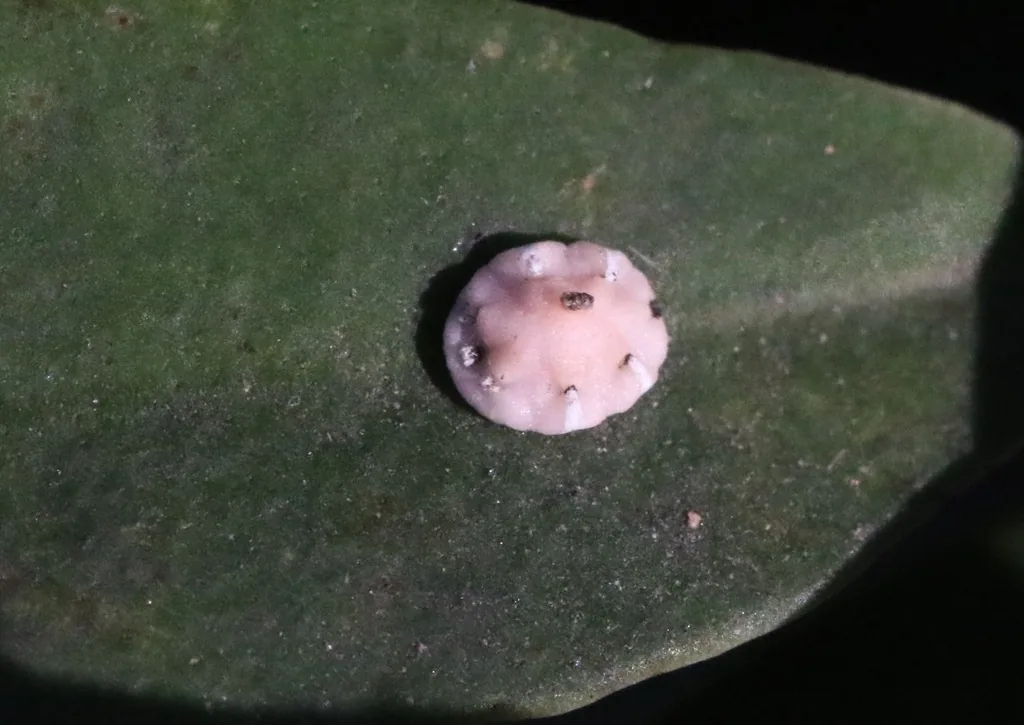
- The adult female has a reddish-brown body under a thick, wet-looking wax cap that is grayish to pinkish white. From above it looks rectangular to oval; from the side it is dome-shaped, and older females have a broad wax rim at the edge. UF/IFAS describes the adult female as elliptical and reddish brown with a short anal process, 2 to 4 mm long and 1 to 3.5 mm wide.[5][1][3][2][4]
- Adult females grow to about 3 millimeters (1/8 inch) across.[3]
- The eggs are oval, reddish orange, and fill the cavity under the female's body; there is no separate egg sac. No males are known.[3][5][1]
- Newly settled nymphs look small, white and starlike as they begin to secrete tufts of wax. On holly, many line up along the veins on top of the leaves. UF/IFAS says the first-stage crawlers are pink with working legs, and the second and third stages secrete wax around themselves that gives them a star-like look.[3][4]
Look-alikes
| Look-alike | How to tell them apart |
|---|---|
| Indian wax scale | Indian wax scale is a bright white, circular soft scale whose hosts include Japanese and Chinese hollies.[2] |
| Barnacle scale | Another wax scale, but larger, growing to almost 1/4 inch across.[3] |
| Armored scales | Lift the bump: on an armored scale the cover comes off over a soft body, while a soft scale like this one comes up whole and can be squished. Soft scales also produce honeydew and sooty mold.[2] |
Where it lives
CDFA says it probably originated in the northern Neotropics and now occurs worldwide, and gives its U.S. range as New York to Florida and west to New Mexico. It has never been found in California's natural environment, though CDFA inspections intercepted it 58 times from 2000 through November 2016. Texas A&M AgriLife reports hedges throughout the eastern half of Texas and the Southeast increasingly infested. UF/IFAS adds that it may occur in the northern United States but has not become a pest there because it cannot survive the winter.[1][3][4]
Biology and life cycle
Eggs hatch over 2 to 3 weeks. The crawlers move to leaves, twigs and stems and often migrate to new growth at the top of the plant. Nymphs go through three stages and can still move about before becoming adults, which produce eggs and die. UF/IFAS notes that scales settling on leaves often line up along the midrib, and older nymphs can move within the plant to find new flushes of growth.[3][1][4]
In Texas there are two fairly distinct generations a year, with eggs hatching in late April through May and again in late July through August, and it overwinters as newly mature females.[3]
In Georgia, UGA Extension puts crawler emergence between the last week in May and the second week of June.[2]
Hosts include many hollies, elm, crape myrtle, oak, loblolly pine, deodar cedar, Indian hawthorn, Virginia creeper and citrus. In Texas it has also been found on elephant ear, golden euonymus, honeysuckle and pomegranate, and CDFA's host list adds almond, quince, apple, fig, plum, myrtle, oleander and mango.[3][2][1]
Most scales sit on top of holly leaves, where foliar sprays reach them but heavy rain also knocks back their survival.[3][1]
UF/IFAS reports three generations a year in Florida, in April and May, July and August, and October and November, against two a year common elsewhere in its range.[4]
Damage and signs
- Wax scales remove large amounts of sap. Heavy infestations discolor leaves, cause early leaf drop and branch dieback, and can kill plants.[3][1]
- Their honeydew grows black sooty mold and attracts bees, wasps and ants. Even after the scales are dead, many scales and the sooty mold stay on the plant. UF/IFAS says the honeydew also draws paper wasps, hornets, velvet ants and imported fire ants, and that sooty mold can significantly reduce photosynthesis.[3][4]
Health risk
It feeds on plant sap; none of these sources reports a risk to people or pets.[3][1]
Control
Prevention
Inspect hollies before you buy, plant them in suitable sites, and water and fertilize them properly; UGA Extension notes scale insects are drawn mainly to stressed plants.[3][2]
For hollies that keep getting reinfested, consider replacing them with shrubs this scale doesn't attack, such as junipers, ligustrum, boxwood, pittosporum, oleander or wax myrtle.[3]
Where susceptible hollies such as 'Burford' holly keep getting infested, UF/IFAS suggests resistant species, including Ilex buergeri, I. crenata, I. glabra, I. myrtifolia, I. verticillata and I. vomitoria.[4]
Sanitation
Prune away and discard heavily infested foliage, which also opens the canopy so sprays cover better.[3]
Biological control
Three parasitic wasp species have been used against it in some parts of the U.S., but Texas A&M AgriLife reported no natural enemies seen in Texas. UF/IFAS names them as Coccophagus lycimnia, Metaphycus eruptor and Scutellista cynea.[3][4]
Pesticides
Aim sprays at crawlers. In Texas, check leaves every 1 or 2 weeks from late April and again from mid-August for newly settled nymphs, then spray insecticidal soap or horticultural oil at 7- to 10-day intervals. A soil-applied systemic such as imidacloprid must go on before egg hatch and may miss scales on twigs. Follow the label.[3][2]
More from the California Department of Food and Agriculture
The California Department of Food and Agriculture gives it an A rating: it has never been found living in California, but high-risk inspections, dog teams and nursery inspections intercepted it 58 times between 2000 and 2016. Nationally, it was intercepted 108 times at U.S. ports of entry between 1995 and 2012.[1][5]
Where sources disagree
U.S. range: Texas A&M AgriLife (2006) says it is widely distributed from Maryland to Florida and from Missouri to California, while CDFA gives New York to Florida and west to New Mexico and says it has never been found in California's natural environment.[3][1]
Generations: Texas A&M AgriLife describes two fairly distinct generations in Texas, and CDFA gives 2 to 3 a year, each lasting about 3 to 4 months. UF/IFAS reports three generations a year in Florida and calls two a year common across its global range.[3][1][4]
Eggs: CDFA says a female produces about 75 to 100 eggs in her life, while Texas A&M AgriLife says hundreds of eggs can pour out of a female's body at certain times of year.[1][3]
Common questions
- What are the pink waxy bumps on my holly?
- Likely Florida wax scale, a reddish soft scale under a thick coat of pinkish-white wax that is common on holly.[2][3]
- How many generations are there?
- Two fairly distinct generations a year in Texas; CDFA gives 2 to 3. UF/IFAS reports three in Florida.[3][1][4]
- How can I tell if a treated wax scale is dead?
- Dead scales can stay on the plant after treatment. UF/IFAS suggests squishing one: if it is still juicy it is alive, and if it is dry it is dead.[4]
Sources
- California Department of Food and Agriculture (Pest Ratings), “California Pest Rating: Ceroplastes floridensis Comstock: Florida Wax Scale.” blogs.cdfa.ca.gov/Section3162/?p=3231 (accessed 2026-11-11)
- University of Georgia Cooperative Extension, “Biology and Management of Scale Insects in Ornamentals (Circular 1186, July 2025).” fieldreport.caes.uga.edu/publications/C1186/biology-and-management-of-scale-insects-in-ornamentals/ (accessed 2026-11-11)
- Texas AgriLife Extension Service, Texas A&M University System, “Florida Wax Scales: Control Measures in Texas for Hollies (L-5479, Drees, Reinert and Williams, December 2006).” lubbock.tamu.edu/florida_wax_scale_l5479/ (accessed 2026-11-11)
- University of Florida IFAS Extension (EDIS), “Florida Wax Scale, Ceroplastes floridensis Comstock, EENY-510/IN913 (S. Sharma and E. Buss; Featured Creatures).” ask.ifas.ufl.edu/publication/IN913 (accessed 2026-11-14)
- USDA APHIS PPQ Identification Technology Program (IDtools), “Ceroplastes floridensis (Scale Insects identification tool, edition 2, April 2014).” idtools.org/scales/index.cfm?packageID=1114&entityID=3488 (accessed 2026-11-11)
- iNaturalist, “Ceroplastes floridensis taxon page (order and family).” www.inaturalist.org/taxa/330197 (accessed 2026-10-06)