On this page
How to identify it
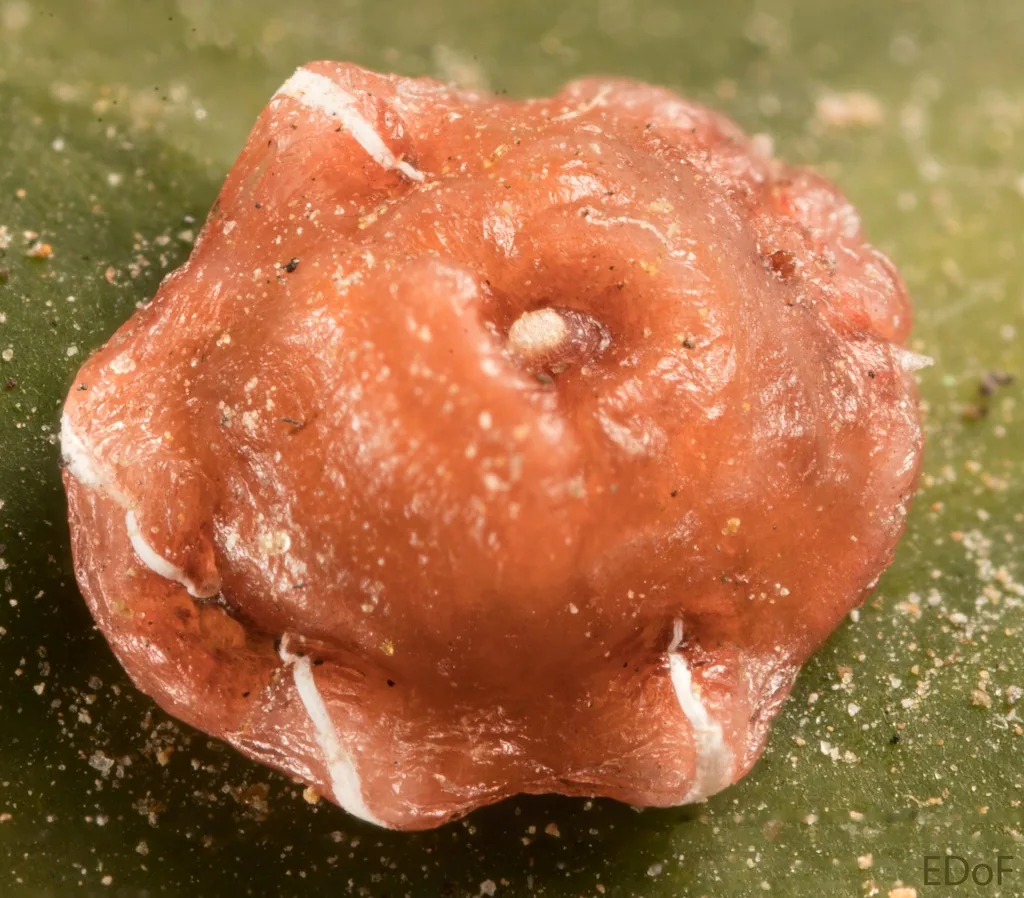
- The adult female is covered in reddish-brown wax with no distinct horn on top. Seen from above it is roughly rectangular or oval and can grow to over 3.1 mm across.[1]
- UF/IFAS describes the adult female's wax cover as pinkish to red, convex and longer than wide, 3.5 to 4.5 mm long, with two conspicuous pairs of white bands running up the sides from the breathing pores (spiracles).[7]
- Crawlers are pink and have working legs, and UF/IFAS describes the nymphs as pinkish. Second- and third-stage nymphs put out clumps of wax that give them a star-like look.[1][7]
Look-alikes
| Look-alike | How to tell them apart |
|---|---|
| Fig wax scale (Ceroplastes rusci) | Fig wax scale's hard wax cover is pale pink to almost pure white, and its margin is divided into eight squarish plates. Red wax scale's cover is reddish brown. UF/IFAS describes fig wax scale's pinkish-gray wax as divided into plates separated by dark red lines, the color of the body beneath, while red wax scale has a smoother pinkish-red cap with two pairs of white bands. Fig wax scale was first found in Florida nurseries in 1994 and 1995 and has been a pest there mainly of ixora.[2][1][8][7] |
Where it lives
Red wax scale is widely distributed in warm regions; UF/IFAS lists places including Hawaii, Bermuda, Mexico, Cuba, the Dominican Republic, Australia, New Zealand, China, Japan, India, the Philippines and South Africa. In the continental United States, ScaleNet lists it only from Florida, where UF/IFAS says the 1955 find was a new state and continental record.[1][7]
Biology and life cycle
It reproduces mainly without mating and has one or two generations a year; two a year have been recorded in Queensland and the Northern Territory of Australia.[3][1]
Females lay pink eggs under their bodies, protected by the wax cover. A single female may lay anywhere from 5 to more than 1,100 eggs.[1][3]
Crawlers usually settle on young twigs, and the later stages stay put. Crawlers can be carried short distances by wind, animals, people or equipment, and the scale moves long distances on infested nursery plants.[3]
UF/IFAS and ScaleNet give long host lists, including citrus, mango, avocado, loquat, Japanese persimmon, camellia, gardenia, holly, ixora, oleander, pittosporum, schefflera, azalea and rose. The UF/IFAS list also includes maple, boxwood, coconut, coffee, fig, English ivy, privet, lychee, apple, sago palm and wisteria.[1][7]
Damage and signs
Health risk
The sources treat it only as a plant pest; none mentions bites or any risk to people or pets.[1][3]
Control
Prevention
Check new nursery plants closely: infested plants for planting are how this scale moves long distances, and it has been intercepted on bonsai holly from China and on other tropical plants shipped to Europe. UF/IFAS says its first continental U.S. find apparently came in on imported foliage plants.[3][1][7]
Biological control
Ants that tend red wax scale for honeydew reduce how many scales are parasitized by wasps; in field tests, parasitism was higher where ants were kept off.[4]
To let parasites and predators work, control scale-tending ants with sticky barriers on trunks or with insecticide baits, and avoid persistent broad-spectrum insecticides.[5]
Pesticides
A thorough spray of horticultural oil timed to when scale crawlers are active controls most scales. Soft scales can also be controlled with the systemic insecticide imidacloprid on larger plants; read and follow the label.[5]
Where the sources disagree
Color: UF/IFAS (2001) describes the wax cover as pinkish to red with two pairs of white bands; ScaleNet describes the body as covered with reddish brown wax.[7][1]
Classification: the 2001 UF/IFAS red wax scale profile files it under the older order Homoptera; UF/IFAS's fig wax scale profile and current classifications place these soft scales in Hemiptera.[7][8]
Common questions
- Is red wax scale the same as pink wax scale?
- Yes. Ceroplastes rubens goes by pink, red or ruby wax scale.[3][1]
- What plants does red wax scale attack?
- Its host list is long: citrus, mango and avocado as well as ornamentals such as camellia, gardenia, holly, ixora and schefflera.[1]
- How did red wax scale get to Florida?
- It was first found in November 1955 on greenhouse-grown aglaonema at an Orange County nursery, and UF/IFAS says introduced foliage plants were apparently responsible for its establishment in Florida.[7]
Sources
- ScaleNet (scale insect database begun at the USDA ARS Systematic Entomology Laboratory), “ScaleNet catalogue: Ceroplastes rubens Maskell.” scalenet.info/catalogue/Ceroplastes%20rubens/ (accessed 2026-11-14)
- ScaleNet (USDA ARS Systematic Entomology Laboratory and collaborators), “Ceroplastes rusci (Linnaeus) (ScaleNet catalogue entry).” scalenet.info/catalogue/Ceroplastes%20rusci/ (accessed 2026-11-14)
- European Food Safety Authority (EFSA Journal), “Pest categorisation of Ceroplastes rubens (EFSA Panel on Plant Health 2024, EFSA Journal 22: e8888; PubMed abstract).” doi.org/10.2903/j.efsa.2024.8888 (accessed 2026-11-09)
- Springer (Oecologia), “Density-dependent ant attendance and its effects on the parasitism of a honeydew-producing scale insect (Itioka and Inoue 1996, Oecologia 106: 448-454; PubMed abstract).” doi.org/10.1007/BF00329700 (accessed 2026-11-09)
- University of California Statewide IPM Program, “Pest Notes: Scales (UC ANR Publication 7408).” ipm.ucanr.edu/home-and-landscape/scales/ (accessed 2026-11-12)
- iNaturalist, “Ceroplastes rubens taxon page (order and family).” www.inaturalist.org/taxa/486438 (accessed 2026-11-09)
- University of Florida IFAS Extension (EDIS Featured Creatures), “Red Wax Scale, Ceroplastes rubens Maskell (EENY-237, G. W. Dekle, 2001; EDIS archival copy at journals.flvc.org).” journals.flvc.org/edis/article/view/108573 (accessed 2026-11-14)
- University of Florida IFAS Extension (EDIS Featured Creatures), “Fig Wax Scale, Ceroplastes rusci (Linnaeus), EENY-187/IN344 (A. B. Hamon and G. J. Mason).” ask.ifas.ufl.edu/publication/IN344 (accessed 2026-11-14)