On this page
How to identify it
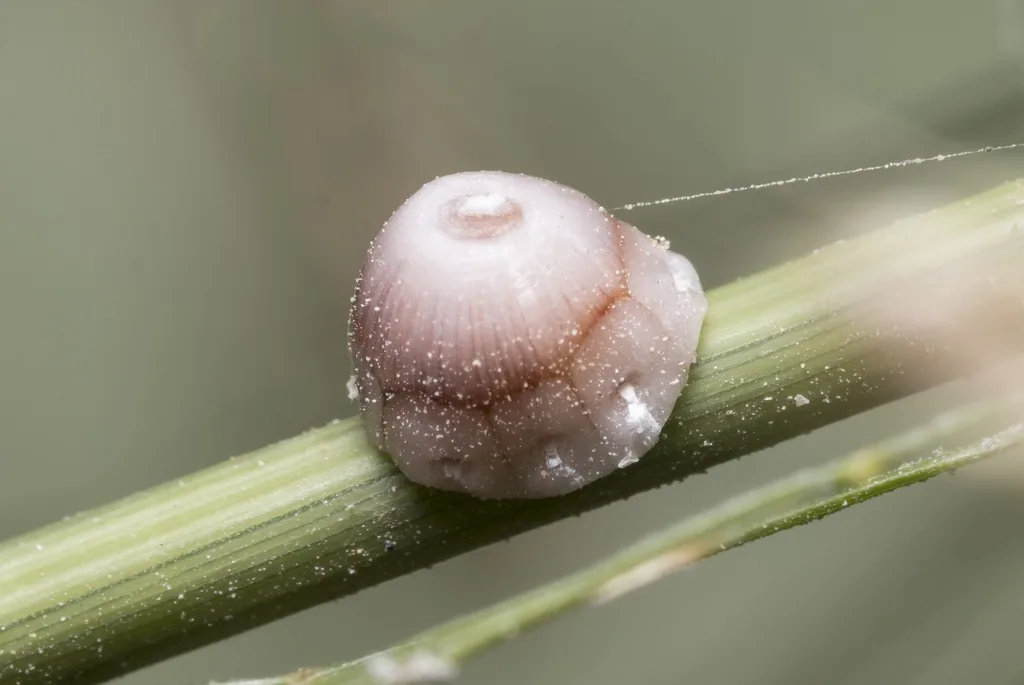
- The adult female is encased in a thick, hard, broadly oval wax case that ranges from grayish white with a red tinge to pale pink or purplish, and is often almost pure white.[2][1]
- The wax is divided into nine plates: one large domed plate on top with a small dark center spot, and eight smaller plates around the edge, each with its own center. Other wax scales in California have seven plates.[2][1]
- The color deepens to red where the edge plates meet the top, fine pinkish lines often radiate across the wax, and a line of very white wax runs from each breathing pore on the sides.[1]
- UF/IFAS notes that the dark red lines between the plates are the color of the scale's body showing through the wax, and that white wax on the front and middle side plates marks the breathing-pore bands.[4]
Look-alikes
| Look-alike | How to tell them apart |
|---|---|
| Red wax scale (Ceroplastes rubens) | Red wax scale's wax cover is reddish brown and looks sub-rectangular or oval from above; UF/IFAS describes it as pinkish to red, convex, longer than wide, 3.5 to 4.5 mm, with two conspicuous pairs of white bands. Fig wax scale's cover is pale pink to almost white and divided into a large top plate and eight smaller edge plates.[5][1][6] |
Where it lives
Probably native to tropical Africa, it has been reported from 64 countries, including the Mediterranean region. In the United States it is known from Florida and southern California, where it was found on fig trees in Fallbrook, San Diego County, in May 2024 and later in three counties, including a natural area in Orange County in October 2025.[3][2][1]
Biology and life cycle
In Europe it has one generation a year in colder climates and two in warmer areas. Each female lays about 1200 eggs on its host in spring, and again in late summer where there are two generations.[2]
The number of generations varies by place: two a year have been recorded in Greece and one a year on figs in southern France.[1]
It feeds on plants in 53 families. It is a pest of guava, fig, citrus, mango, grape and oleander, and other hosts include almond, avocado, cotton, pistachio, palms, lychee, peach and many ornamentals.[3][2]
Its life cycle has not been studied in Florida. On fig trees in Israel, adult females overwinter on twigs and lay eggs very early in spring, and the crawlers that hatch move to feed on the leaves.[4]
After about one month the young scales molt and move to the leaf stalks or new shoots. They mature in summer and produce a new generation of crawlers, which mature late in fall and overwinter on the twigs. In Egypt the scales were found equally on the upper and lower leaf surfaces of figs.[4]
In Florida it has been identified on ixora, sugar apple, mimusops and pygmy date palm. In Greece it has also been found feeding on sweet orange and mandarin.[4]
Damage and signs
- It is a pest of figs in the Mediterranean region and usually a minor pest of citrus in Israel, though occasionally a serious one. It sucks phloem sap and excretes honeydew that coats leaves, blocks light, weakens the tree and disfigures fruit.[1][2]
- The California infestation was considerable but was not causing significant damage to the fig trees.[1]
- In experiments it carried two grapevine leafroll viruses from infected to healthy vines, though far less efficiently than a mealybug tested alongside it.[7]
- UF/IFAS reports it as a pest of citrus in Italy, where infrequent major local infestations have occurred, and of ixora in Florida.[4]
Health risk
The sources treat it only as a plant pest; none mentions bites or any risk to people or pets.[1][2]
Control
Prevention
Inspect plants now and then for scales, honeydew, sooty mold and ants. Before spraying, check whether many of the scales are already dead or parasitized; if they are, hold off and look again later.[8]
Traps and physical control
On small plants, prune off heavily infested twigs if the scales are limited to a few parts of the plant.[8]
Biological control
Recorded natural enemies include the parasitic wasps Coccophagus lycimnia and Scutellista caerulea (also called S. cyanea), which UF/IFAS says aid in control, and lady beetle and syrphid fly larvae were attacking the California infestation.[1][2][4]
Ants that feed on scale honeydew protect scales from their natural enemies, so keep ants out of infested plants with sticky barriers on trunks or with insecticide baits.[8]
Pesticides
For garden plants, a thorough horticultural oil spray timed to when crawlers are active controls most scales.[8]
Major local outbreaks on citrus in Italy were controlled with refined petroleum oils, and similar outbreaks in the Aegean Islands of Greece with oils applied in summer.[4]
Where the sources disagree
North American range: UF/IFAS's fact sheet says that in North America it appears to be established only in Florida; CDFA has since recorded it on fig trees in southern California from 2024.[4][3]
Common questions
- How do I recognize fig wax scale?
- Look for a hard, domed wax covering, pinkish to almost white, divided into a large top plate with a dark center spot and eight smaller plates around the edge.[2][1]
- Is fig wax scale in the United States?
- Yes. It is known from Florida, and since 2024 it has been found on fig trees in southern California, now in three counties.[1][3]
- Does fig wax scale hurt grapevines?
- It feeds on grape, and in laboratory tests it spread grapevine leafroll viruses between vines, though only at low rates.[7][3]
- Does fig wax scale attack ixora?
- Yes. In Florida it has mainly been a pest of ixora since it was found in nurseries in 1994 and 1995; it has also been identified there on sugar apple, mimusops and pygmy date palm.[4]
Sources
- ScaleNet (scale insect database begun at the USDA ARS Systematic Entomology Laboratory), “ScaleNet catalogue: Ceroplastes rusci (Linnaeus).” scalenet.info/catalogue/Ceroplastes%20rusci/ (accessed 2026-11-12)
- California Department of Food and Agriculture, Plant Pest Diagnostic Laboratory, “Fig wax scale (Ceroplastes rusci) Pest Fact Sheet (N. von Ellenrieder, April 2025).” www.cdfa.ca.gov/plant/ppd/PDF/figwax.pdf (accessed 2026-11-12)
- California Department of Food and Agriculture (Pest Ratings), “California Pest Rating Profile: Ceroplastes rusci (Linnaeus), fig wax scale (proposed rating B; comment period 12/04/2025 to 01/18/2026).” blogs.cdfa.ca.gov/Section3162/wp-content/uploads/2026/01/Ceroplastes-rusci-1.pdf (accessed 2026-11-12)
- University of Florida IFAS Extension (EDIS), “Fig Wax Scale, Ceroplastes rusci (Linnaeus), EENY-187/IN344 (A. B. Hamon and G. J. Mason; Featured Creatures).” ask.ifas.ufl.edu/publication/IN344 (accessed 2026-11-14)
- ScaleNet (scale insect database begun at the USDA ARS Systematic Entomology Laboratory), “ScaleNet catalogue: Ceroplastes rubens Maskell.” scalenet.info/catalogue/Ceroplastes%20rubens/ (accessed 2026-11-12)
- University of Florida IFAS Extension (EDIS, journals.flvc.org), “Red Wax Scale, Ceroplastes rubens Maskell, EENY-237/IN393 (G. W. Dekle, September 2001; EDIS archival copy, PDF).” journals.flvc.org/edis/article/view/108573 (accessed 2026-11-14). Ask IFAS returns 410 Gone for IN393; this is the EDIS journal's archival copy.
- American Phytopathological Society (Plant Disease), “Transmission of Grapevine Leafroll Viruses by Planococcus ficus and Ceroplastes rusci (Mahfoudhi et al. 2009, Plant Disease 93: 999-1002; PubMed abstract).” doi.org/10.1094/PDIS-93-10-0999 (accessed 2026-11-09)
- University of California Statewide IPM Program, “Pest Notes: Scales (UC ANR Publication 7408).” ipm.ucanr.edu/home-and-landscape/scales/ (accessed 2026-11-12)
- iNaturalist, “Ceroplastes rusci taxon page (order and family).” www.inaturalist.org/taxa/330198 (accessed 2026-11-09)