On this page
How to identify it
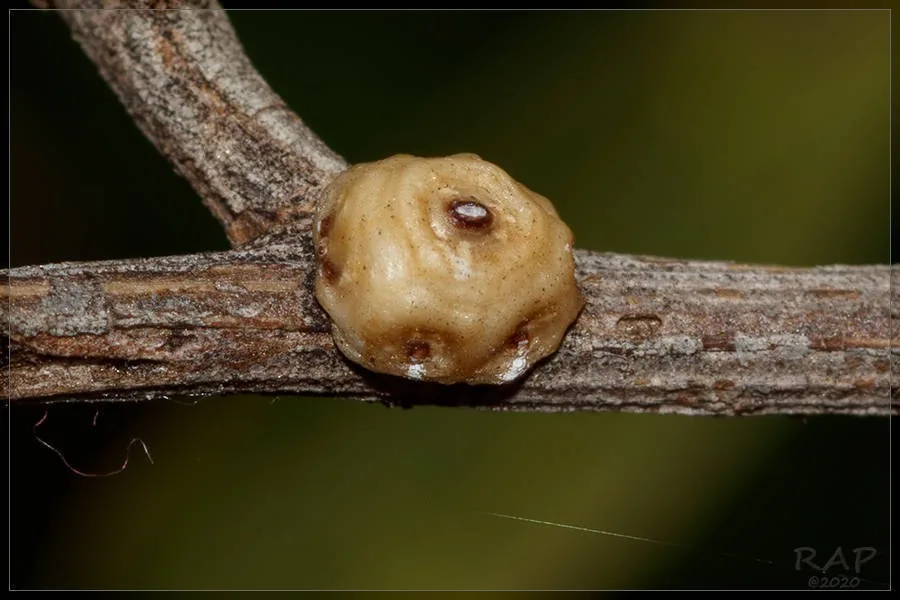
- Mature females are about 1/4 inch long, with a reddish-brown body under a thick, pearly-gray to dirty grayish-white wax cover divided by shallow grooves into plates, each with a darker spot around a small wax button; the large rear plate has three buttons.[1][2][3]
- Nymphs are reddish and partly covered with pure white, star-shaped or conical wax plates; young nymphs feed on the upper side of leaves, often lined up along the veins, and third-stage nymphs move to the twigs.[1][2]
- Eggs are laid in a chamber under the female's body, with no separate egg sac. The USDA scale key separates it from similar wax scales, including Chinese wax scale, by microscopic features such as the shape of its body hairs.[3]
Look-alikes
Where it lives
NC State says gardenia is its most common host in North Carolina, and UC IPM says it is a pest mainly on gardenia in southern California. The USDA scale key notes U.S. port interceptions from China, Colombia, Hawaii, Jamaica, Mexico and elsewhere, and hosts in more than 60 plant families.[1][2][3]
Biology and life cycle
Adults are on stems and twigs from late July through winter, and each female lays hundreds of eggs beneath her body; NC State notes the timing isn't precise, with nymphs photographed on leaves and stems into early winter.[1][2]
There is one generation a year; see where the sources disagree on when crawlers appear.[1][2]
NC State says it has been recorded on Cannabis, citrus, gardenia, guava, passion flower and plants in 119 genera and 63 families.[1]
Damage and signs
Health risk
NC State, UC IPM and the USDA scale key describe plant feeding only and don't mention any risk to people or pets.[1][2][3]
Control
Biological control
Control ants on infested plants, since they attack the scale's natural enemies; UC IPM notes that female scales are commonly killed by parasites, which leave round emergence holes.[2]
Pesticides
Spray while crawlers and young nymphs are exposed; once the scales are fully covered in wax they are very hard to reach. UC IPM recommends thorough horticultural oil sprays at that stage, and NC State adds that oil helps loosen sooty mold. NC State found immature Indian wax scales highly susceptible to carbaryl (Sevin) and pyrethroid sprays and expects the same of barnacle scale.[2][1]
Where the sources disagree
Crawler timing: NC State says crawlers probably emerge in late May to early June; UC IPM says wax scale crawlers are most abundant in fall but may be present from summer through winter.[1][2]
Harm to plants: NC State says infested plants sometimes turn almost black with sooty mold and growth is stunted; UC IPM says wax scale infestations rarely, if ever, threaten plant health.[1][2]
Common questions
- What are the gray, waxy bumps on my gardenia stems?
- Likely barnacle scales, soft scale insects under a thick, pearly-gray wax cover; gardenia is their most common host in North Carolina.[1]
- When should I spray for barnacle scale?
- When crawlers and young nymphs are exposed on the leaves. NC State puts this around late May to early June in North Carolina, while UC IPM says wax scale crawlers are most common in fall; sprays do little once the scales are covered in wax.[1][2]
Sources
- NC State Extension, “Barnacle Scale.” content.ces.ncsu.edu/barnacle-scale (accessed 2026-11-13)
- University of California Statewide IPM Program, “Wax scales (Home and Landscape).” ipm.ucanr.edu/home-and-landscape/wax-scales/ (accessed 2026-11-13)
- USDA APHIS PPQ Identification Technology Program, “Ceroplastes cirripediformis Comstock, barnacle scale or barnacle wax scale (Scale Insects, Edition 2; Miller, Rung, Parikh, Venable, Redford, Evans and Gill; content last updated April 2014).” idtools.org/scales/index.cfm?packageID=1114&entityID=3487 (accessed 2026-11-13)
- Global Biodiversity Information Facility (GBIF), “Ceroplastes cirripediformis Comstock, 1881 (GBIF Backbone Taxonomy).” api.gbif.org/v1/species/2092416 (accessed 2026-11-13)
- iNaturalist, “Ceroplastes cirripediformis taxon page (order and family).” www.inaturalist.org/taxa/120449 (accessed 2026-10-06)