On this page
How to identify it
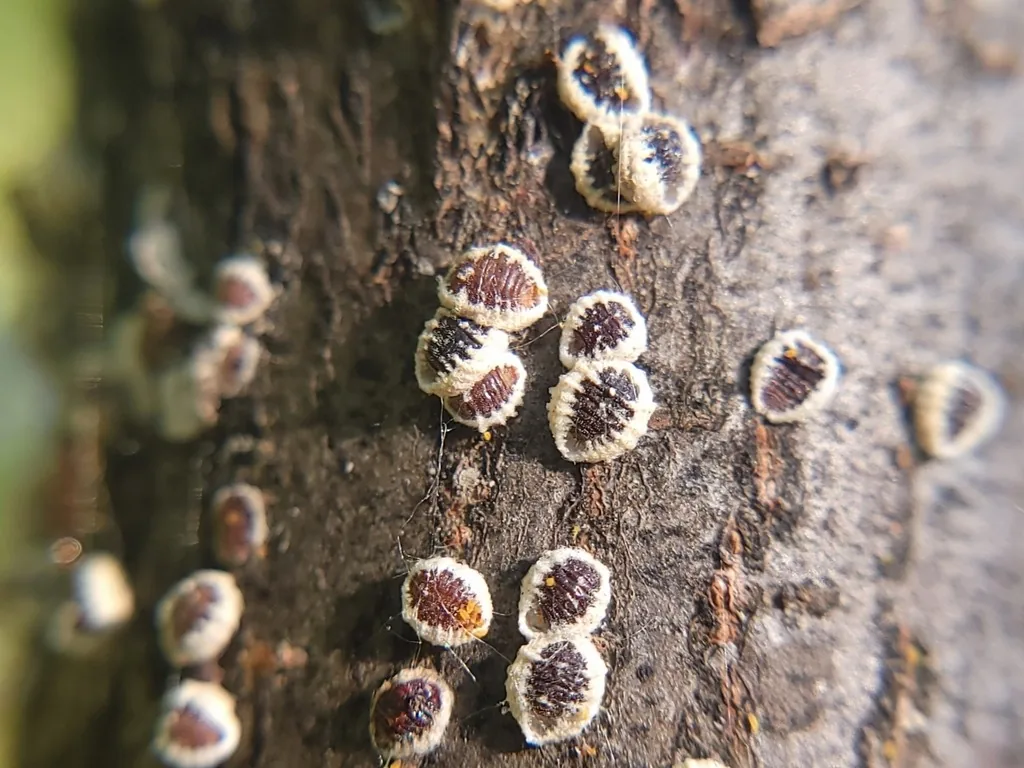
- Mature females are oval and edged with a fringe of white wax. Sources give different sizes and colors: PNW says reddish brown to purplish and about 0.4 inch across, Utah State brown and about 5/16 inch, and UMass black and about 1/8 inch.[1][2][3]
- Crawlers are tiny and yellow to orange; PNW says they can also be dark brown. They appear in late spring and summer.[1][2][3]
- Sticky honeydew and black sooty mold on leaves are common signs.[1]
- Male cocoons look like white puffed rice on the bark.[2][3]
Look-alikes
Where it lives
This non-native scale was first noted in New York in 1884. It is now widespread in North America on native and European elms, and rarely on hackberry and zelkova. Utah State says it's common on 'Camperdown' elm. GBIF files it as Eriococcus spurius; extension guides still use Gossyparia spuria.[3][2][1][6]
Biology and life cycle
Sources name the winter stage differently. PNW says immature crawlers, while Utah State says second-stage nymphs and Montana State says nymphs. All place them in bark cracks, at bud bases or in twig crotches.[1][2][4]
Females mature from mid-April to late May and lay eggs by late June. Utah State puts crawler hatch at mid-June to mid-July. Crawlers settle along the midrib and veins under the leaves, and many die when the leaves drop in fall.[1][2][3][4]
Damage and signs
Health risk
It feeds on elms; none of the extension sources mentions any risk to people.[1][2][4]
Control
Prevention
Sources differ on Asiatic elms. PNW says Chinese elm and other Asiatic elms aren't infested and Siberian elm resists it, though it's a poor shade tree. UMass says only that Asiatic elms may be less susceptible.[1][3]
Keep trees healthy and avoid excess nitrogen fertilizer, which favors scale buildup.[1]
Traps and physical control
Prune out isolated infestations, and wrap tape near adult scales, sticky side out, to catch crawlers.[1]
Biological control
Lady beetles, green lacewings and parasitic wasps help control it; UMass lists at least four parasite species. Avoid broad-spectrum insecticides that kill them.[1][3]
Pesticides
Growing-season sprays target crawlers, usually in late spring to early summer, so scout for crawlers first. Dormant oil can be used before bud break. Montana State reports that this scale has become resistant to imidacloprid.[1][2][5]
Timing crawler checks
Use a hand lens to look along the leaf veins for the tiny yellow crawlers. UMass gives crawler activity at about 1029 to 1388 growing degree days (base 50 F).[3][2]
Tape wrapped sticky side out near the adult scales catches crawlers as they move and shows when to act.[1]
Common questions
- What are the reddish scales with white fringes on my elm?
- Probably European elm scale. The adult females sit in twig forks and have a white waxy fringe.[1][3]
- Which elms resist European elm scale?
- PNW says Chinese and other Asiatic elms aren't infested and Siberian elm resists it; UMass says Asiatic elms may only be less susceptible.[1][3]
- Why do my elm leaves turn yellow and sticky?
- European elm scale sucks sap and excretes honeydew; leaves yellow early, especially low in the tree, and sooty mold grows on the honeydew.[4][1]
Sources
- Pacific Northwest Pest Management Handbooks (OSU, WSU, University of Idaho), “Elm (Ulmus): European elm scale (Insect Management Handbook).” pnwhandbooks.org/insect/hort/landscape/hosts-pests-landscape-plants/elm-ulmus-european-elm-scale (accessed 2026-11-13)
- Utah State University Extension, “European Elm Scale.” extension.usu.edu/planthealth/ipm/ornamental-pest-guide/arthopods/scales/european-elm-scale.php (accessed 2026-11-13)
- UMass Amherst Center for Agriculture, Food, and the Environment, “Gossyparia (Eriococcus) spuria (Landscape, Nursery and Urban Forestry Insect and Mite Guide).” www.umass.edu/agriculture-food-environment/landscape/publications-resources/insect-mite-guide/gossyparia-eriococcus-spuria (accessed 2026-11-13)
- Montana State University Extension, “European Elm Scale (A Guide to Pests, Problems, and Identification of Ornamental Shrubs and Trees in Montana).” montana.edu/extension/Full_HTML_Pubs/a-guide-to-pests-problems-and-identification-of-ornamental-shrubs-and-trees-in-montana/insects/european-elm-scale.html (accessed 2026-11-13)
- Montana State University Extension, Urban IPM, “European Elm Scale (insect fact sheet).” urbanipm.montana.edu/documents/entomology/fact_sheets/insect_fact_sheet_european_elm_scale.pdf (accessed 2026-11-13)
- Global Biodiversity Information Facility (GBIF), “Eriococcus spurius (Modeer, 1778) (GBIF Backbone Taxonomy).” api.gbif.org/v1/species/5160887 (accessed 2026-11-13)