On this page
How to identify it
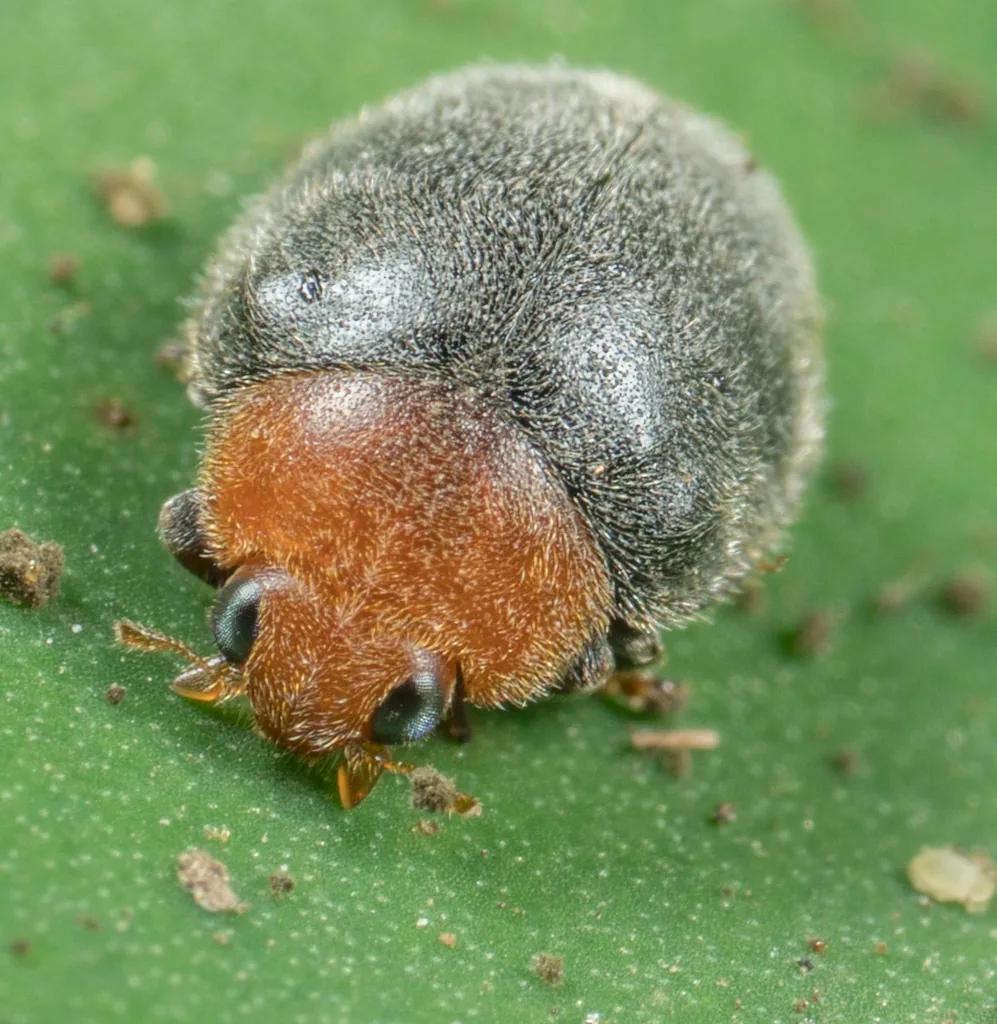
- Adults are dome-shaped lady beetles about 1/8 to 1/6 inch (3 to 4 mm) long, blackish to dark gray with an orange to dark brown head and thorax and an orange-brown wing tip, without spots.[1][3][2]
- Larvae are covered in long, white, woolly wax filaments. UC IPM says they reach about 1/2 inch, and the Pacific fact sheet says about 10 mm.[1][3][2]
- Mature larvae are more than twice the size of an adult female mealybug and move faster.[1]
- Eggs are oblong and yellow, laid singly or in groups in mealybug egg sacs.[1][2]
Look-alikes
Where it lives
Native to Australia and now found worldwide. It reached California in the late 1800s to fight citrus mealybug but tolerates cold poorly and overwinters at low numbers only on the coast; it is also released in greenhouses and interiorscapes.[3][2][1]
Biology and life cycle
Egg counts differ: UC IPM says a female lays about 200 to 400 eggs over about two months, while the Pacific fact sheet says up to 10 a day and about 500 in all. Eating waxy host eggs stimulates laying.[1][3]
Eggs hatch in about 5 days at 80°F, and larvae feed for 3 to 4 weeks before pupating in sheltered spots on stems.[1][3]
UC IPM says egg to adult takes about 4 to 6 weeks in warm weather, with about four generations a year in California; the Pacific fact sheet gives 25 to 30 days.[1][3]
Below 68°F and in short days reproduction slows sharply, so it often can't control mealybugs over winter.[1]
Damage and signs
- They don't feed on plants. Each larva can eat more than 250 young mealybugs or over 1,000 mealybug eggs, and they also take egg-sac-producing scales and sometimes aphids.[1]
Health risk
Mealybug destroyers feed on mealybugs, soft scales and sometimes aphids. UC IPM, Texas Master Gardeners and the Pacific fact sheet describe them only as predators; none of them mentions bites, stings or any effect on people or pets.[1][2][3]
Control
Prevention
Before treating mealybugs, check for larger, faster larvae with visible legs; they may be mealybug destroyers.[1]
Biological control
Ants guard mealybugs and soft scales for their honeydew and fend off the beetles, so control ants, for example with a sticky band on tree trunks. Avoid organophosphate, carbamate and pyrethroid insecticides where the beetles work.[3][1]
They are cold-sensitive and must be reintroduced in spring where winters are long. When buying adults, check the underside: females have black to dark brown front legs and males orange, and mostly-male shipments do little.[2][1]
Where the sources disagree
Larva size: UC IPM says mature larvae reach about 1/2 inch; the Pacific fact sheet says up to 10 mm.[1][3]
Egg count: UC IPM says a female lays about 200 to 400 eggs; the Pacific fact sheet says up to 10 a day and about 500 in all.[1][3]
Development time: UC IPM gives about 4 to 6 weeks from egg to adult in warm weather; the Pacific fact sheet gives 25 to 30 days for the life cycle.[1][3]
Aphids: UC IPM says they feed only sporadically on aphids and other soft-bodied insects; Texas Master Gardeners say aphids are commonly taken when mealybugs are scarce.[1][2]
Adult color: UC IPM describes the abdomen as blackish to dark gray; Texas Master Gardeners call adults dark brown, and the Pacific fact sheet gives black wing covers.[1][2][3]
Common questions
- Are these white fuzzy bugs mealybugs?
- Check their size and speed. Mealybug destroyer larvae are bigger, move faster and have long wax filaments over the back and sides.[1]
- Will they survive the winter?
- Usually not well: this tropical beetle overwinters poorly, at low numbers on the coast and less well or not at all inland, so it is reintroduced in spring where winters are cold.[1][2][3]
Sources
- University of California Statewide IPM Program, “Mealybug Destroyer (Natural Enemies Gallery).” ipm.ucanr.edu/natural-enemies/mealybug-destroyer/ (accessed 2026-11-13)
- Texas Master Gardeners, Galveston County (Texas A&M AgriLife Extension), “Mealybug Destroyer (Beneficials in the Garden and Landscape).” txmg.org/galveston/beneficials-in-the-garden-and-landscape/mealybug-destroyer/ (accessed 2026-11-13)
- Pacific Pests, Pathogens and Weeds (University of Queensland and Pacific Community), “Mealybug ladybird (Cryptolaemus montrouzieri), Fact Sheet 395.” apps.lucidcentral.org/ppp_v9/text/web_full/entities/cryptolaemus_montrouzieri_395.htm (accessed 2026-11-13)
- Global Biodiversity Information Facility (GBIF), “Cryptolaemus montrouzieri Mulsant, 1853 (GBIF Backbone Taxonomy).” api.gbif.org/v1/species/1043717 (accessed 2026-11-13)
- iNaturalist, “Cryptolaemus montrouzieri taxon page (order and family).” www.inaturalist.org/taxa/244084 (accessed 2026-11-12)