On this page
How to identify it
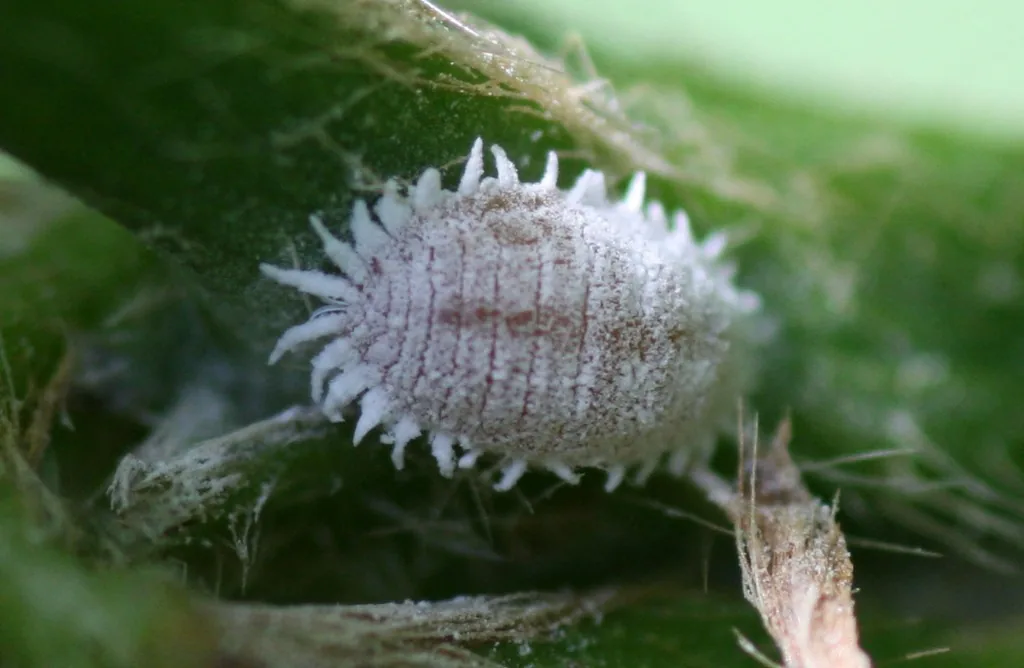
- Adult females are yellow and covered with white wax, fringed with short waxy filaments less than a quarter of the body length. Pacific Pests, Pathogens & Weeds gives them as about 2.2 mm long and 1.4 mm wide; the Hawaii Department of Agriculture says about 1/16 inch, with males smaller.[2][3]
- Eggs, up to 600, sit in a waxy sac under the female. Males become tiny winged, fly-like insects with no mouthparts that live only to mate.[2]
- Heavy colonies leave papaya fruit coated in a crust of mealybugs and wax, with black sooty mold growing on the sticky liquid they excrete.[2]
Look-alikes
| Look-alike | How to tell them apart |
|---|---|
| Pink hibiscus mealybug | Squash one on white paper: papaya mealybug leaves a yellow smear, pink hibiscus mealybug a pink one. Under magnification the papaya mealybug female has 8 antenna segments, the pink hibiscus mealybug 9.[2] |
| Other mealybugs | Many mealybugs look alike. A firm ID needs an expert to examine slide-mounted adult females under a microscope with a taxonomic key.[2] |
Where it lives
Native to Mexico and Central America (CDFA, Hawaii Department of Agriculture) or to Central America (EFSA), it has spread since the 1990s through the Caribbean, southern Asia, Africa, the Indian and Pacific Ocean islands and the Middle East. In U.S. territory it was found in Florida in 1998, Puerto Rico in 2001, Guam in 2002 and Hawaii in 2004, where the Hawaii Department of Agriculture reported USDA-APHIS confirmed it on Maui on June 2, 2004. A 2001 greenhouse infestation in Illinois was controlled with natural enemies, and it has never been found outdoors in California. It reached Israel by 2016 and the Northern Territory of Australia in July 2023.[1][3][4][2][5]
Biology and life cycle
Estimates of its host range differ: CDFA cites at least 55 plant species in at least 18 families, the Hawaii Department of Agriculture said in 2004 more than 60 plants, EFSA lists plants in 172 genera and 54 families, and a 2021 modeling paper says more than 200 plants. Papaya is the preferred host, and hibiscus, custard apple, plumeria, citrus, avocado, cotton, mango, eggplant, pepper and tomato are all attacked.[1][3][4][6][2]
CDFA cites up to 15 generations a year and 100 to 600 eggs per female; EFSA reports up to 11 generations a year in India.[1][4]
Crawlers spread by walking to nearby plants or riding on wind, clothing, equipment, vehicles and animals. Long-distance spread is mainly through trade in fruit, nursery plants and cut flowers.[2][4][1]
Damage and signs
- Feeding causes yellowing, stunting, leaf deformation, early leaf and fruit drop and heavy honeydew. Sooty mold on the honeydew blocks light from the leaves, and crusted, stained papaya fruit becomes unsellable.[1][2]
- CDFA notes it is not reported to cause economic damage in Florida and has been brought under control by biological control on several Caribbean islands.[1]
Health risk
It is a sap-feeding plant pest. CDFA, Pacific Pests, Pathogens & Weeds and the Hawaii Department of Agriculture describe it only as a pest of plants; none of them mentions bites, stings or any effect on people or pets.[1][2][3]
Control
Sanitation
Remove weedy host plants, prune off heavily infested branches and low branches that ants use, and control ants, which guard mealybugs for their honeydew.[2]
Biological control
Released parasitic wasps, especially Acerophagus papayae, have controlled it in the Caribbean, South America and the Pacific. The Hawaii Department of Agriculture said in 2004 that USDA had started a biological control program for it on the mainland in 1999 and found parasitic insects that were highly successful elsewhere, including Palau. Lady beetles such as the mealybug destroyer, lacewings and hover flies also feed on it.[2][1][3]
Pesticides
Broad insecticides can make the problem worse by killing these natural enemies. Horticultural oil or insecticidal soap sprays suppress it and are less likely to kill those natural enemies; it takes several sprays, covering leaf undersides, stems and fruit thoroughly, and late-afternoon spraying reduces the chance of leaf burn.[2]
Why California rates it a top-priority pest
The California Department of Food and Agriculture gives it an A rating: it has never been found in California's environment, but the state has intercepted it four times (on plumeria and betel from Hawaii, papaya from Mexico and rambutan from Honduras), and USDA has intercepted it nearly 650 times since 1994, mostly on produce from Mexico bound for California.[1]
A 2021 climate model found that the central and eastern United States are suitable for seasonal invasions of the mealybug.[6]
Regulatory status
CDFA's pest rating profile says USDA circulated a Deregulation Evaluation of Established Pests (DEEP) report on February 26, 2014, proposing to change papaya mealybug from actionable to non-actionable for the entire United States.[1]
The same profile gives it an A rating for California and says it is not known to be under official control in any state or nation and is not known to be listed as a quarantine pest by any nation.[1]
Where the sources disagree
Native range: CDFA and the Hawaii Department of Agriculture say Mexico and Central America; EFSA says Central America.[1][3][4]
Host range: CDFA cites at least 55 species in 18 families, Hawaii (2004) more than 60 plants, EFSA 172 genera in 54 families, and a 2021 modeling paper more than 200 plants.[1][3][4][6]
Generations: CDFA cites up to 15 a year; EFSA reports up to 11 a year in India.[1][4]
Eggs: CDFA gives 100 to 600 per female; Pacific Pests, Pathogens & Weeds says up to 600.[1][2]
How serious it is: the Hawaii Department of Agriculture warned in 2004 that it could seriously damage papayas, avocados, hibiscus and plumeria; CDFA notes it is not reported to cause economic damage in Florida.[3][1]
Common questions
- What are the cottony clusters on my hibiscus?
- Possibly papaya mealybugs, which form cotton-like masses on hibiscus, papaya and many other plants. Squash one on paper: a yellow smear points to papaya mealybug, a pink one to pink hibiscus mealybug.[1][2]
- Why are the leaves yellow and deformed?
- Heavy mealybug feeding causes yellowing, stunting and deformed leaves, and the sooty mold growing on their honeydew darkens leaves further.[1][2]
- Should I spray papaya mealybugs?
- Start with oil or soap sprays and ant control. Strong insecticides kill the parasitic wasps and lady beetles that usually keep it in check.[2]
Sources
- California Department of Food and Agriculture (Pest Ratings), “California Pest Rating: Paracoccus marginatus Williams and Granara de Willink: Papaya mealybug.” blogs.cdfa.ca.gov/Section3162/?p=3022 (accessed 2026-11-13)
- Pacific Pests, Pathogens & Weeds (ACIAR and the Pacific Community), “Papaya mealybug, Fact Sheet 328 (Pacific Pests, Pathogens, Weeds & Pesticides).” apps.lucidcentral.org/pppw_v11/text/web_full/entities/papaya_mealybug_328.htm (accessed 2026-11-13)
- Hawaii Department of Agriculture, “News Release NR04-11: Papaya Mealybug Found on Maui (June 10, 2004).” dab.hawaii.gov/blog/news-releases/news-release-june-10-2004/ (accessed 2026-11-13)
- EFSA Journal, via PubMed, “Pest categorisation of Paracoccus marginatus (EFSA Panel on Plant Health 2023).” pubmed.ncbi.nlm.nih.gov/37009439/ (accessed 2026-11-13)
- Journal of Insect Science, via PubMed, “Genetic insights into the first detection of Paracoccus marginatus in Australia (Yadav et al. 2025).” pubmed.ncbi.nlm.nih.gov/39868734/ (accessed 2026-11-13)
- Pest Management Science, via PubMed, “The potential global distribution of the papaya mealybug, Paracoccus marginatus, a polyphagous pest (Finch et al. 2021).” pubmed.ncbi.nlm.nih.gov/33089608/ (accessed 2026-11-13)
- Global Biodiversity Information Facility (GBIF), “Paracoccus marginatus Williams & Granara de Willink, 1992 (GBIF Backbone Taxonomy).” api.gbif.org/v1/species/5164055 (accessed 2026-11-13)
- iNaturalist, “Paracoccus marginatus taxon page (order and family).” www.inaturalist.org/taxa/922656 (accessed 2026-10-06)