On this page
How to identify it
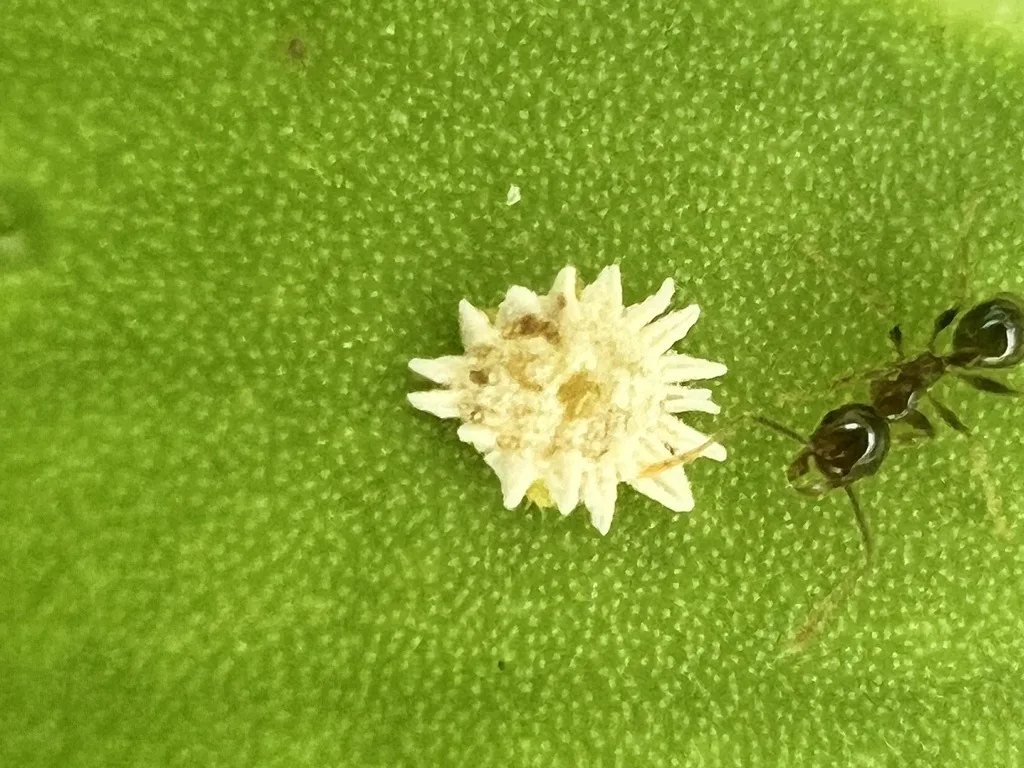
- Adult females are oval and fairly flat to distinctly convex, with a reddish-brown to orange body under thick buff to yellowish-orange (occasionally white) wax. ScaleNet gives a length of 1.5 to 3.5 mm; Pacific Pests, Pathogens and Weeds says up to 2.5 mm. UF/IFAS gives 1.5 to 2.5 mm and calls the adult female the best life stage for identification.[2][1][4]
- The wax forms 10 to 12 pairs of pyramid-shaped or conical lumps around the edge of the body, plus 5 to 8 similar lumps on the back.[2][1]
- Unlike many mealybugs, the female makes no egg sac. UF/IFAS likewise says no ovisac is present.[2][4]
- Males develop inside white waxy cocoons about 2 mm long, often found in large numbers on the leaves, and emerge as tiny fly-like winged insects. UF/IFAS says males are oblong and smaller than females and develop in very thin white cottony wax cocoons.[2][1][4]
Look-alikes
| Look-alike | How to tell them apart |
|---|---|
| Other mealybugs | Coconut mealybug's thick orange-yellow wax, marginal pyramid-shaped lumps and lack of an egg sac help set it apart, but a firm species identification is made from adult females. UF/IFAS notes mealybugs can be very small or resemble disease organisms or plant parts, and final species identification is often based on slide-mounted adult females.[2][5][4] |
Where it lives
Coconut mealybug is widely distributed, with records from North, Central and South America, Europe, Asia, Oceania and Africa. ScaleNet lists U.S. records from California, Florida, Louisiana and Hawaii. GBIF holds 59 U.S. records since 1990 from 4 state-level areas, the most from Florida (27), Hawaii (15) and California (14).[2][1][6]
Biology and life cycle
It lives on the foliage of its hosts. ScaleNet's host records include palms, avocado, banana and coconut. University of Hawaii CTAHR says it has a very wide host range and is relatively common on well-fertilized palms in Hawaii landscapes; its landscape pest guide lists avocado, banana, banyan, breadfruit, canna, citrus, coffee, Dracaena, fig, ginger, grape, guava, heliconia, orchids and palms as hosts.[2][3][7]
It spreads as crawlers (newly hatched nymphs) that walk or are carried by wind, vehicles, animals and birds, on clothing, and in the plant trade.[1]
DNA studies suggest that what is called coconut mealybug may be at least three closely similar species, with different forms in California and Hawaii and in Florida.[2]
Mealybugs in its genus are hard to tell apart: a California Department of Food and Agriculture team published a key to identify the U.S. Nipaecoccus species from adult females, with DNA barcodes for coconut mealybug and its relatives.[5]
Males and females can't readily be told apart in the first two instars; in the third, females begin to resemble adults, while males change inside a cocoon before emerging as winged adults, UF/IFAS says.[4]
UF/IFAS says it is also called nipa, avocado, sugarapple or Kentia mealybug because of its wide host range, and attacks plants in more than 40 families, including sago palm, pygmy date, California fan, parlor, queen, Kentia, lady and Washington palms, avocado, banana, citrus, coffee, grape, ginger, heliconia, dracaena, orchids and potato.[4]
Damage and signs
- Adults and nymphs suck sap, and heavy feeding turns plants yellow and weak.[1]
- Their honeydew drips onto the leaves and grows black sooty mold, which weakens plant growth. UF/IFAS adds that sooty mold reduces photosynthesis and can lead to leaf loss and occasionally the death of a young plant.[1][3][4]
- Pacific Pests, Pathogens and Weeds calls it a mealybug of minor importance except where it is tended by ants. UF/IFAS says ants feed on the honeydew and may defend the mealybugs from predators and parasitoids.[1][4]
- UF/IFAS says it may be economically damaging to palms and tropical fruit crops, and its photos show heavy infestations yellowing the fronds of pygmy date palm.[4]
Health risk
It feeds on plant sap. ScaleNet, Pacific Pests, Pathogens and Weeds and University of Hawaii CTAHR describe it only as a plant pest and don't mention any risk to people or pets.[2][1][3]
Control
Prevention
Check nursery plants before planting them, and help infested plants grow out of the damage with manure or fertilizer. UF/IFAS stresses inspecting plants before bringing them into a landscape, nursery or collection, and searching all plant parts regularly, including leaf undersides and stems, so infestations are found before damage is obvious.[1][4]
Control the ants that tend the mealybugs: pour boiling water on nests, prune branches that touch the ground and remove weeds.[1]
Traps and physical control
Prune off infested parts of the plant. UF/IFAS says pruning or washing infested parts helps with small infestations, and a brisk spray of water removes mealybugs and reduces their numbers.[1][4]
Biological control
Ladybird beetles and a parasitic wasp (Pseudaphycus) attack coconut mealybug; avoid malathion and synthetic pyrethroids, which kill them. UF/IFAS says the parasitic wasp Pseudaphycus utilis successfully controlled coconut mealybug in Hawaii and Puerto Rico, and urges conserving predators, parasites and diseases for long-term control.[1][4]
Pesticides
Use a soap solution or horticultural (white) oil on the mealybugs. Avoid malathion and synthetic pyrethroids on the plants because they kill natural enemies; pyrethroids can be used against the ants instead. UF/IFAS says the wax protects mealybugs from many insecticides; horticultural oil and insecticidal soap can give good control but need thorough coverage and repeat applications, crawlers are the most susceptible stage, and rotating among insecticide groups helps avoid resistance.[1][4]
University of Hawaii CTAHR's landscape pest guide says mealybugs in general are hard to control with chemicals because their wax protects them: every spray needs full coverage, including leaf undersides, and soaps and horticultural oils need thorough coverage and repeat applications. It lists systemic insecticides (imidacloprid, dinotefuran, spirotetramat, acetamiprid) as options for mealybugs and also advises controlling the ants that tend them (see where the sources disagree).[7]
Where the sources disagree
Size: ScaleNet gives adult females a length of 1.5 to 3.5 mm; Pacific Pests, Pathogens and Weeds says up to 2.5 mm. UF/IFAS gives 1.5 to 2.5 mm.[2][1][4]
Appearance: ScaleNet describes females under thick buff to yellowish-orange wax, with males developing in white cocoons; University of Hawaii CTAHR's palm gallery page says the males are yellowish and the females longer, narrower and white.[2][3]
Sprays: Pacific Pests, Pathogens and Weeds recommends soap or horticultural oil and warns against broad-spectrum sprays that kill natural enemies; University of Hawaii CTAHR's landscape guide says systemic insecticides can give excellent control of mealybugs in general. UF/IFAS also says systemic insecticides can provide excellent options for scale control, while stressing that natural enemies should be conserved.[1][7][4]
Common questions
- What are the orange, spiky mealybugs on my palm?
- Probably coconut mealybug: thick yellowish-orange wax with 10 to 12 pairs of pyramid-shaped spikes around the edge, often with clusters of small white male cocoons nearby.[2][1]
- Will coconut mealybug kill my palm?
- Usually it is a minor pest, but heavy feeding turns plants yellow and weak and its honeydew leads to sooty mold, especially where ants tend it.[1][3]
- What should I spray?
- Pacific Pests, Pathogens and Weeds recommends a soap solution or horticultural oil and says to avoid malathion and synthetic pyrethroids on the plant, which kill the mealybug's natural enemies. University of Hawaii CTAHR's general mealybug advice adds that any spray needs thorough coverage, and lists systemic insecticides as another option.[1][7]
Sources
- Pacific Pests, Pathogens and Weeds (Australian Centre for International Agricultural Research / Pacific Community), “Coconut mealybug (Mini Fact Sheet 347).” apps.lucidcentral.org/ppp/text/web_mini/entities/coconut_mealybug_347.htm (accessed 2026-11-13)
- ScaleNet (scale insect database begun at the USDA ARS Systematic Entomology Laboratory), “ScaleNet catalogue: Nipaecoccus nipae (Maskell).” scalenet.info/catalogue/Nipaecoccus%20nipae/ (accessed 2026-11-13)
- University of Hawaii at Manoa, College of Tropical Agriculture and Human Resources, “Coconut mealybug (Palm Pest and Disease Image Gallery).” www.ctahr.hawaii.edu/nelsons/palms/Coconut%20mealybug.htm (accessed 2026-11-13)
- University of Florida IFAS Extension (EDIS), “Coconut Mealybug, Nipaecoccus nipae (Maskell), EENY448/IN815 (Featured Creatures; A. Espinosa, A. Hodges, G. Hodges and C. Mannion).” ask.ifas.ufl.edu/publication/IN815 (accessed 2026-11-14)
- Zootaxa 2018;4444(2):163-178, via PubMed, “Identification of Nipaecoccus (Hemiptera: Coccomorpha: Pseudococcidae) species in the United States, with descriptions of Nipaecoccus bromelicola sp. n. and the male of N. floridensis Beardsley.” pubmed.ncbi.nlm.nih.gov/30313935/ (accessed 2026-11-13)
- Global Biodiversity Information Facility (GBIF), “Nipaecoccus nipae: U.S. occurrence records since 1990 by state (GBIF occurrence search).” api.gbif.org/v1/occurrence/search?taxonKey=2093704&country=US&hasGeospatialIssue=false&occurrenceStatus=PRESENT&year=1990%2C2026&facet=stateProvince&facetLimit=400&limit=0 (accessed 2026-11-13)
- University of Hawaii at Manoa, College of Tropical Agriculture and Human Resources, “Hawai'i Landscape Plant Pest Guide: Sucking Insects (IP-36, Hara & Niino-DuPonte, 2015).” www3.ctahr.hawaii.edu/oc/freepubs/pdf/IP-36.pdf (accessed 2026-11-13)
- Global Biodiversity Information Facility (GBIF), “Nipaecoccus nipae (Maskell, 1893) (GBIF Backbone Taxonomy).” api.gbif.org/v1/species/2093704 (accessed 2026-11-13)
- iNaturalist, “Nipaecoccus nipae taxon page (order and family).” www.inaturalist.org/taxa/330245 (accessed 2026-11-09)