On this page
How to identify it
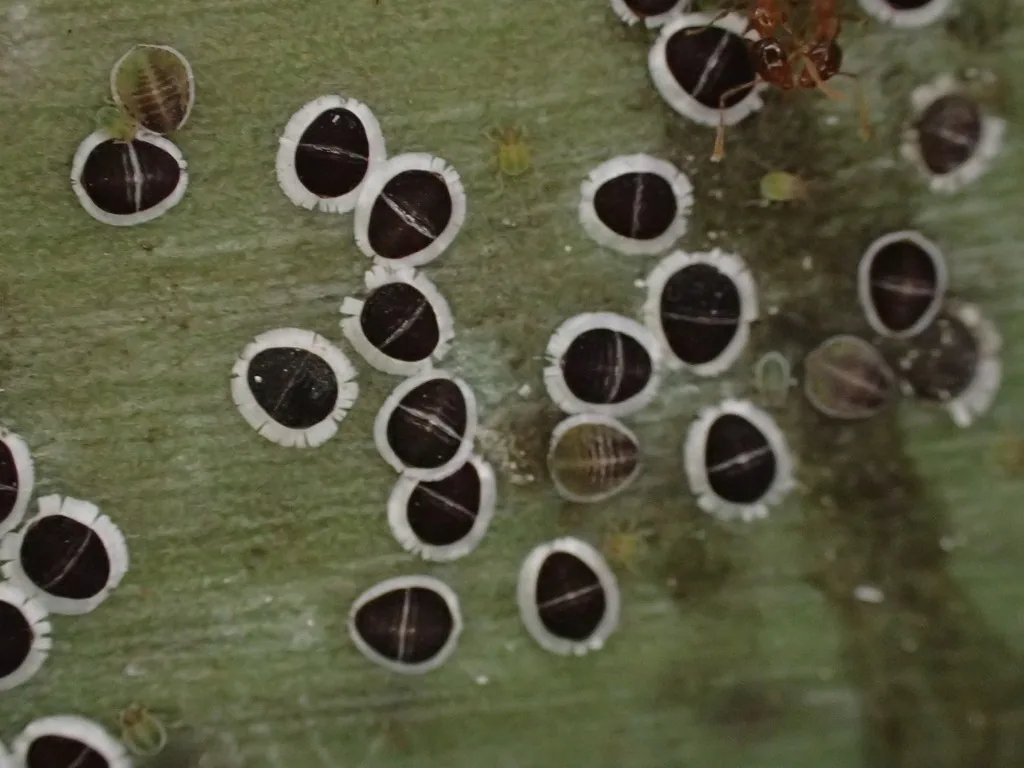
- Wingless females have an oval body, dark brown to black, with white wax on the host and wax glands along the whole of each side.[3]
- The head bears a pair of sturdy horns, widely separated, long, straight and tapered. Under magnification there is a pair of short, dagger-like bristles on a bump near the base of the antennae.[3]
- Wingless females come in two forms that differ in horn length, number of antennal segments, wax glands and the position of the siphunculi.[5]
- Colonies have been found on the unfurled spindle leaf of coconut and on the flower stalks and fruit of Butia palm.[6][3]
- University of Florida Extension describes adults as 1 to 2 mm long, wingless, oval and slightly convex, glossy dark brown with a fringe of white wax plates. They have working legs but stay mostly put unless disturbed, and can eject honeydew droplets up to 1/2 inch away.[1]
- Nymphs are up to 1 mm long and light green to olive, oval with a white waxy fringe; there are three nymphal stages.[1]
Look-alikes
| Look-alike | How to tell them apart |
|---|---|
| Cerataphis lataniae | Of the nine Cerataphis species, only C. lataniae and the palm aphid are known to infest palms, and the two are easily confused. The palm aphid has a pair of short, dagger-like bristles on a bump near the base of each antenna; in C. lataniae these bristles are simple. University of Florida Extension notes that this trait is highly variable, which makes some taxonomists doubt the two are separate species.[3][1] |
| Whiteflies (pupae) | University of Florida Extension says adult palm aphids are commonly mistaken for whitefly pupae. Every palm aphid stage has a pair of small horns on the front of the head.[1] |
| Tessellated scale (Eucalymnatus tessellatus) | Another flat, brown insect of palm fronds, and the two can occur together. University of Florida Extension describes adult female tessellated scales as 2 to 5 mm long, reddish to dark brown, with polygonal plates on the back and no wax cover; the palm aphid is 1 to 2 mm, glossy dark brown with a white wax fringe and horns on the head.[7][1] |
| Orchid aphid (Cerataphis orchidearum) | University of Florida Extension says the palm aphid, C. lataniae and the orchid aphid are commonly confused with one another.[1] |
Where it lives
Native to Asia, it now occurs throughout the world's tropical regions; University of Florida Extension says it was likely spread by the international trade in live palms from the early 20th century. In the United States it is common in southern Florida but rare north of Lake Okeechobee, and has been reported from Brevard, Broward, Hillsborough, Lee, Manatee, Miami-Dade, Monroe, Orange, Palm Beach, Pinellas, Polk, St. Lucie and Seminole counties. In South America it is found mainly on palms, including acai and tucuma palms in the Amazon and Butia in southern Brazil, and infestations have been documented on date palm.[3][4][1]
Biology and life cycle
Colonies seen on coconut in India and on Butia palm in Brazil were made up of wingless females, which reproduce without mating, and their nymphs; no winged forms were present.[6][3]
It feeds on palms and has been recorded on banana; in South America it is known from four plant families, mostly palms. It is particularly important on coconut and oil palm. In India it was reported on the 'Kalparaksha' coconut, a Malayan Green Dwarf selection, but not on the other coconut varieties at the same research farm.[4][3][6]
Ants tend the colonies for their honeydew: in Brazil a carpenter ant fed on the honeydew and defended the aphids, and in India two ant species attended the colonies.[3][6]
In Florida it lives on the unopened frond and the youngest two or three fronds, sometimes on young fruit, and can sit motionless while feeding for long periods.[1][2]
In its native range it alternates between galls on the tree Styrax benzoin, where colonies reproduce sexually and are guarded by sterile soldiers, and palms. Where Styrax is absent, as in Florida, it lives on palms alone and reproduces without mating, with multiple generations a year and especially high numbers in warmer months.[1][2]
It infests several palms but prefers the 'Malayan Dwarf' coconut; other hosts include date palm, Chinese fan palm, Alexander palm and Washington palm.[1]
Florida researchers watched palm aphids duel about 15 times in the lab at about 23 degrees C. An aphid lowers its head, slips its horns under its opponent's head and snaps upward; duels lasted up to 19 minutes, with blows often about 40 times a minute. The aphids ignored other small insects and did not defend themselves against a lady beetle larva that ate several of them.[2]
Damage and signs
- In Brazil it is one of the main pests of acai seedlings and young plantations up to three years old, and it causes significant damage to Australian royal palm. On Butia palms no clear symptoms were seen.[3]
- As with other aphids, the sticky honeydew can attract ants and sooty mold.[8]
- University of Florida Extension says high populations occasionally become severe in nurseries and landscapes and can cause substantial damage to young coconut palms. Feeding on the phloem yellows the tissue and saps vigor, honeydew grows sooty mold that can limit photosynthesis, and heavily infested palms can be stunted.[1]
- In a dense planting of 'Malayan Dwarf' coconut palms in Miami sprayed repeatedly for palm aphid without much success, a serious tessellated scale infestation built up, with up to 200 mature female scales per pinna and most foliage crusted with sooty mold; University of Florida Extension thinks the sprays may have interfered with natural enemies of both pests.[7]
Health risk
The sources treat it only as a plant pest; none mentions bites or other risk to people or pets.[4][3]
Control
Prevention
Check newly bought palms carefully for aphids; keeping them out of the landscape helps prevent damaging outbreaks. Watch palms for sooty mold, and scout monthly for both aphids and their natural enemies.[1]
Biological control
Ants can keep natural enemies away: in India no predators were seen in palm aphid colonies attended by ants. UC IPM notes that ants protect aphids from natural enemies and advises keeping ants off plants so beneficial insects can do their job.[6][8]
Because palm aphids move little, biological control can work: syrphid fly and lady beetle larvae commonly feed on them and can be released against infestations.[1]
Pesticides
If aphids are numerous and natural enemies few, University of Florida Extension says horticultural oil can be used. Professional growers may need an insecticide, but the most effective product against this aphid has not been determined, and pyrethroids, which kill natural enemies, should be a last option.[1]
Where the sources disagree
Which aphids live on palms: University of Florida Extension says the palm aphid and C. lataniae are the only aphids known to infest palms; the 2025 Brazilian study says only that they are the only two of the nine Cerataphis species known to do so.[1][3]
Separate species: the 2025 study separates the palm aphid from C. lataniae by its dagger-like bristles; University of Florida Extension says that trait is highly variable and some taxonomists question whether the two are really separate species.[3][1]
Common questions
- Is it a scale or an aphid on my palm?
- University of Florida Extension says the palm aphid resembles a whitefly or scale insect. A small, oval, dark brown to black insect edged with white wax, clustered on new fronds, flower stalks or fruit, may be the palm aphid. Under magnification every stage shows a pair of horns on the front of the head, which scale insects lack.[3][1]
- Why are ants crawling over my palm fronds?
- Ants tend palm aphids for their honeydew and defend them, so ant traffic on new fronds or fruit stalks can point to an aphid colony.[3][8]
- Do palm aphids spread plant diseases?
- It has not been implicated in transmitting any plant virus. As with other aphids, its honeydew can attract ants and sooty mold.[4][8]
- Is the palm aphid a problem in Florida?
- It is common in south Florida but rare north of Lake Okeechobee. University of Florida Extension says it can be a major pest of young landscape palms, especially coconut, with especially high populations in warmer months.[1]
Sources
- University of Florida/IFAS Extension (Featured Creatures), “Palm Aphid, Cerataphis brasiliensis (Hempel), EENY-520/IN924 (B. C. Wells).” ask.ifas.ufl.edu/publication/IN924 (accessed 2026-11-14)
- Florida Entomological Society (Florida Entomologist), “Intraspecific dueling in palm aphids, Cerataphis brasiliensis (Howard, Halbert and Giblin-Davis 1998, Florida Entomologist 81(4): 552-554).” journals.flvc.org/flaent/article/view/59411 (accessed 2026-11-14)
- International Journal of Tropical Insect Science (Springer Nature), “So close and unnoted: a new host plant of Cerataphis brasiliensis (Hempel) (Hemiptera: Aphididae) (2025, open access).” link.springer.com/article/10.1007/s42690-025-01738-7 (accessed 2026-11-14)
- USDA APHIS PPQ Identification Technology Program (AphID), “AphID: Cerataphis brasiliensis.” www.aphid.aphidnet.org/Cerataphis_brasiliensis.php (accessed 2026-11-14)
- Neotropical Entomology 2008;37(2):137-142, via PubMed, “A closer look at intraspecific variation of Cerataphis brasiliensis (Hempel) (Hemiptera: Hormaphididae) (Mews, Cabette and Albino, 2008).” pubmed.ncbi.nlm.nih.gov/18506291/ (accessed 2026-11-14)
- Phytoparasitica (Springer Nature), “Report on the palm aphid, Cerataphis brasiliensis on 'Kalparaksha' coconut cultivar (2011), abstract.” link.springer.com/article/10.1007/s12600-011-0174-4 (accessed 2026-11-14)
- University of Florida/IFAS Extension (Featured Creatures), “Tessellated Scale, Eucalymnatus tessellatus (Signoret), EENY 456/IN826.” ask.ifas.ufl.edu/publication/IN826 (accessed 2026-11-14)
- University of California Statewide IPM Program, “Aphids (Pest Notes).” ipm.ucanr.edu/home-and-landscape/aphids/ (accessed 2026-11-14)
- iNaturalist, “Cerataphis brasiliensis taxon page (order and family).” www.inaturalist.org/taxa/656055 (accessed 2026-11-14)