On this page
How to identify it
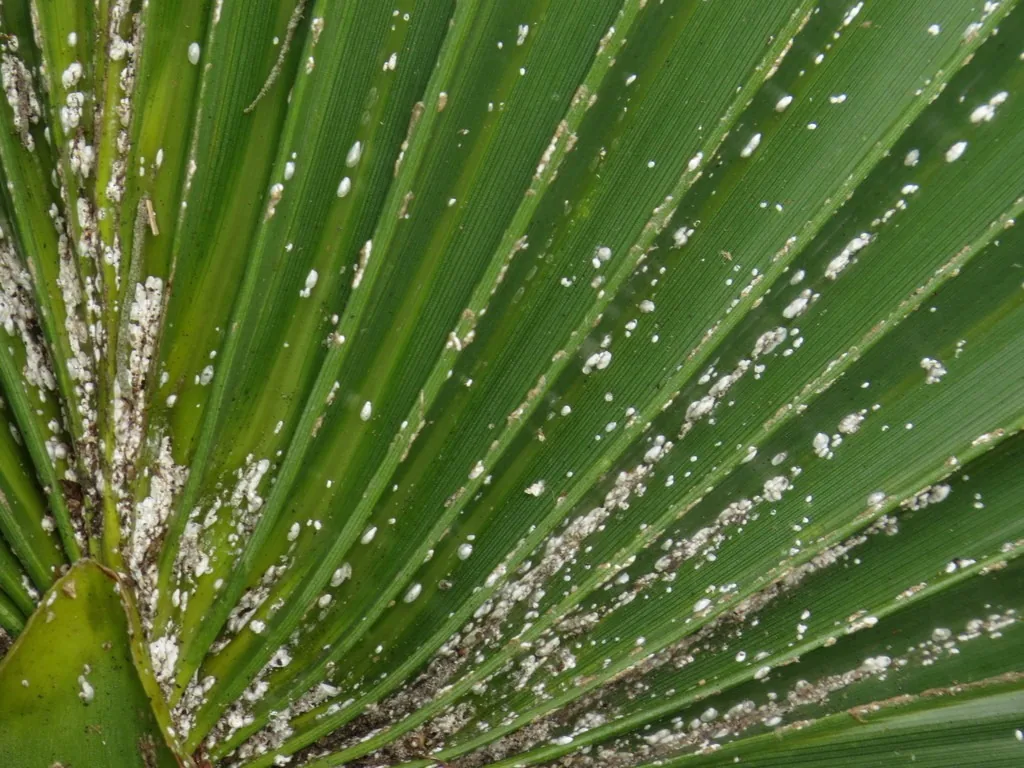
- The female's armor is white and nearly circular, with the first shed skin sitting slightly off center as a whiter or yellowish spot. Under it the female is pink to reddish and round. UF/IFAS gives the female as light pink to reddish brown, almost circular but irregular, and 0.039 to 0.059 inch (1 to 1.5 mm) across, with a white shed skin covered in yellow wax.[1][2][4]
- Male armor is similar but smaller and more elongate. Adult males are tiny, pale and winged, with four eyes and no mouthparts. UF/IFAS describes the male covering as light pink or cream; winged adult males are rarely seen and short-lived.[1][2][4]
- Females lay at least eight cream to pink eggs under their armor. UF/IFAS calls the eggs light pink or cream.[1][4]
- As an armored scale it makes little or no honeydew and very little wax.[2]
Where it lives
ScaleNet records it in Florida, where it was first described, and in Alabama, California, Georgia, Louisiana, Mississippi, North Carolina, South Carolina and Texas, plus Mexico, the Bahamas, Bermuda, Cuba, Haiti, Guadeloupe, Colombia and France. It is a pest of palms in the southern and southwestern United States, western Mexico, the West Indies and Bermuda. UF/IFAS says it is probably native to the southern United States, occurs throughout the South, Mexico and the Caribbean, and may turn up in greenhouses in cooler regions on infested palms.[2][4]
Biology and life cycle
It reproduces sexually: males leave their armor, find and mate with a female, and die a short time later. Females lay their eggs under the armor.[2][1]
On sabal palms it is often found with a small sap beetle in the flower stalks; the beetle feeds on shed scale skins, with no evidence that it eats living scales.[2]
UF/IFAS says details of its life cycle are unknown, though it is reportedly often associated with a fungus.[4]
Damage and signs
- Hosts are palms, including cabbage (sabal) palm, saw palmetto, dwarf palmetto, coconut palm, Mexican fan palm, Mexican blue palm and San Jose hesper palm. UF/IFAS also notes one unusual non-palm host, globe daisy (Globularia salicina).[1][2][4]
- Its saliva is apparently not acutely toxic to the palm. When it was accidentally introduced to Bermuda without its parasites, it severely damaged and killed many Bermuda palmettos; after parasites were brought in, its numbers dropped to acceptable levels. UF/IFAS dates its arrival in Bermuda to the 1920s, where it killed native Bermuda palmettos (Sabal bermudana) until parasitized scales from Florida were brought in.[1][4]
- Sabal palmetto is resistant to most insect pests, but a stressed palm, such as a newly transplanted one, can become susceptible to palmetto scale.[3]
- It is usually found on the leaves but in heavy infestations also on the trunk or fruit. UF/IFAS says feeding shows as yellow splotches or a general yellowing (chlorosis) of the fronds.[4]
Health risk
It feeds only on plants; none of these sources reports a risk to people or pets.[1][2]
Control
Prevention
Keep palms unstressed, with careful transplanting and good aftercare, since stressed cabbage palms are the ones that become susceptible.[3]
Biological control
Parasitic wasps normally keep it at acceptable levels. ScaleNet lists parasitic wasps in the genera Aphytis, Encarsia and Coccobius among its natural enemies. UF/IFAS names Coccobius donatellae, described in 1997, as its primary parasitoid, and says Aphytis fuscipennis and Encarsia citrina are also confirmed in Florida.[1][2][4]
Pesticides
Horticultural oil works. NC State advises using no more than the 2% rate to avoid frond damage, watering the palm well first, and keeping it out of direct sun until the residue dries.[1]
Where sources disagree
Classification: NC State treats it as an armored scale (Diaspididae), while the ScaleNet catalogue currently places it in the family Halimococcidae.[1][2]
Host range: NC State says it infests most ornamental palms, and ScaleNet lists records from many palm genera, yet a study ScaleNet cites calls it specific to sabal palms. UF/IFAS calls it fairly host-specific, with reported damage focused on palms.[1][2][4]
Common questions
- What are the white specks on my palm fronds?
- Possibly palmetto scale, a tiny scale with white, nearly round armor. Other scales can look similar, so a close look or a sample to your extension office helps.[1][2]
- Will palmetto scale kill my palm?
- Not usually where its natural parasites are present. Stressed palms, such as new transplants, are more at risk.[1][3]
- How do I treat palmetto scale?
- Horticultural oil at no more than 2%, on a well-watered palm kept out of direct sun until dry.[1]
- Is palmetto scale native?
- Probably. UF/IFAS says it is probably native to the southern United States, where parasitic wasps normally keep it from becoming a significant pest.[4]
Sources
- NC State Extension, “Palmetto Scale (PDIC Factsheet).” content.ces.ncsu.edu/palmetto-scale (accessed 2026-11-11)
- ScaleNet (scale insect database begun at the USDA ARS Systematic Entomology Laboratory), “ScaleNet catalogue: Comstockiella sabalis (Comstock, 1883).” scalenet.info/catalogue/Comstockiella%20sabalis/ (accessed 2026-11-11)
- Florida Department of Agriculture and Consumer Services, Division of Plant Industry, “Sabal palmetto, Our State Tree: Is It a Tree? (DPI Circular 42, Anderson 2020).” ccmedia.fdacs.gov/content/download/95617/file/sabal-palmetto-circular.pdf (accessed 2026-11-11)
- University of Florida IFAS Extension (EDIS), “Palmetto Scale, Comstockiella sabalis Comstock, EENY465/IN835 (A. Espinosa, A. Hodges and G. Hodges; Featured Creatures).” ask.ifas.ufl.edu/publication/IN835 (accessed 2026-11-14)
- iNaturalist, “Comstockiella sabalis taxon page (order and family).” www.inaturalist.org/taxa/890484 (accessed 2026-10-06)