On this page
How to identify it
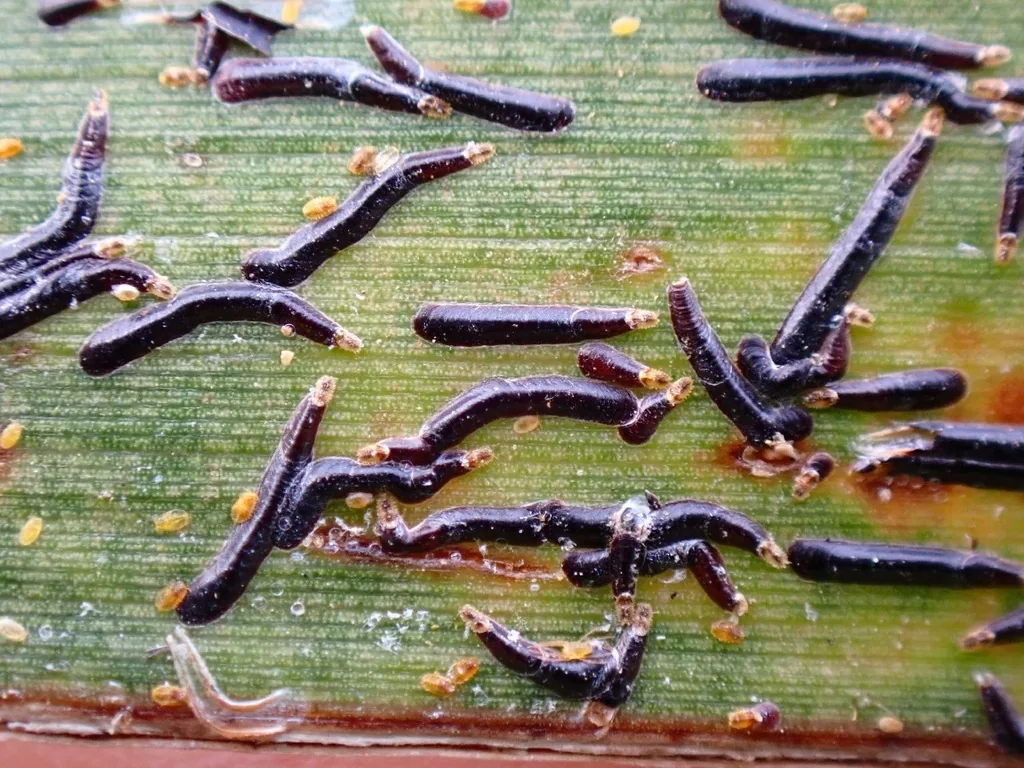
- The female's cover is narrow and very elongate, shiny dark brown to black and about 8 times as long as wide, with the yellow shed skins at one end. NC State gives a length of up to 3 / 16 inch; ScaleNet gives 1.4-3.0 mm long and 0.3-0.4 mm wide.[2][1][5]
- Under the lifted armor you can see the cream to yellowish body and a whitish, papery lower layer; eggs are yellowish to orange and crawlers yellow.[1][5]
- The covers tend to line up parallel to the leaf veins. Check leaves, especially the undersides; they are occasionally on bark and fruit too.[1][2]
- Males are unknown; females reproduce without mating (parthenogenetic).[2][5]
Where it lives
A tropical species, probably African in origin, now found throughout the tropics and common in greenhouses in temperate regions. In the US the Diaspididae of the World database lists it as present in Connecticut, the District of Columbia, Florida, Georgia, Illinois, Louisiana, Maryland, Massachusetts, Missouri, New Jersey, New York, Ohio, Oklahoma, Pennsylvania, Tennessee and Wisconsin, and widespread in Hawaii, with colder-state records under glass; it once occurred in California greenhouses but was eradicated.[2]
Biology and life cycle
Each female lays 20 to 30 eggs under her armor. The eggs hatch soon after being laid, and the crawlers wander briefly, then settle within about 24 hours, insert their thread-like mouthparts and never move again. The second stage appears in about 3 days, and development takes about a month.[1][5][2]
Crawlers are the dispersal stage: they move to new parts of the plant or are carried by wind or animals, and many die along the way. Over longer distances it travels on infested plants moved by people.[2]
Damage and signs
- Hosts include palms, Swiss cheese plant (Monstera), citrus, coconut, coffee, mango, avocado, guava, banana, figs, dracaena, gardenia, ixora, plumeria and privet.[2][1]
- Toxic saliva injected while feeding can leave yellowish (chlorotic) spots on infested leaves; in Puerto Rico it caused heavy yellowing and leaf drop on Honduras mahogany.[2][5]
- In Florida it is occasionally a very serious pest of palms and greenhouse plants and of tropical fruit trees outdoors, and scale specialists rank it among the serious armored scale pests worldwide.[1][5][2]
- A 2025 survey of urban palms in Costa Rica found it on both areca palm (Dypsis lutescens) and pygmy date palm (Phoenix roebelenii).[3]
Health risk
It feeds on plant sap; none of the sources describes any harm to people or pets.[1][2][5]
Control
Prevention
Because it spreads on infested plants, check the leaves of new palms and tropical houseplants, especially the undersides, for the narrow black covers before bringing them home.[2][1]
Biological control
Lady beetles are somewhat effective against it and tiny parasitic wasps also attack it. In the Costa Rica survey, Aphytis and Signiphora wasps were reared from it, the first record of a Signiphora wasp parasitizing this scale.[1][3]
Pesticides
Armored scales are susceptible to horticultural oils. During the growing season NC State suggests not exceeding the 2% rate and watering plants well before treating to prevent injury. Follow the label.[1]
Where sources disagree
Host range: NC State says it has been collected from at least 50 plant families and 130 genera; the Diaspididae of the World catalogue cites a count of 63 genera in 31 families.[1][2]
Crawlers: NC State says crawlers settle within 24 hours; the catalogue cites a crawler stage lasting three days.[1][2]
Natural enemies: on the Seychelles, an early study found no effective parasites or predators, but introduced lady beetles (Chilocorus nigritus and C. distigma) later achieved complete control there.[5]
Common questions
- What are the thin black lines on my palm leaves?
- Possibly black thread scale: long, narrow, shiny black covers, often lined up along the leaf veins.[1][2]
- Can black thread scale live on houseplants up north?
- Yes, indoors. It is a tropical species that is common in greenhouses in temperate regions and is reported as a greenhouse pest in many parts of the world; US records from colder areas are under glass.[2][5]
Sources
- NC State Extension, “Black Thread Scale Insect (PDIC Factsheet).” content.ces.ncsu.edu/black-thread-scale-insect (accessed 2026-11-12)
- Naturalis Biodiversity Center, “Ischnaspis longirostris (Diaspididae of the World 2.0).” diaspididae.linnaeus.naturalis.nl/linnaeus_ng/app/views/species/taxon.php?id=113088 (accessed 2026-11-12)
- Entomological Communications, “Armored Scale Insects (Hemiptera: Diaspididae) on Dypsis lutescens and Phoenix roebelenii (Arecaceae) in Urban Environments of Costa Rica (Solano-Gutierrez and Hanson 2025).” entomologicalcommunications.org/index.php/entcom/article/download/ec07002/249/9505 (accessed 2026-11-12)
- iNaturalist, “Ischnaspis longirostris taxon page (order and family).” www.inaturalist.org/taxa/330225 (accessed 2026-11-12)
- ScaleNet: A Literature-based Model of Scale Insect Biology and Systematics, “Ischnaspis longirostris (Signoret) catalogue entry.” scalenet.info/catalogue/Ischnaspis%20longirostris/ (accessed 2026-11-12)
- EPPO Global Database (European and Mediterranean Plant Protection Organization), “Ischnaspis longirostris (ISCPLO).” gd.eppo.int/taxon/ISCPLO (accessed 2026-11-12)