On this page
How to identify it
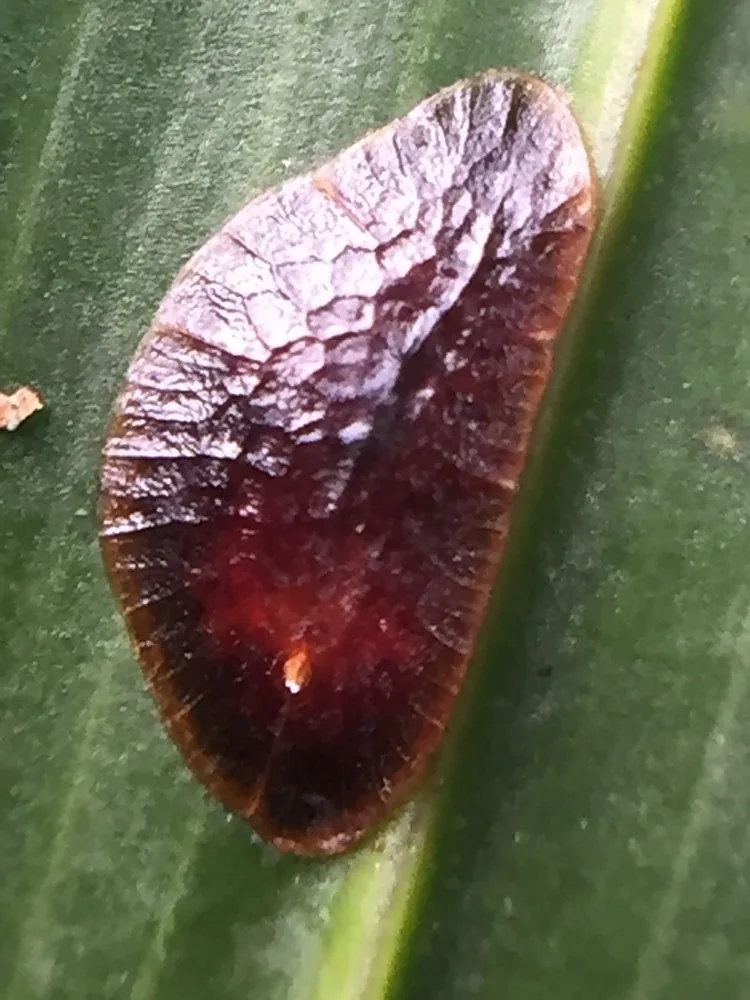
- The adult female is oval or pear-shaped, flat and reddish to dark brown, and can be slightly lopsided. ScaleNet gives a length of 2 to 5 mm; Florida's Division of Plant Industry gives 4 to 5 mm. UF/IFAS gives 2 to 5 mm long and 2 to 3 mm wide and says it looks flat when viewed from the side.[2][1][3]
- Under a 10-power hand lens the back of a grown female looks checkered, divided into polygonal cells by a smooth ridge down the middle. Cells near the ridge are concave, and the larger cells toward the edge are flat.[1][2]
- A thin layer of clear wax covers the body. There is no egg sac, and no males of this species are known.[2]
- As in other soft scales, the cover is part of the body and can't be lifted off, and it excretes honeydew.[4][5]
- UF/IFAS says its legs are well developed compared with most soft scales, and the scales are usually found on leaves and stems.[3]
Look-alikes
| Look-alike | How to tell them apart |
|---|---|
| Brown soft scale | Young females that haven't developed the tile pattern resemble brown soft scale (Coccus hesperidum); telling them apart reliably takes a slide-mounted specimen under a microscope.[2] |
| Stellate scale | Another soft scale found on palms, star-shaped rather than oval, that sometimes shows up on coconut palm foliage but usually not in numbers high enough to count as a pest.[5] |
| Palm aphid | Palm aphids also live on palms, and in Miami the two have infested the same coconut palms. Palm aphids are 1 to 2 mm long, glossy dark brown with a fringe of white wax and a pair of small horns on the head, and usually sit on the unopened and youngest fronds.[6][3] |
Where it lives
Probably South American in origin, it has been spread by people to all parts of the world on its cultivated hosts, and ScaleNet's catalog lists it from 82 countries; a 2018 review added Laos as a new country record. In the United States ScaleNet lists records from Hawaii and 19 other states plus the District of Columbia, including California, Texas, New York, Michigan and Massachusetts. Florida's Division of Plant Industry held specimens from 39 Florida counties by 1973. UF/IFAS lists it from Africa, Australia, North, Central and South America, the Caribbean, Asia and Europe, and says it has been found throughout Florida, often on palms.[1][2][7][3]
Biology and life cycle
Females reproduce without mating, and the eggs hatch inside the mother's body, so the young are born as first-instar crawlers. UF/IFAS adds that some females lay eggs that hatch quickly instead.[2][3]
Crawlers are the mobile stage that moves over the plant to find a feeding spot. For soft scales as a group, the USDA palm screening aid says many species have one or two generations a year in the United States, and some have up to six in a greenhouse or the tropics.[5]
Its host list is long: ScaleNet records hosts in 129 genera and 59 plant families. Florida's list includes areca, fishtail, coconut, queen, pygmy date, lady, windmill and Alexander palms, plus mango, avocado, lychee, longan, anthurium, gardenia, oleander, English ivy, hollies, figs and bird's-nest fern. UF/IFAS adds kentia, Chinese fan, Canary Island date, date, miniature date and Washington palms, plus plumeria, guava, papaya, coffee, citrus, jasmine, pittosporum and Dahoon holly.[1][2][3]
UF/IFAS says it reproduces slowly for a scale insect, with fewer than two dozen young per female. Outdoors it has one or two generations a year; in greenhouses generations come more often and overlap.[3]
Damage and signs
- Infestations in commercial nurseries often become economically important whenever pest management is neglected. UF/IFAS says heavy infestations can weaken or even kill a host plant.[1][3]
- The USDA palm pest screening aid calls it a small, flat, brown scale that can be a serious pest of palms in landscapes, which is rare among soft scales.[5]
- Soft scales feed on phloem sap and excrete honeydew that drips onto leaves and surfaces below, where blackish sooty mold grows. Heavy scale infestations can yellow leaves, make them drop early and cause dieback.[4]
- UF/IFAS describes a dense planting of 'Malayan Dwarf' coconut palms in Miami with up to 200 mature females per leaflet (pinna). The palms had been sprayed repeatedly for palm aphid without much success, which probably disrupted the natural enemies of both pests, and most of the foliage was coated with a thick crust of sooty mold growing on their honeydew.[3]
- On most palms it stays sparse, a few scales on a frond or even on a whole palm. UF/IFAS says damaging numbers usually follow interference with its natural control, or its arrival in a new region without its natural enemies.[3]
Health risk
These sources treat it only as a plant pest; none mentions bites or other risk to people or pets.[2][1]
Control
Prevention
Routinely inspect leaves and stems of palms and other susceptible plants, and check new plants before adding them. Scales spread as crawlers carried by wind, birds or insects, and from plant to plant where leaves touch. UF/IFAS says to search all plant parts, including leaf undersides and stems, and to inspect plants before they go into a landscape, nursery or collection.[8][3]
Traps and physical control
Prune out heavily infested parts, and spray plants with enough water force to knock scales off, covering stems and leaves thoroughly. A water spray removes every stage and spares natural enemies.[8]
Biological control
Most plants tolerate low to moderate numbers of scales. Good plant care and protecting the beneficial insects that attack scales come first. UF/IFAS names the parasitic wasp Metaphycus stanleyi as a common natural enemy, and a Verticillium fungus has been reported attacking it in the Seychelles.[4][3]
Pesticides
Where treatment is needed, a thorough horticultural oil spray timed to active crawlers works on soft scales, and soil-applied imidacloprid controls soft scales on larger plants. Always read the label. UF/IFAS says to pick insecticides, timing and methods that spare natural enemies: crawlers are the stage most open to contact products, and oil and soap need thorough coverage and repeat applications.[4][3]
Where sources disagree
Size: ScaleNet gives adult females 2 to 5 mm long, while Florida's Division of Plant Industry gives 4 to 5 mm.[2][1]
How serious it is: Florida's Division of Plant Industry describes it mainly as a greenhouse and nursery pest, while the USDA palm screening aid says it can be a serious pest of landscape palms.[1][5]
Wax: ScaleNet says a thin layer of clear wax covers the body; UF/IFAS says it has no wax cover or egg sac.[2][3]
Florida spread: Florida's Division of Plant Industry held specimens from 39 counties by 1973; UF/IFAS says it has been found throughout Florida.[1][3]
Common questions
- What are the flat brown scales with a checkered pattern on my palm?
- Flat, reddish to dark brown scales with a checkered pattern of plates on the back are typical of tessellated scale, a soft scale often found on palms in south Florida.[2][1]
- Can tessellated scale live on indoor plants?
- Yes. It is mainly a greenhouse pest: it was first described from a palm in a greenhouse in France, and kentia, lady and parlor palms, anthurium, philodendron and figs are among its recorded hosts.[2][1]
- Is a handful of these scales on my palm a problem?
- A few scales can be washed or pruned off. Keep checking the plant, because nursery infestations become a problem when pest management is neglected. UF/IFAS says it usually stays sparse on palms, and damaging buildups tend to follow interference with its natural enemies, such as repeated spraying.[8][1][3]
Sources
- Florida Department of Agriculture and Consumer Services, Division of Plant Industry, “Tessellated Scale, Eucalymnatus tessellatus (Signoret) (Entomology Circular No. 138, November 1973).” thefsca.org/wp-content/uploads/2025/02/ent138.pdf (accessed 2026-11-14)
- ScaleNet (scale insect database begun at the USDA ARS Systematic Entomology Laboratory), “ScaleNet catalogue: Eucalymnatus tessellatus (Signoret, 1873).” scalenet.info/catalogue/Eucalymnatus%20tessellatus/ (accessed 2026-11-14)
- University of Florida/IFAS Extension (Featured Creatures), “Tessellated Scale, Eucalymnatus tessellatus (Signoret), EENY-456/IN826.” ask.ifas.ufl.edu/publication/IN826 (accessed 2026-11-14)
- University of California Statewide IPM Program, “Pest Notes: Scales.” ipm.ucanr.edu/home-and-landscape/scales/ (accessed 2026-11-14)
- USDA APHIS PPQ Identification Technology Program (IDtools), “Soft Scales (Screening Aid to Palm Pests).” idtools.org/palm_sap/index.cfm?packageID=86&entityID=709 (accessed 2026-11-14)
- University of Florida/IFAS Extension (Featured Creatures), “Palm Aphid, Cerataphis brasiliensis (Hempel), EENY-520/IN924.” ask.ifas.ufl.edu/publication/IN924 (accessed 2026-11-14). Used for palm aphid identification only.
- Zootaxa, via PubMed, “Choi, Soysouvanh, Lee and Hong (2018), Review of the family Coccidae (Hemiptera: Coccomorpha) in Laos.” pubmed.ncbi.nlm.nih.gov/30314105/ (accessed 2026-11-14)
- Kansas State University Research and Extension, “Scale Insect Pests (MF3457, July 2019).” bookstore.ksre.ksu.edu/pubs/MF3457.pdf (accessed 2026-11-14)
- iNaturalist, “Eucalymnatus tessellatus taxon page (order and family).” www.inaturalist.org/taxa/474598 (accessed 2026-11-14)